
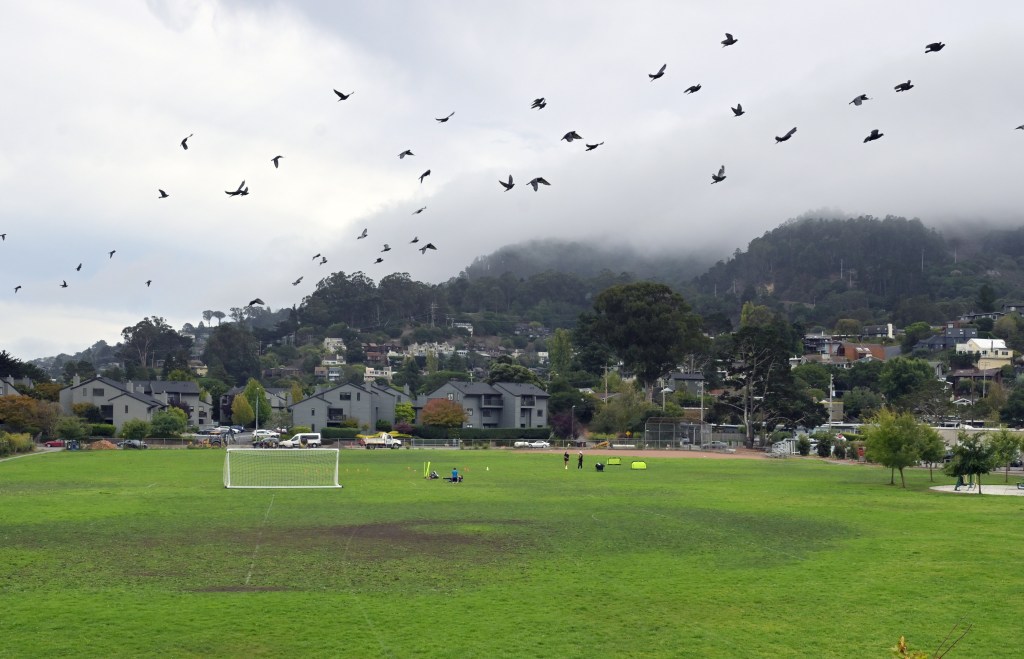
After receiving extensive public comments, Sausalito is finalizing its proposal to build 81 affordable apartments on two city properties.
The City Council reviewed and completed the request for proposals during its meeting on Tuesday. The projects would include a 50-apartment complex on 2 acres at the southwestern corner of MLK Park and 31 apartments at the city corporation yard on Nevada Street.
The request for proposals outlines factors such as the scope of work, developer responsibilities, design requirements, neighborhood sensitivities, desired amenities and selection criteria.
Officials faced opposition for including the sites in the city housing element, which addresses the state mandate to plan for 724 new dwellings by 2031. Vice Mayor Melissa Blaustein and Councilmember Joan Cox led nine committee meetings and two public workshops.
“I understand the upset of the community,” Blaustein said. “A lot of us have concerns about what sites we have, what sites we don’t have, but my deeper concern and the reason for the housing element and the state’s action is this creation of affordable housing.”
In November, Sausalito voters approved a zoning change to allow the affordable apartment projects on city properties, which cuts development costs while giving the city more control over what is built. That set off a fast-track process to issue a request for proposals for the MLK Park site before April.
The council responded by convening a group of residents and experts to shape the request for proposals. The city seeks one developer for both sites.
The forums raised concerns about issues such as traffic, noise and parking, according to a staff report. They also showed support for a community center and pool at the MLK Park site and “a strong preference for housing designs that are compatible with adjacent residential neighborhoods and reflect Sausalito’s coastal character,” the report said.
Participants also “addressed issues including teacher housing, accessibility for persons with disabilities and seniors, environmental sustainability and parking,” it said.
During the public comment period of the council meeting, nearly 20 people offered further refinements and criticism.
Fred Moore, a planning commissioner, said the draft was among “the most comprehensive and elaborate” request for proposals he has seen in 40 years. He worried it would “dissuade” developers.
Jeff Barnaby, president of the board at New Village School, was concerned about the effects of construction, traffic, parking and safety for his 140 students and families. A letter from Lycée Français de San Francisco, a neighboring school, said the draft document leaves “too much discretion to the developer.” Both schools sought project oversight roles.
Commenters repeatedly called for the structures to be no more than two stories.
“The RFP right now encourages developers to think about three stories, and I don’t think we need to encourage them to do that,” said Jennifer Nimmo.
Sophia Collier, who designed view-impact software used by the city planners, said she was “probably the only person that actually did a view study of the corporation yard.”
“These units could fit there, but they can’t fit there without care,” she said.
“You start with telling or informing a developer what you want,” architect Michael Rex said. “If they can’t provide it financially, you can always cut back. … Don’t be fearful of asking.”
During the discussion, members of the council suggested additional revisions. They also raised larger questions about the next steps if no developer responds or satisfies the criteria.
“We need a preference, strong preference if not requirement, for two stories,” Mayor Steven Woodside said. “I think we need to make sure it’s mandatory that we use the tools we have available to look at views, measure views and study them.”
Councilmember Joan Cox suggested that affordability references be streamlined, 80% of the apartments be reserved for seniors and the city conduct an in-house fiscal feasibility study of developers’ plans.
Councilmember Jill Hoffman suggested that the request for proposals mention a third site at MLK Park — a parcel owned by the Sausalito Marin City School District — that could be used for teacher housing. The state has various subsidies for teacher and workforce housing, she said.
Councilmember Ian Sobieski agreed with Rex, saying the city should “ask for everything we want.”
He also urged the council to create a “plan B” of alternative sites should the request for proposals draw insufficient responses. The city could be exposed to the so-called “builders’ remedy,” a provision in state law allowing developers to construct outsized buildings if a municipality’s housing plans are decertified by state housing officials.
The council unanimously approved the suggested request for proposals refinements. Assistant City Manager Brandon Phipps said he would soon present staff proposals to update the Marinship zoning code and development options.