
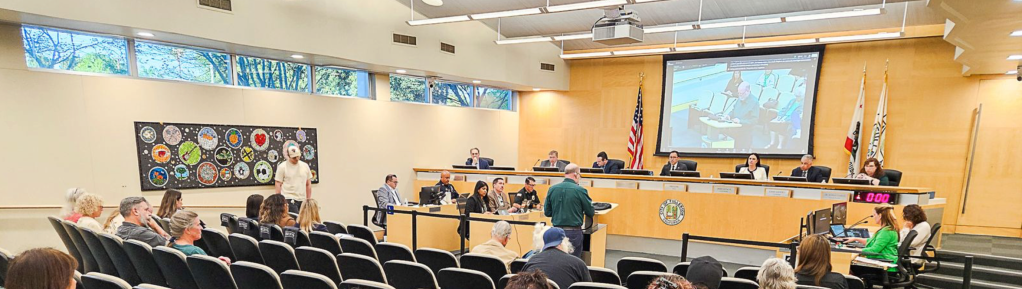
The city of Fullerton is grappling with a significant financial crisis, facing a projected $13.7 million deficit for the fiscal year 2026-2027. Fullerton’s financial stability has eroded, leaving officials scrambling to address mounting fiscal challenges. How did this happen?
In the wake of the Covid pandemic shutdowns, Fullerton’s budget, which originally stood at approximately $110 million, faced a $10 million deficit in 2021. Revenue declines forced the City Council to implement severe cuts, resulting in the layoff of 156 non-regular (part-time) employees and 7 full-time employees. Essential services, including parks, libraries, and the Fullerton Museum Center, were adversely affected.
While all councilmembers agreed that decisive action was necessary to address the city’s ongoing structural deficit – they differed on how to accomplish that. Councilmembers Ahmad Zahra and Jesus Silva opposed cuts that would harm staff and core services.
Fullerton’s City Council majority voted in April 2021 to remove City Manager Domer, with Mayor Bruce Whitaker, Mayor Pro Tem Nick Dunlap, and Councilmember Fred Jung in favor, while Councilmembers Ahmad Zahra and Jesus Silva opposed the decision. Zahra considered Domer ethical and believed that replacing him wouldn’t address the city’s financial issues. He expressed a preference for the council to provide guidance rather than to dismiss the city manager. The dismissal without cause, as laid out by the city manager’s contract, triggered nearly $200,000 in severance pay. Whitaker also noted that all three of the Councilmembers who supported Domer’s dismissal also opposed Measure S, a proposed 1.25% local sales tax increase to bring in recurring revenue.
While the terms of Domer’s contract allowed for impromptu reviews, Mayor Whitaker later commented that he was surprised when Council member Jung requested the April review. Whitaker then proposed Steve Danley as the Acting City Manager, describing him as a generalist with valuable Human Resources expertise and saying he became aware of him during his work for the County government (Whitaker worked for Chris Norby when he was 4th District Supervisor). Despite having no experience for the top position, Danley was hired as Acting City Manager at $208,000 for a six month period ending in October plus a later extension through December 2021.
Meg McWade, Fullerton Public Works Director and several senior employees left shortly after Domer’s termination. Some said that they had been harassed and demoralized by a councilmember. The exodus of professional staff led to consequences including general choas, a series of temp-company hires, and stalled state required reports resulting in fines.
The situation was somewhat alleviated by the American Rescue Plan Act (ARPA). The City received the first tranche of American Rescue Plan Act (ARPA) federal relief of $16.3 million on May 17, 2021, allowing the city to stabilize operations and backfill critical positions. And by 2022, Fullerton had reduced its deficit to $700,000, largely due to ARPA allocations and the strategic use of reserves.
Ellis Chang, who served as the Administrative Service Director from 2019 to February 2025 (a role that included acting as the Finance Director and City Treasurer) was responsible for managing city finances, noted that the reliance on one-time funds rather than sustainable revenue growth remained a pressing concern.
“We would be ending fiscal year 24-25 with a negative ending fund balance,” Chang said. “Without additional, more sustained budget cuts and programmatic cuts, it’s going to be very difficult for the city to operate the way it has done historically.”

The proposed 2023-24 budget again revealed a troubling gap, projecting $244 million in revenue against $253 million in expenditures—a nearly $10 million shortfall.
The city’s proposed 2024/25 budget included secured state and federal funding for street and facility improvements, with total general fund revenue projected at $127.7 million. Property and sales taxes accounted for most of the revenue, while public safety accounted for 72% of expenditures. The city was expected to end the fiscal year with a $27 million balance, exceeding the 10% contingency reserve goal by 7%. Proposed expenditures were expected to rise by $12 million, including transfers to an infrastructure fund. A projected $9.4 million deficit would be covered by excess reserves, leaving an ending balance of $22.6 million. However, by the end of 2025, the projected expenditures of $135 million grew to $144 million, adding to the deficit
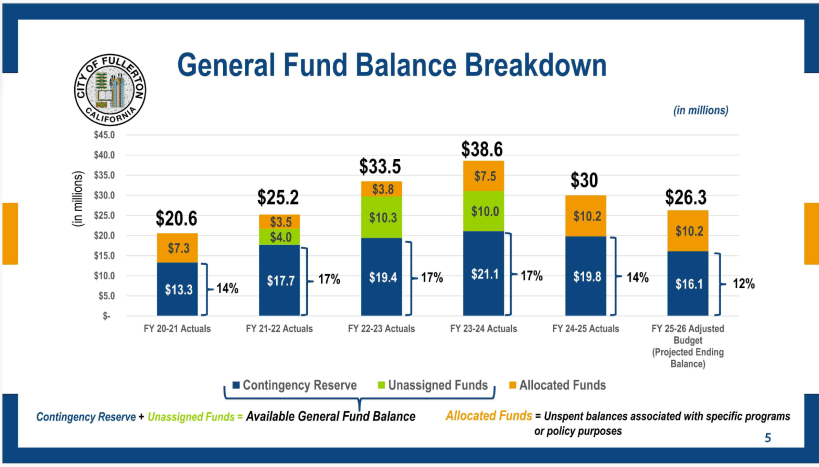
The 2025-26 fiscal year review presented at the March 17, 2026 council meeting revealed that Fullerton’s unassigned fund balance was fully depleted. Interim Finance Director Stephen Avalos reported that the city’s contingency reserve had dipped to 14%, below the targeted 17%. Projections further indicate an operating deficit of $3.7 million for the end of FY 2025-26. In addition, an accounting error was disclosed. City staff revealed that during an audit, funds previously considered part of the general fund reserves had already been spent or earmarked for specific projects. This revelation significantly shrank Fullerton’s financial cushion, raising concerns that reserves could drop to a precarious 2% without swift corrective measures.
At the March 17 council meeting, Mayor Fred Jung angrily accused Councilmember Ahmad Zahra of grandstanding after Zahra proposed that an independent investigation was needed to discover how this happened and how to avoid the current situation in the future. Mayor Protem Nick Dunlap (also after an angry outburst directed at Zahra) said that underlying fundamentals of this budget need to be correct. Councilmember Shana Charles agreed with Zahra that an investigation into what went wrong needed to happen to prevent future problems. Councilmember Jamie Valencia said she was trying to understand how to prevent this in the future and hoped there was a plan. To view the video of the budget presentation and council discussion visit www.cityoffullerton.com click on the “Meetings & Agendas” tab, and scroll to the the March 17, 2026 council meeting. The budget presentation starts at 52:00
Meanwhile, the Council is deliberating on two proposed 0.5% tax measures to fund infrastructure and public safety, amid ongoing concerns about the city’s structural deficits. City Manager Eddie Manfro has scheduled a meeting with the Fiscal Sustainability Ad Hoc Committee at 6pm on March 30 at the Fullerton Community Center, 340 W. Commonwealth. The session, open to the public and livestreamed on Zoom, will focus on potential budget cuts, cost containment strategies, and revenue opportunities, including reconsideration of tax measures. Members of the committee are appointed by each councilmember and include Tony Bushala (D1), Erik Wehn (D2 original member Jack Dean, stepped down), Jennifer Duong (D3), Lisa Wozab (D4), and Derek Smith (D5).
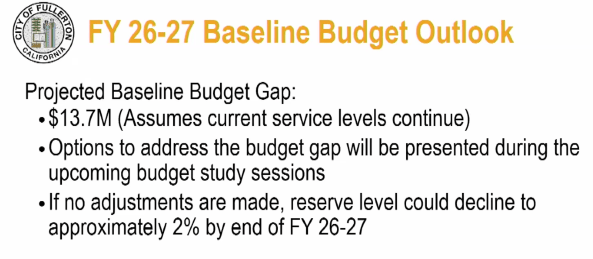
The challenge now rests on the city’s ability to rebuild trust and credibility with residents to support necessary tax increases. A half cent sales tax would bring in $15 million a year in added revenue. As Fullerton navigates these turbulent financial waters, its leaders face the daunting task of stabilizing the city’s finances while maintaining essential services for its residents. “If no adjustments are made, reserve levels could decline to approximately 2% by end of fiscal year 2026/27,” (well below the required 10%.) said Avalos.
The story of Fullerton’s budget is not just a story of numbers; it is a story of people, choices, and trust. Councilmembers, staff, and residents have long wrestled with trade-offs between maintaining services, paying employees, and sustaining long-term financial health. One-time relief funds were lifesaving but could not solve the city’s structural deficits. Previous budget cuts only temporarily balanced operations without addressing the underlying problem – lack of recurring reliable revenue.
Yet amid these challenges, there were victories. Fullerton retained a strong AA credit rating, maintained critical services, and invested strategically in economic development and infrastructure. Residents continued to engage with the Council, advocating for parks, libraries, public safety, support for immigrants affected by ICE, and homelessness services.
Since the era of Covid shutdowns, Fullerton’s budget journey has been one of crisis management, cautious recovery, and looming deficits. The city is now at a crossroads: either implement long-term revenue strategies—including tax measures backed by transparency and accountability—or risk running reserves down to dangerously low levels. The choices made today will determine whether Fullerton can achieve lasting financial stability or continue to struggle with recurring deficits for years to come.
FY202526 Adopted Operating Capital Improvements Budget
Like this:
Like Loading…
Related
Discover more from Fullerton Observer
Subscribe to get the latest posts sent to your email.
Categories: Election, Elections, Local Business, Local Government, Local News