
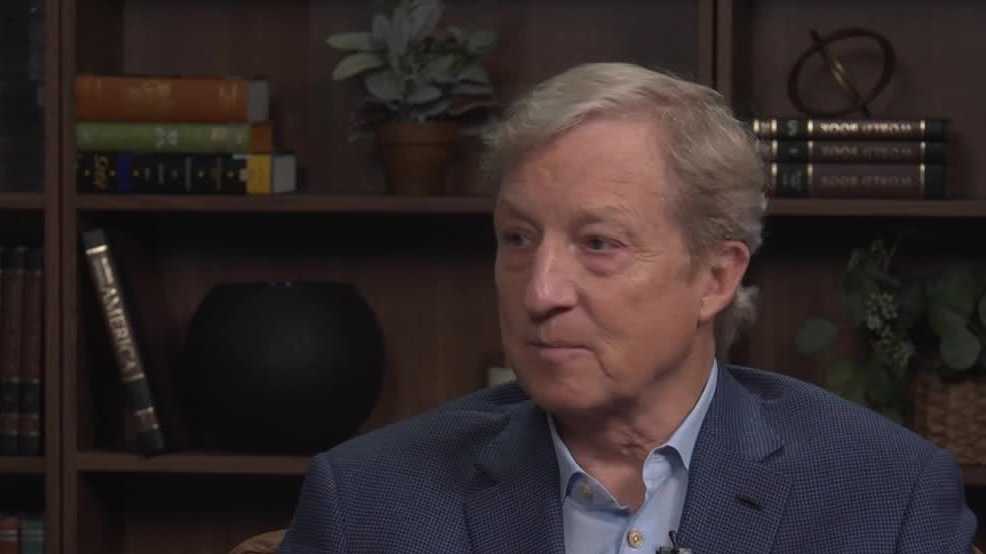
Tom Steyer explains why he should be California’s next governor | California Politics 360
Tom Steyer, thank you so much for making time for us. Ashley, thank you so much for inviting me on. So this is *** hard time and *** hard job. Why do you want to be governor right now? I want to be governor because I think California needs *** results-oriented change maker to solve the problems that we’re facing, the number one problem of which is Californians can’t afford to live in California anymore. It’s time for us to address the structural issues in California and get back to delivering the California dream for Californian citizens. California is facing multi-year money problems. Should you be elected governor, you’d have to handle this. The options on the table right now are either cutting taxes or, or excuse me, raising taxes or cutting programs. Which option do you see yourself choosing? Actually, I’ve said on the first day of my governorship, I will call *** special election to close *** corporate real estate tax loophole that people call split roll, which has been on the books since the, you know, over 40 years that’s worth $22 billion *** year to the cities and counties of California. I think I’m, I’m also talking about closing another corporate tax loophole called Water’s Edge that’s worth about $5 billion *** year. We have *** structural deficit in the state of California to deliver the services that Californians need and deserve, and I’m starting on day one, bringing tens of billions of dollars to the table so that we can actually deliver those services. But with closing those corporate loopholes, do you risk losing businesses, billionaires that this state is heavily relying on for its money? Well, you know, one of the things that’s true, Ashley, is I did spend 25 years in the private sector. I am very aware of how important it is to have *** vibrant, growing, dynamic economy, which, let’s face it, California is about half the growth of the whole United States. So let me ask you *** question. I’m talking about closing *** corporate real estate tax loophole. How many people do you think are going to take their office buildings or their shopping malls and move them to Las Vegas or Austin, Texas or Miami, Florida? No, I am very deliberately thinking through the second order effects of everything I do. And if you look, I’ve taken on and passed propositions to put billions of dollars into Californians’ pockets, taking on oil companies and beating them, tobacco companies and beating them, and out of state companies who are paying less California state tax on their Californians than California companies. None of those did anything to hurt our economy. Every one of those was closing *** loophole that was unfair at the expense of California citizens, and that’s what I’m talking about doing now. What should California do with the medical that it’s providing right now to undocumented people? So I am *** fan of healthcare as *** right. But what we’ve seen and what you’re implicitly asking is Our healthcare costs have been ballooning for so long that at this point, healthcare is eating up every family. Every business Every nonprofit and the budget of the state of California. So in the short run, what I’m talking about doing in terms of meeting that shortfall is by closing these corporate tax loopholes, including especially this real estate. So continue it, continue providing Medi-Cal, yes, but let me say this. Long term, what we’ve seen is that healthcare has been escalating in cost. In the United States and in California for 40 years at 6 to 8% *** year and it’s just, there’s no end in sight. I am also going to start preparing the state on day one of my governorship for single payer, actually trying to cut out the middlemen so we can deliver healthcare to all Californians at *** reasonable price. We are paying about twice as much for healthcare per person as countries that use single payer. There’s *** reason for it. It’s structural. It’s going to be very complicated to get that done. It will take at least 3 years, but it’s something that we absolutely have to do because if you look at the state budget closely, what you see is every service is being squeezed, every reduction is being reduced. Because healthcare just keeps eating up the budget, and we have to make *** structural change to solve that. OK, so two things to unpack here and just for the folks who are watching this who don’t know what single payer exactly is, it’s getting rid of private health insurance and the legislature has been having this debate for *** long time with concerns that doing so could limit people’s options. Maybe people do like their private health insurance, and there’s also *** lot of unknowns with trying to establish such *** system, California. Is struggling to implement just basic programs like *** 911 program for example, how can you as governor guarantee that *** single payer program is something that is effective and, and accomplishes what you’re saying it will accomplish? Well, we’re really what we’re cutting out is people making money out of the healthcare system that we’re doing it just delivering healthcare from healthcare professionals and how do I know that will work? Look, I went to Stanford Business School, as I said, I was *** professional investor for 25 years. I am very accustomed to the arguments about the efficiency in *** private sector. Business and how that drives down costs. Well, we’ve waited 45 years for that to happen and it absolutely hasn’t happened. What we’re seeing instead. Is that when you only have one customer. If your only customer is the state of California or the people of California, what you see is they’re very efficient, but their efficiency is figuring out how can we raise costs, how can we raise revenues and reduce services slash costs. So to *** very large extent, we need *** structural change here. And let me say this too, and you’re absolutely right when you talk about what is single payer. God is in the details. In every one of these issues, it’s going to be critical to have *** governor. Who gathers all of the people around the table to make sure that we get the details right. You know, we can’t have *** state where we have laws on the books, we have ideas, people pass and nothing happens. We need somebody who’s gonna actually have an executive function. Who’s going to know how to drive results? Who’s going to insist on results? We’ve had so much talk in this state about good ideas and big plans. The truth is we need results. I’m somebody who spent his entire life being measured by results and getting results, and that’s what we need in our next governor. Just before we put *** bow on this, what’s your timetable to implement the single payer? I said the minimum is 3 years. It’s going to take *** long time to work through, to make sure you have the details right, to make sure you’ve consulted all the people who are heavily affected, to make sure in fact that we treat. The private health care plans fairly and make sure that everyone that we’re satisfied on that, but the truth is. Look, we can’t afford this. If you look at our budget, I, I, I’ll tell you, everyone can’t afford the current healthcare system that we have now. The, the idea that we can is untrue. And for the people who don’t agree with me, I beg them to look at the data. I am someone, if you look at every one of these policy situations, we’re doing things that don’t work and then we double down on it. There’s something wrong here. There really is. And you know, I, we’ve had 45 years to get this system right. I, I think honestly structurally there’s something driving this in the wrong way and we absolutely have to make *** change. Another big spending point for the state is education. It’s almost half of the state budget. Just given the teacher strikes that we’re seeing across the state right now coupled with classroom performance issues with California students struggling to read, do math and science, what will you do to address this? I, I mean, uh, that situation coupled with the fact that, I mean, California is already spending more money than ever on, on schools. So I, I don’t believe that any society that doesn’t have. An excellent education program for its children can be considered *** successful society, and you’re right, we are failing. We are not preparing our kids adequately for the future and we have to change. So let’s talk about how we can realistically go about that because everybody wants this to happen. There’s nobody in the state of California who don’t want our kids to perform well, to be prepared for the future, and to excel they are literally the future. So let me start by saying this. I know everyone in California thinks we spend an enormous amount on education, and in absolute dollars we do, but once you do *** cost-adjusted basis, because California is so much more expensive than the rest of the country, when you do *** cost adjusted basis, we spend 31st out of 50 states. That’s why affordability is such *** huge thing. When I’ve talked to teachers. About why they’re striking, and they have two reasons. One is, I can’t afford my healthcare. I literally, they’re paying $1000 to $2000 *** month for healthcare. I don’t have the money. And two, they literally can’t afford to live in the districts where they teach. So teachers are having to make, they are not overpaid. It’s very hard to attract teachers to California because given our cost of living, they are, you know, they are very far from overpaid. So part of this, you know, of the money from this corporate real estate tax loophole, about over 40% of that will go to the schools. But let’s also talk about how we can do the schools better because that’s your implicit question of, you know, you, I, you know, I, I do think I’m right about the money, but I think it’s also true. How can we better? And the one thing that I absolutely think we should be pushing harder. Is teacher support, teacher training, you know, I think to *** large extent we need to put more money into the teachers themselves to get them to be their best selves quicker because what we can see is we are not doing an adequate job there. We need to support our teachers who run the classrooms and give them all the tools possible so that in fact we can get back to being the top 10 state in the country, which we absolutely have to do and we cannot. There can be no excuses if we don’t do that, so more money. I think what I said was 2 things. I think what I said was. More money into the system, but also much more teacher support and training which will cost money. Yes, and we need to pay it because the truth is that if you look at all the studies over *** long period of time. The amount of training, the amount of skill in the classroom is actually the most determinative thing in terms of how how kids do. I know that, you know, I know we’ve gone back to phonics and I think that’s *** great thing, but the truth is preparing the teachers, supporting the teachers, and giving them the tools to succeed in the classroom is actually the single most powerful thing we can do. OK, so switching gears, I’m curious, how would you specifically try to lower costs for Californians generally? Well, let me say this, costs are *** bunch of things. The first and biggest is housing. So let me start with housing, and I always say there’s no silver bullet in housing, it’s silver buckshot, so we need to shorten the times and make the permitting simpler because the cost and time of permitting is extremely high in our state and debilitating. We made *** move on it last year in reforming SEA, but we’re far from done in terms of permitting. We need to. And we’ve made *** move on this too. We need to update our zoning requirements so that in fact we can build the houses where they’re needed and where they’re wanted. Third, we need to do industrial construction of houses. There is technology now to build off-site. That technology can drive down the cost per square foot of *** house by 33 to 5. That exists right now. The state needs to support that with buying power because those are new companies and new technologies, but that technology is here and we need to drive down the cost per square foot. And if we can do that, that completely changes the game. Lastly, Cities and counties are very reluctant to give permits. And they’re reluctant to give permits for housing because every time they permit, Housing units, they’re getting the equivalent of an unfunded mandate. People are going to live there, and the city and county are going to be responsible for their education and their healthcare, and they don’t have enough money to do it. We changed the way we deliver money to the city and council 50 years ago. And so the last thing they want is more unfunded mandates. By closing the corporate real estate tax loophole that delivers the money to the cities and counties so that they can go back to being willing to permit housing, which we absolutely have to do. I mean, actually, I’m sure you know this. But people are suffering. You know, I was talking to somebody literally this week who’s worked. For the University of California system. For 20 years, not *** professor, but somebody who works as *** custodian. Who’s living in his car. He has worked for the state of California for 20 years. He is *** fully employed person. He has been *** fully employed person. He’s never not been *** fully employed person, and he’s living in his car. The cost of housing has got to come down and there are ways to do this that exist, but if you’re going to do it, my attitude is going to be. I’m gonna look at every line on that cost of *** house and ask why it can’t come down. And it’s going to be we’re going to have to take this as an urgent matter that is torturing Californians, torturing them. So it’s like. It’s not one of those things where, yeah, we’ll deal with that next year. We won’t deal with that next week. We will deal with that right away. Housing is *** huge cost driver of course, but regular everyday Californians are dealing with high costs for, I mean, essentially everything whether that’s groceries, services, the cost of everyday goods, and just you being *** billionaire. I mean what do you say to people who just feel like you can’t actually relate to how much it actually costs to live in this state? Well, all I can say is. Two things 1, I spend my time traveling around the state of California talking to people. More than any other candidate for governor, every single day I am out on the road speaking directly to Californian citizens because this is *** huge state and one size doesn’t fit all. So if you don’t go to Salinas, you don’t know how people feel in Salinas, and that goes for every part of the state, the Inland Empire where I was yesterday, every part of the state. So I am hearing this, you know, my opinion, two things. If you see someone and look them in the eye, they’re not *** statistic anymore. And now all of *** sudden you know someone who’s living in their car, you know someone who’s been homeless and what that feels like. And so we all know the problems. The question is your question really is about how deeply do you feel it, and I go around every single day to talk to people who are suffering because of. Really the fact they can’t afford to, but is there *** difference between seeing it and actually feeling it? I didn’t inherit any money. I started *** business and did well. It is, I don’t think that that, you know, I don’t think that should be *** bad thing. I started with absolutely nothing and I’ve never inherited *** single penny, so I’m someone who’s had to start at the bottom. I mean, my business was one room, no windows, no partners, no employees, so I think I know what it looks like and no, by the way, no salary. I think I know what it is to feel like when you have absolutely no money and you’ve got to hustle, but the second thing I will say is this. We need someone who’s going to get results. We’ve had an awful lot of people in the state of California who have talked. What we need is someone who’s actually going to get results, and I got results every year that I was in the private sector. And if you look at what I’ve done in terms of taking on. Funded corporate interests and getting rid of their loopholes and I’ve registered over *** million people in the state of California. We started *** community bank 20 years ago basically to go into the communities where banks wouldn’t go and do low income housing lending, use car lending, business lending to reverse it. We need someone who’s going to get stuff done, who’s going to get results. That’s actually who I am. That’s *** segue to my next question. There is *** national conversation about government waste and fraud. You’re talking about *** lot of use of taxpayer money, potentially billions from closing these corporate loopholes. I mean, what will you do to protect these dollars and make sure they’re efficient? You know, I think that’s *** very fair question, Ashleigh. I really do, because I think if you’re going to be the governor. And people are going to pay their hard earned money in taxes. You have an absolute responsibility to steward that money carefully. And so I’ll start by saying this. You can ask my wife. I’m the cheapest person you’ve ever met, and I’m not shy about it, and I’ll tell you why, because every dollar we don’t waste is *** dollar we can spend on *** kid. Every dollar we don’t waste is money we can spend on healthcare for someone who’s sick. Give me an example of how you’re the cheapest person. Well, I have one pair of sneaks. I, yes, I, I drive ***, uh. An American, uh, these are sorry, just for people who can’t see, they’re are they Nike Nike Air Force Ones? Yes, OK. I have, uh, I drive *** Mustang, an electric Mustang that’s 3 years old. I had my last car for years. That’s not that cheap. It’s not that cheap, but the only reason I got *** car that was *** mid-size car instead of *** small car is I’ve got grandkids, and I wanted to make sure that if anything happened they’d be safe in *** bigger car that’s more secure. No, I am someone who does not spend money because I know that money has so much power in it. And exactly what I was saying, I want to make sure that every dollar we have in this state, so I, I know that there are people out there running for governor who are saying the way that we’re going to pay for things, even in this tough economy, even with the Trump administration attacking us and taking away, kicking people off Medi-Cal and trying not to pay. Um, our fair share of federal tax money is from waste, fraud, and abuse. And I’ve talked to people inside the government to talk about that and truthfully, will we be close on every dollar? We will, we look at every single program and change the ones where we feel as if It’s not effective. We’re spending billions of dollars and it’s not effective. So regardless of whether it’s fraudulent. It’s failing and you know I said I’m going to be *** change agent. Look, we obviously have programs in our state where we’re spending *** lot of money. And getting very poor and very expensive results. And the example I’d use here is we do low-income housing. It costs 900 $900,000 *** key. We’re talking permanent supportive housing for homeless people, $750,000 *** key. OK. There’s *** number of programs in our state where you look at it and go like, OK, we need to Understand exactly what’s going into that because the bottom line doesn’t work and that’s the bottom line coming out of the pockets of Californian citizens and Californian corporations and we need to make sure that they know that we’re cheap as hell and we’re going to make their money work really hard for them. I absolutely agree with you and there’s no excuse for it, but good grief, if I started in one room with no windows and no people, I think I know how to make sure we aren’t wasting money. Uh, speaking of, I guess *** room with no windows, California’s prison system, just crime in generally in the state, and there’s *** tug of war in California between, you know, this court order that the state is under to stabilize its prison population, but at the same time people in the state want to feel like criminals are being held accountable. How will you balance that? So let me say this. We’re coming out of *** period of mass incarceration. Where we had the highest prison population anywhere and people were in jail for really in prison for really long periods of time, and we’ve been moving away from that. The most recent change was Prop 36, which passed with like 70% of people voting for it. What that enables us is for nonviolent criminals. So let’s be clear, we need our streets to be safe. If we’re going to revitalize our cities, we need to make sure that people are safe on the streets, period. And that’s ***. Absolute given what Prop 36 said was if you show up and do your man-made behavior, you can go for treatment instead of incarceration. You can be in places where, in effect, you can be gradually reintroduced back into society, be productive, and avoid going back to prison afterwards. So in my mind there’s been *** big move which I’m supportive of of the concept of it’s not just incarceration, it’s also rehabilitation. And so to *** large extent I fully appreciate violent criminals have got to be off the streets. They just do. For us to have the cities we want, that has to be true. But the move to treatment, the move to rehabilitation, which is something that has been ongoing for the last approximately 20 years, I’m fully supportive. It’s much less expensive for the people of California. It’s much more effective in terms of returning. People to society and it doesn’t, and it also absolutely does not preclude the idea that violent criminals have to be off the school. OK, switching gears, uh, uh, should California delay its state climate goals? So Actually, I don’t know how much you know about my history with climate. I know your history, but I wrote *** book. Um, which I appreciate everyone watching this program is probably going to rush out and buy, which I think is fantastic, um, called Cheaper, Faster, Better, How We Win the Climate War. And my point is this. The technology is here where it is much cheaper to be clean than it is to be dirty. It is much cheaper to use renewable energy than it is to use fossil fuel energy. There is *** gigantic electricity revolution sweeping the entire planet Earth, and if we miss it, and *** lot of the technology comes from California. And the opportunities to build huge profitable companies around these technologies absolutely exist and we should be pushing as hard as possible. You know, climate goals, what we need to do, if you’ll excuse me, we need to do 4 things, and these should be our climate goals. But your answer is no, we shouldn’t change. We don’t have to because my point is this, it’s much cheaper to be clean on climate. Climate goals, it’s like which is cheaper to run, you know. But many renewable energy or fossil fuel energy, renewable energy is much, much cheaper. Why don’t we just do the clean, cheap thing? But many Californians may feel left behind in this in this movement right now. I mean, still 90% of registered cars in the state are gas powered. We have *** loss of refining capacity in the state. While supply is dwindling, essentially, the demand is still there. I mean, how will you manage that situation, especially now with the war in Iran or any other geopolitical problem that could happen should you be elected governor? We need to have more refining capacity for the remaining internal combustion engines for sure. But wouldn’t that be counter to some of California’s climate goals right now if we allow the refining capacity to open back up? We’re going to have to have that happen because as you said, there’s *** base of people who need that and people are not going to scrap their car, which is *** big capital expenditure for every family in order to do something clean. They’re going to wait until their car is no longer usable or in one way, shape or form. But let me say this. Yes, we need more refining capacity, but the other thing that’s true is You might have noticed the price of gasoline has gone up *** lot. The price of *** barrel of oil in the United States has gone from $60 to $100 based on the war that President Trump has declared in Iran. Giving 70 *** $70 billion windfall to oil and gas producers in the United States and actually taking, they just asked for $200 billion from the pockets of Americans to spend on *** war that we don’t understand instead of putting it in our schools and in our healthcare. So when you ask me about should we be delaying it, no, we don’t need to delay it because the truth is what we need to do is deploy the clean technology. It’s so much better. We have *** president who’s trying to prevent us from leaving the 21st century and drag us back to the middle of the 20th century with much more expensive technology. I mean, It’s, it’s absolutely counterintuitive. It’s *** terrible economic decision. We need to be in the forefront of technology. We’re California. I said cheaper, faster, better. The cost of Batteries plus renewables is so much lower than fossil fuels that it’s *** joke, and that is only going like that. Clean technology is getting less expensive. Fossil fuels are getting more expensive. There’s *** huge gulf. Yet Secondly, let’s let’s make the polluters pay. They’re polluting. Pay me. You know what, you don’t get to take your the polluters are saying at this point though that if they continue to have to pay more, they’re going to leave the state at *** time when the state still needs them. The polluters, it depends where you define it. The oil industry, I should say the oil industry, all we’re talking about is the refining industry, not the oil industry, just these refiners. We’ve either got to make sure that there are refiners within the state of California that meet our needs, or that we get competition from outside the state where there are refineries who could meet our needs, where we get them to supply our needs. Is that something that you can do on day one? No, but the actual truth is we’ve got *** very small number of refineries holding us up. We need to make sure we either That we have more options than just those because they’re going to, you know, insist on. Windfall profits. How will you represent all Californians, even people who aren’t in your political party? I can understand why you’d ask that because I think some people don’t behave that way and the President of the United States doesn’t behave that way. My job as governor is to absolutely represent every Californian. This is *** democracy. People have *** right to disagree. People have *** right to different opinions, and the assumption should be Californians who disagree. Disagree fairly, honestly, and with good intent. And so my attitude would be, we, I absolutely want to be *** governor for every single Californian and for people who disagree with me. Let’s have *** conversation. I frankly love talking to people who disagree with me. I don’t find it threatening. I think people in California overwhelmingly are people of good faith, of good interests, and who see the world differently. And isn’t that what *** democracy is all about? And it isn’t about punishing people for disagreeing. It’s about listening to people who disagree, and they might be right. Is there something on the other side of the aisle that you see that Republicans support that you’re like, oh yeah, I could get behind that. Look, you talked about education. I may have *** different answer. We all wanna educate our kids. You know California Republicans feel as if they want to have *** vibrant economy. Guess what? I want to have *** vibrant economy. I absolutely want to make sure that Californian businesses continue to lead the world. We’re talking about tactics, not values, and that doesn’t bother me in the least. What grade would you give Governor Gavin Newsom for the last two terms? I don’t know. Look, *** through F. I don’t know. I think that people have come to really appreciate how Gavin has stood up. You, you won’t give us *** grade. You won’t, you won’t grade him. No, I haven’t, I haven’t followed it closely enough to give him *** grade. OK, my last one for you. What are three words you would use to describe California under your leadership? Prosperous Just Shared values. All right, Tom Steyer, we appreciate your time. Ashley, thank you so much for having me super fun.
Tom Steyer explains why he should be California’s next governor | California Politics 360

Updated: 8:25 AM PDT Mar 22, 2026
Tom Steyer sat down for an interview with California Politics 360 for a wide-ranging conversation on his run to be the state’s next governor. The billionaire and climate activist is running as a Democrat in the race to replace Gov. Gavin Newsom, who terms out at the end of 2026. This is a hard job and a hard time, why does Steyer want to be governor? “I think California needs a results-oriented changemaker to solve the problems that we’re facing,” Steyer said in response. “The number one problem of which is Californians can’t afford to live in California anymore. It’s time for us to address the structural issues in California and get back to delivering the California dream for California citizens.” But as a billionaire, can he actually relate to every day Californians struggling with costs? “I spent my time traveling around the state of California talking to people,” Steyer said. He also said he started his business from nothing. “My business was one room, no windows, no partners, no employees. I think I know what it looks like, and by the way, no salary.” Steyer says if elected he would call a special legislative session to close corporate tax loopholes to force big businesses to pay the state’s government more money. He estimates the taxes could help bring in about $30 billion more a year. California’s total budget this year is expected to be nearly $350 billion.To bring down costs, Steyer says he primarily wants to get more housing built by making the permitting process less burdensome, update zoning laws, and increase the construction of industrial homes that can be built off-site. His goal is to have one million new homes constructed in the state in four years. Steyer says he would use the extra corporate tax funds to give public schools a boost and eliminate private health insurance by establishing a universal, single-payer healthcare system in California. Steyer said he thinks it would take at least three years to establish. California has struggled to implement new programs. When asked how he’ll ensure the massive program overhaul would be on time and effective, Steyer said the system needs to change. He also said “God is in the details.” “It’s going to be critical to have a governor who gathers all of the people around the table to make sure that we get the details right,” Steyer said. “We can’t have a state where we have laws on the books, we have ideas that pass and nothing happens. We need somebody who’s going to actually have an executive function, who’s going to know how to drive results.” On energy and the environment, Steyer said California should stay the course with its climate goals to phase out the use of oil and gas by 2045. “It is much cheaper to use renewable energy than it is to use fossil fuel energy,” Steyer said. When asked about some Californians feeling left behind in the state’s energy transition, and how about 90% of registered vehicles in the state still rely on gas, Steyer said the state will likely need to reopen its refining capacity. But wouldn’t that counter California’s climate goals?”There are people who need that,” Steyer said in response. When asked how he’ll protect taxpayer dollars, Steyer said, “I’ll start by saying this, you can ask my wife, I am the cheapest person you’ve ever met.” When asked for an example he said he only has one pair of sneakers (a pair of Nike Air Force 1’s) and drives a not-so expensive vehicle, an electric Ford Mustang. “I’m someone that does not spend money because I know money has so much power,” Steyer said. When asked to describe California’s future under his leadership if he’s elected in three words, Steyer chose four. “Prosperous, Just, Shared Values,” he said. KCRA 3 Political Director Ashley Zavala reports in-depth coverage of top California politics and policy issues. She is also the host of “California Politics 360.” Get informed each Sunday at 8:30 a.m. on KCRA 3.
Tom Steyer sat down for an interview with California Politics 360 for a wide-ranging conversation on his run to be the state’s next governor.
The billionaire and climate activist is running as a Democrat in the race to replace Gov. Gavin Newsom, who terms out at the end of 2026.
This is a hard job and a hard time, why does Steyer want to be governor?
“I think California needs a results-oriented changemaker to solve the problems that we’re facing,” Steyer said in response. “The number one problem of which is Californians can’t afford to live in California anymore. It’s time for us to address the structural issues in California and get back to delivering the California dream for California citizens.”
But as a billionaire, can he actually relate to every day Californians struggling with costs?
“I spent my time traveling around the state of California talking to people,” Steyer said. He also said he started his business from nothing. “My business was one room, no windows, no partners, no employees. I think I know what it looks like, and by the way, no salary.”
Steyer says if elected he would call a special legislative session to close corporate tax loopholes to force big businesses to pay the state’s government more money. He estimates the taxes could help bring in about $30 billion more a year. California’s total budget this year is expected to be nearly $350 billion.
To bring down costs, Steyer says he primarily wants to get more housing built by making the permitting process less burdensome, update zoning laws, and increase the construction of industrial homes that can be built off-site. His goal is to have one million new homes constructed in the state in four years.
Steyer says he would use the extra corporate tax funds to give public schools a boost and eliminate private health insurance by establishing a universal, single-payer healthcare system in California. Steyer said he thinks it would take at least three years to establish.
California has struggled to implement new programs. When asked how he’ll ensure the massive program overhaul would be on time and effective, Steyer said the system needs to change. He also said “God is in the details.”
“It’s going to be critical to have a governor who gathers all of the people around the table to make sure that we get the details right,” Steyer said. “We can’t have a state where we have laws on the books, we have ideas that pass and nothing happens. We need somebody who’s going to actually have an executive function, who’s going to know how to drive results.”
On energy and the environment, Steyer said California should stay the course with its climate goals to phase out the use of oil and gas by 2045.
“It is much cheaper to use renewable energy than it is to use fossil fuel energy,” Steyer said.
When asked about some Californians feeling left behind in the state’s energy transition, and how about 90% of registered vehicles in the state still rely on gas, Steyer said the state will likely need to reopen its refining capacity.
But wouldn’t that counter California’s climate goals?
“There are people who need that,” Steyer said in response.
When asked how he’ll protect taxpayer dollars, Steyer said, “I’ll start by saying this, you can ask my wife, I am the cheapest person you’ve ever met.”
When asked for an example he said he only has one pair of sneakers (a pair of Nike Air Force 1’s) and drives a not-so expensive vehicle, an electric Ford Mustang.
“I’m someone that does not spend money because I know money has so much power,” Steyer said.
When asked to describe California’s future under his leadership if he’s elected in three words, Steyer chose four.
“Prosperous, Just, Shared Values,” he said.
KCRA 3 Political Director Ashley Zavala reports in-depth coverage of top California politics and policy issues. She is also the host of “California Politics 360.” Get informed each Sunday at 8:30 a.m. on KCRA 3.