
“In places where a seawall is a requirement, the options are limited engineering-wise,” notes Chang. “We can add features that make it better habitat, such as adding texture, or shelving or small tidepools … which promotes a greater diversity of species.”
For the tiles, marine biologist-founded concrete company ECOncrete provided a proprietary admixture formulated to lessen the more toxic effects of industrial grade concrete. According to the company’s co-founder, Dr. Ido Sella, at least 70 percent of the world’s marine infrastructure is built of concrete, which has a huge impact on coastal marine life over time. Not only are concrete seawalls (such as San Francisco’s) typically smooth and ecologically “grey,” offering no habitable surfaces for organisms to grow on, but the manufacture of standard industrial concrete is a known source of carbon emissions.
Weighed down by negative news?
Our smart, bright, weekly newsletter is the uplift you’ve been looking for.
SERC tested three different tiles in three distinct areas of the Bay to see how welcoming they would be to marine life: tiles made of standard concrete, tiles made of ECOncrete but left smooth, and tiles made from ECOncrete but textured in a pattern of ridges and small shelf-like protrusions.
 The three different tiles researchers tested: smooth normal concrete, smooth bio-enhanced concrete and textured bio-enhanced concrete. Credit: Corryn Knapp / Smithsonian Environmental Research Center
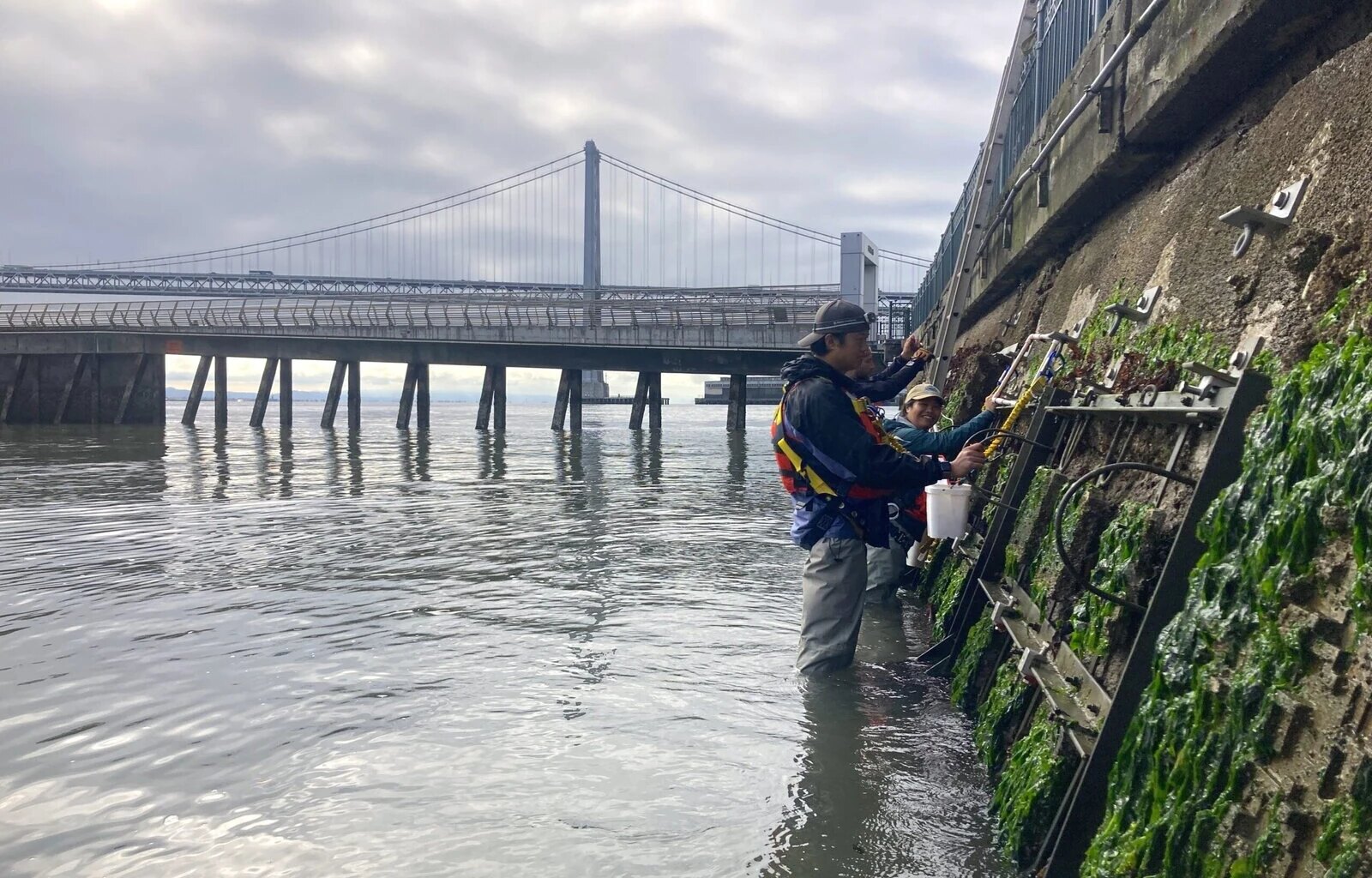
During the years that the tiles were submerged, members of the SERC team regularly visited each site at low tide to photograph and record the variety of marine life they found, test the water salinity and temperature, and collect samples. This was no easy feat: These visits might happen at pre-dawn and after dark, and the sites were often hard to reach. Chang describes the experience as “exhilarating” — albeit cold and wet.
While SERC is still preparing a final report, those seaweed-decorated tiles that recently adorned the Embarcadero demonstrate cause for hope. Not only did the treated textured tiles attract and nurture whole micro-ecologies of seaweeds and shellfish, sea snails and small fish, but many of the organisms that thrived were native to the area. A bonus feature, Chang points out, for “one of the world’s most invaded bays.”