
Many years ago, a wilderness survival expert visited our Boy Scout troop. “What’s the worst thing you can do,” he asked theatrically, “if you’re lost alone in the woods?”
Greg, the smartest of us, raised his hand: “Die.”
Well, he wasn’t wrong. No lies detected. Greg’s a priest now.
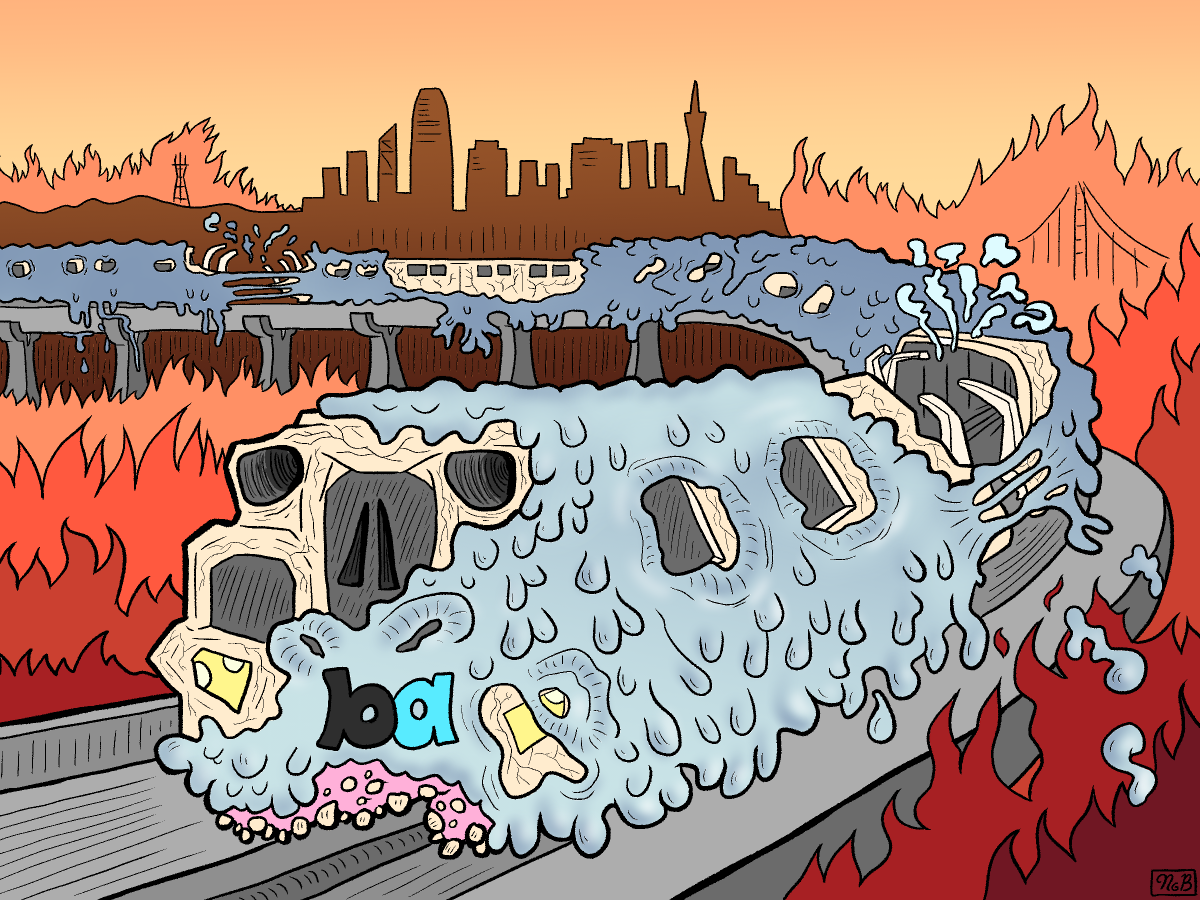
This 40-year-old exchange feels relevant because of all the stories you’re reading about BART — which, in a fiscal sense, is lost alone in the woods with a looming $376 million deficit.
You can tell things are bad because you’re reading about them in the New York Times and Washington Post. Our nation’s flagship newspapers don’t cover BART unless the system’s finances are having a Bear Stearns moment (or if a transit cop kills an unarmed passenger). Either way, something has to go very wrong.
And it has. The one-two punch of the pandemic cratering ridership and the rapid ascent of working from home has crippled the transit agency — and led to a ruinous fiscal shortfall.
Assuming signature-gatherers are successful in getting a measure onto the November ballot, a bare majority of voters across five Bay Area counties will have the opportunity to vote themselves a sales tax increase and, for now, save BART. The estimated revenue generated, some $310 million, would only cover the lion’s share of BART’s deficit. The rest would have to come with efficiencies and austerity.
We live in sad and diminished times: A multicounty all-hands effort (and regressive sales tax) is necessary to mitigate most of a transit system’s structural operating deficit. The best possible scenario here isn’t even a better transit system but one that doesn’t get much worse.
The worst-case scenarios posited in lengthy articles are horrifying, replete with massive service cuts, layoffs and huge fare hikes.
But, in truth, these aren’t really worst-case scenarios. I regret to inform you that, in reality — it could be worse.
Even among knowledgeable and well-informed transit people, there seems to be a less than perfect understanding of the painful details of BART’s “Alternative Service Plan” — the anodyne title for the extreme privations the system will adopt if spurned by voters in November.
If voters pass the November measure, BART and its riders will enjoy a crappier version of the status quo — yay, winning. But if the measure fails, enter the “Alternative Service Plan.” Within BART these are referred to as the “measure fails” scenarios. They’re bloody awful.
There’s a lot of focus on “Phase One” of the Alternative Service Plan, which is understandable because of its rotten details: A 63 percent reduction in service hours, 9 p.m. station closures, 30 minutes between trains and 30 percent fare hikes for this jankier, spottier, dirtier service.
What the general public, and even transit nerds, may not know is that Phase One is the equivalent of tossing cargo out of a sinking ship — which, by design, doesn’t do anything to patch the hole.
Phase One, also by design, doesn’t attempt to run BART on a balanced budget: The system’s bean-counters, we’re told, have determined that any attempt to immediately balance the budget would induce BART to rapidly collapse. It would be akin to McDonald’s immediately shifting from serving burgers to serving dirt. They would be closed on Day Two and so, very nearly, would BART.
The general public also may not know that Phase One — by design and immutably — is intended to be followed by Phase Two. Phase Two is designed to balance the budget. It calls for heavy layoffs of support staff: station agents, janitors, cops, people who run payroll, etc. It would lead to the potential closure of up to 15 stations and even more fare hikes — to a cumulative 50 percent.
There has been a great deal of focus on those station closures. That’s understandable. But it also feels like, if you were lost alone in the woods, missing the forest for the trees.
That’s because, while Phase Two has been posited as the worst-case scenario in the event of voters swatting the November measure, it’s really not. It may be the best-case scenario: It assumes that BART is able to continue offering a sustainable and viable service on a balanced budget without additional revenue. It assumes enough people will continue riding a slower, dirtier, more erratic and more poorly maintained service — and pay a lot more for it. It assumes BART continues to exist.
And that’s a hell of an assumption. Because there is the specter of Phase Three, which is the full shutdown of the BART system, with its remaining revenue going toward securing its assets. If voters reject the November measure and BART sets down this path, the decision to shut down the system could come at any time. Like a dodgy bar or a minor-league hockey franchise, you could show up one day and find a padlock on the door.
So that’s your worst-case scenario. That and dying in the woods.
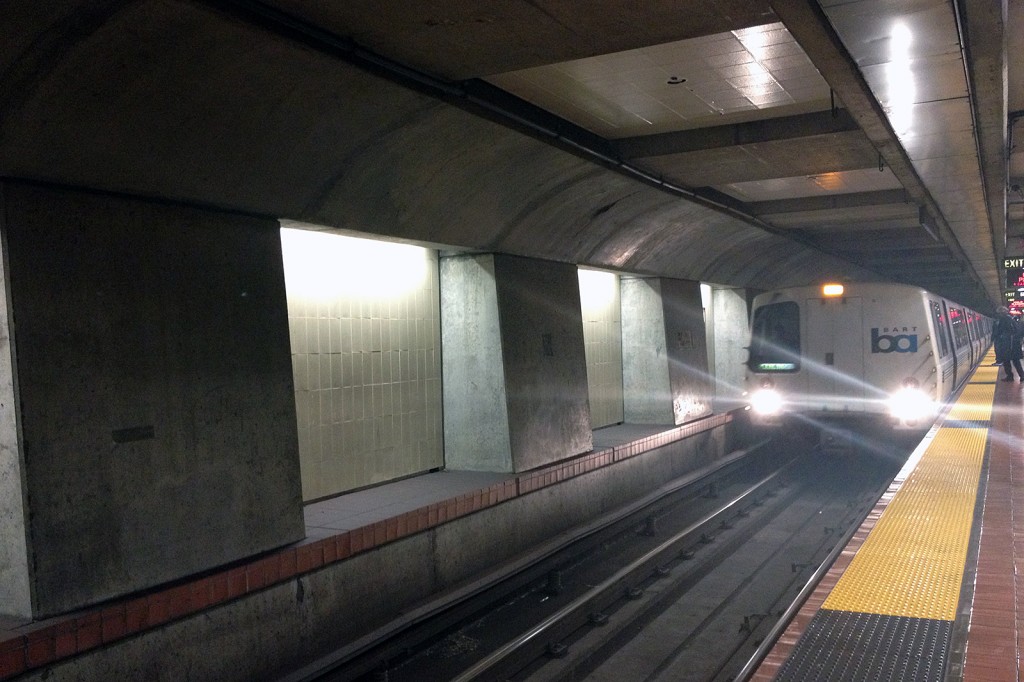 A BART train approaches the 24th and Mission Station, 2013.
Oh by the way, it gets even worse. The five-county measure voters will decide in November would fund more transit agencies than just BART. And if they don’t get additional funds, their services will suffer too — and lead to a not-insignificant number of paying riders no longer transferring onto BART.
Transit funding is beastly complicated but, for many years, BART’s was largely less so. People paid money to ride on the train. The end.
Until the pandemic, BART was able to cover around 70 percent or more of its costs from rider fares — better than four times the national average. That was better than the New York subway system and virtually everyone else. BART’s farebox recovery dropped to 12 percent during the pandemic and registered at 29 percent in fiscal 2024. That’s … much less. But 29 percent is still nearly double the national average.
BART is in a pickle because the pandemic didn’t just obliterate ridership, it also permanently altered Bay Area residents’ work and leisure patterns. BART is a system that was, literally, created to carry people from the outer suburbs to Downtown San Francisco to work and shop. So this is an existential situation for both BART and Downtown San Francisco; the two entities are intertwined.
You might be surprised to learn that, in February, just over 60 percent of all BART trips either started or concluded at the four downtown BART stations. Downtown San Francisco is still the Steph Curry of Team BART, but the overall numbers are proportionately lower. A lot lower: Scott from Moraga is still riding the train, but he’s only going to the office one or two days a week, not five. For a farebox-heavy service like BART, that’s a death knell.
BART’s ability to make up a supermajority of its costs via farebox recovery basically enabled state and regional government to direct transit subsidy dollars elsewhere; you could argue that BART was The Giving Tree of commuter services.
Now BART isn’t making nearly enough back from the farebox to operate the service. Five minutes of research could inform you that there is no way BART can cut its way out of this problem. And even if it theoretically could, no service ever gained much-needed users by making itself crappier, costlier and less viable.
But, along comes the overtly libertarian Washington Post op-ed page with its elbow on the pulse of the Bay Area’s transit crisis to say — maybe it could?
There’s a lot here to boggle the mind. The WaPo notes that ridership isn’t coming back, when BART’s numbers grew 12 percent year over year. It seems confused by the elementary notion that fixed-rail systems have huge fixed costs — and can’t simply scale up and down with ridership. Finally, Jeff Bezos’ op-ed page posits that the solution to this problem is automation — of course it did!
Is automation a bigger part of BART’s future? Quite possibly! That would go a long way toward running shorter trains at all hours as would befit a post-pandemic transit agency.
But there isn’t an on/off “automate” switch to pull here. Automation would be an expensive, yearslong process. Meanwhile, BART is facing a massive deficit now. Of BART’s 4,599 full-time-equivalent employees, 489 are full-time drivers and 23 are part-time. You could cut them all and not even come close to mitigating BART’s deficit.
Of note, data from fiscal year 2023 indicates that BART’s “cost per vehicle per revenue hour” is $283. The same metric for D.C.’s Washington Metropolitan Area Transit Authority is $466.
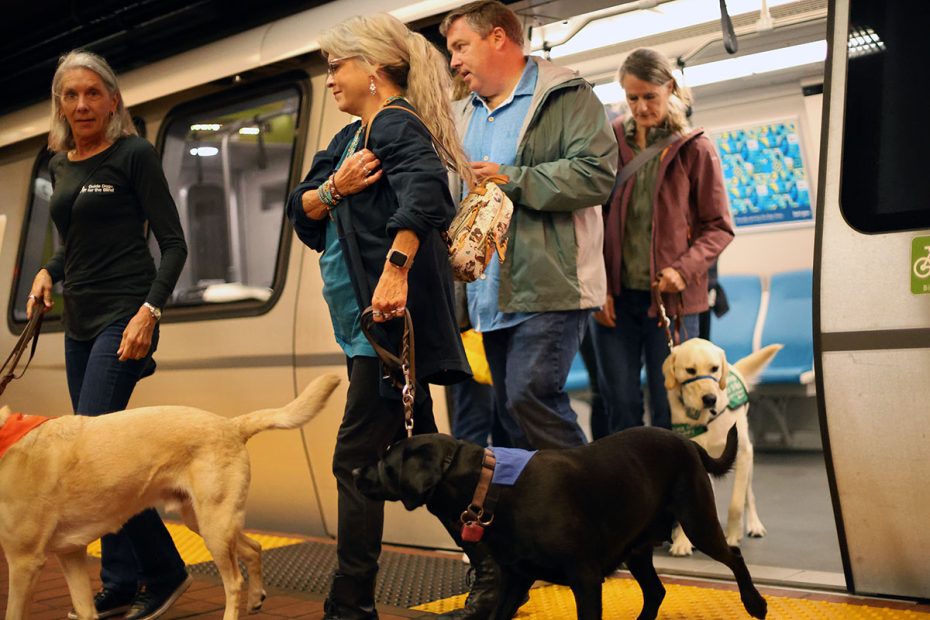 Guide dogs in training and volunteers disembark from BART on Aug. 3, 2024. Photo by Abigail Van Neely.
Does a five-county BART bailout have a chance? Actually, it does: Recent polling puts it at 56 percent and there will be no big-dollar opposition. Signature-gatherering enables a majority vote instead of a two-thirds vote — and signature-gatherers are acting as advance troops pushing the pro-BART vote. It’s no slam dunk, but it’s also not a Hail Mary.
That’s in large part because this is not the UN Security Council. One or more counties cannot veto the will of the others. If San Francisco and Alameda counties vote overwhelmingly for this — and Alameda has twice the population of San Francisco — you only need to avoid getting swamped in Santa Clara, San Mateo and Contra Costa. Plenty of Richmond-area Contra Costa voters figure to be favorable as well.
It’s news every time BART conks out or someone misbehaves — or worse — on a train. The system is still karmically suffering from its 1970s decision to put carpeting on its trains. But BART’s actual riders appear willing to be forgiving. Customer satisfaction is presently at 89 percent. On-time performance is at 93 percent. Violent crime isdown 36 percent and property crime is down 49 percent.
There are, indeed, ways forward when you’re lost alone in the woods. Provided, of course, you don’t do the worst thing you could do.