
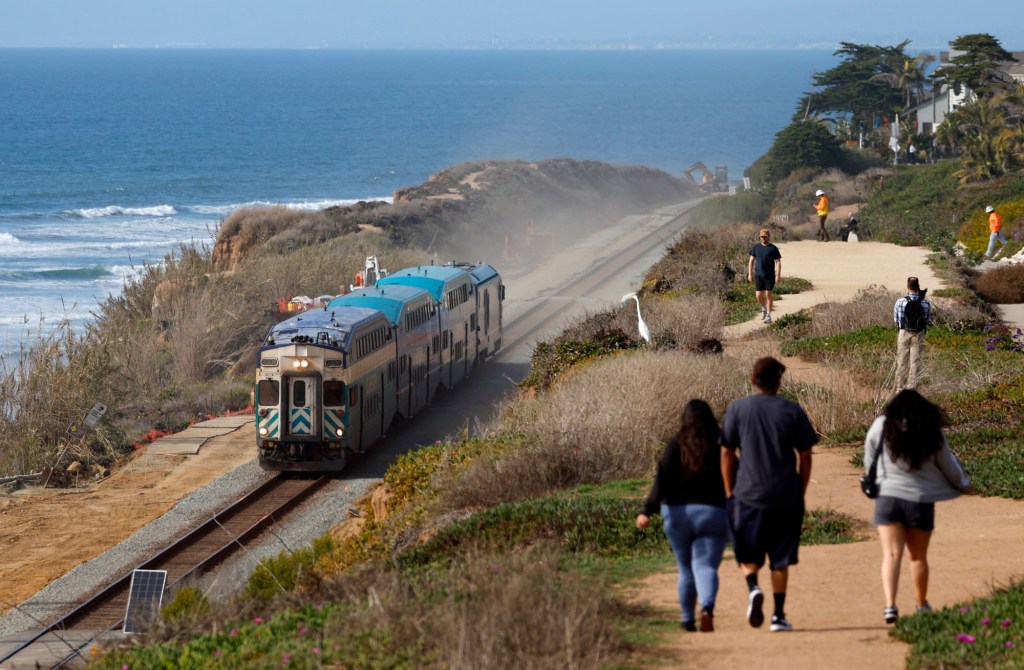
Another fence is causing trouble in Del Mar, where residents went to court a few years ago to stop the installation of a safety fence along the railroad tracks on the seaside bluffs.
This time, surfers and sunset lovers are fighting to prevent a temporary fence that a contractor wants to add at a construction site that’s part of the ongoing railroad bluff stabilization efforts.
The new barrier is needed at 11th Street, where work is about to begin on additional drainage improvements. The project is part of the most recent phase of stabilization work that began in February 2024 to safeguard the tracks atop an eroding coastal cliff.
People use a long-established “goat trail” worn into the sandy bluff to get to the beach below 11th Street, a popular surfing spot. The trail crosses the tracks illegally, which generations of Del Mar residents have considered their right.
“Please do not approve the temporary fencing for safety reasons along the Del Mar bluff,” said 40-year resident Isla Cordelae at a Del Mar City Council meeting last week, where the San Diego Association of Governments presented an update on the bluff stabilization.
“This street has served as vital emergency access to lifeguards, paramedics, fire department and immigration officials for both sea and land operations,” Cordelae said.
She and other speakers said the temporary fence could last for years or become permanent, as SANDAG, the city and other agencies work with the community to create new, legal access across the railroad tracks to the beach.
“The train that runs along Del Mar’s scenic natural bluffs and the surfers, beachgoers and sunset lovers who enjoy them daily have peacefully coexisted for nearly 100 years now,” Jenny Beyler said in an email to the City Council.
“The past year or more of ‘bluff stabilization’ has been difficult to take,” Beyler said, but she’s taken comfort that it will end soon. A short, partial chain-link fence was erected for previous work at 11th Street, but so far pedestrians have been able to get around it.
“But now they want to take that away … by blocking access completely,” she said. “All I am asking is to keep at least the small entry in the fencing for surfers to get to the cliff path …”
A residents group called Friends of Del Mar Bluffs filed suit in 2022 to stop construction of a 6-foot-tall, wire-mesh fence along the railroad tracks in Del Mar, a public safety project proposed by North County Transit District that the city had been fighting for years.
The fence would take away “the public’s right to continue to access and use portions of the Del Mar bluffs in NCTD’s right-of-way for sitting, walking, running, meditating, observing the Pacific Ocean and other public uses,” the lawsuit stated.
Transit officials said the fence was essential and long overdue to prevent people from trespassing on the tracks and being killed, as trains were becoming faster and more frequent.
However, the California Coastal Commission also opposed the fence, and the commission’s executive director issued a cease-and-desist order stating that the barrier would “disrupt or eliminate pedestrian access” on trails along the bluff and to the beach.
NCTD announced in 2024 it had abandoned the plan for a safety fence in Del Mar, although it added the same thing in areas where it was missing in Oceanside and Encinitas. Much of the 60-mile rail route from downtown San Diego to the Orange County border is fenced.
Clint Peace, SANDAG’s senior director of capital delivery, said the agency will continue working with the contractor and the city to find a solution for the 11th Street fencing.
“This is an active construction site,” Peace said. “The concerns are about construction site liability and safety, not about crossing the tracks.
“We are going to work to get in and out of there as soon as possible, and open up the area,” he said.
It’s not just bluff-top fences that Del Mar doesn’t like about the railroad project. City Council members and residents have publicly complained about the color of an asphalt access road, the size of drainage ditches, the burlap covering placed on graded areas, the location, size and texture of seawalls, and the slow progress on mitigation projects including a new legal rail crossing.
The city also has many concerns about a separate SANDAG project that was supposed to take about 1.7 miles of the railroad tracks off the bluffs and move them inland through a tunnel to be bored beneath the city. NCTD has said the tracks will remain on the bluffs until well after the new route is built, which easily could be 10 years or longer, and that it’s undecided what will happen next with its blufftop right-of-way.
Five possible routes being considered should be narrowed to a single preferred route by the end of 2029, Peace said last week. The most recent estimate for the tunnel project was up to $5 billion, although construction costs are rising rapidly.
SANDAG Chief Executive Mario Orso spoke briefly at the meeting to say the agency is working to find a middle ground that will meet everyone’s requirements for the bluff projects.
The tracks are part of the 351-mile Los Angeles-San Diego-San Luis Obispo (LOSSAN) corridor, San Diego’s only rail link to Los Angeles and the rest of the United States.