
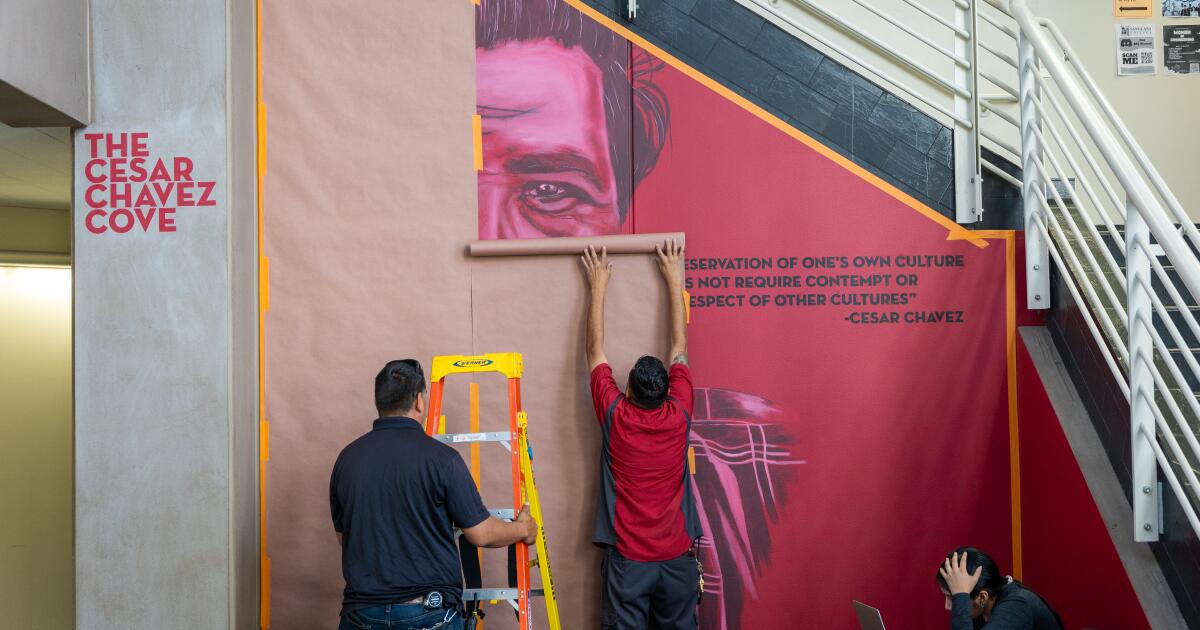
It’s been nearly a week since a New York Times investigation reported explosive allegations that Cesar Chavez sexually assaulted girls and fellow labor leader Dolores Huerta in the 1960s and ’70s.
You’re reading the Essential California newsletter
Sign up to start every day with California’s most important stories.
By continuing, you agree to our Terms of Service, which include arbitration and a class action waiver. You agree that we and our third-party vendors may collect and use your information, including through cookies, pixels and similar technologies, for the purposes set forth in our Privacy Policy such as personalizing your experience and ads.
The news stunned California, where Chavez rose to national prominence in the mid-1960s as a galvanizing force for better pay and working conditions for agricultural laborers.
The president of United Farm Workers — the union co-founded by Chavez and Huerta in 1962 — condemned Chavez’s acts.
“It’s unforgivable,” Teresa Romero said. “Any abuse of a woman or a child, anything like that, is unforgivable. … We don’t justify it. We don’t accept it. That’s not who we are.”
Huerta, who said Chavez raped her in the 1960s, kept the sexual abuse a secret for decades until allegations surfaced in the Times.
“I carried this secret for as long as I did because building the movement and securing farmworker rights was my life’s work,” she said in a statement. “The formation of a union was the only vehicle to accomplish and secure those rights and I wasn’t going to let Cesar or anyone else get in the way.”
The accusations have created an outcry to erase Chavez’s name from schools, parks, streets, buildings and holidays.
In California, the labor leader’s name and image are rapidly being erased.
Removing Cesar Chavez’s name and likeness
It took three decades for the labor leader’s name and likeness to be added to hundreds of buildings, roads, parks and schools, but it has taken just a few days for them to come down.
As my colleagues reported, many officials said it was important that communities respond immediately and redirect the focus from Chavez to the larger movement.
In San Fernando, a Chavez statue that had been completely covered was pulled off its pedestal and put into storage. In Fresno, the City Council voted to strip his name from a major street — just three years after its controversial decision to rebrand it in his honor.
On Thursday, L.A. Mayor Karen Bass and members of the City Council announced they would abandon a celebration marking Chavez’s birthday and rename the holiday “Farm Workers Day” to honor laborers who toil in the fields.
Resurrecting a decades-old debate
Before Boyle Heights’ Brooklyn Avenue was renamed Cesar E. Chavez Avenue in 1993, many in the community were opposed. Longtime residents and merchants of different nationalities and ethnic groups viewed the renaming as erasure of their multi-ethnic community’s identity.
They lost the battle but refused to accept the name change. Some still refer to the street by its original name.
Now, amid talks of renaming the street in the wake of sex abuse allegations, the old debate has resurfaced, along with its conflicting emotions, The Times’ Ruben Vives reported.
Some residents, including those who supported the name change years ago, think the street should be renamed again.
Pivoting on how to teach about Chavez
Educators are now scrambling to revamp lessons about one of California’s most widely taught historic figures.
Teachers at K-12 and university campuses told The Times they were rewriting lesson plans, reframing discussions and preparing for difficult conversations with students about the labor leader’s life and contradictions.
The California Department of Education and Los Angeles Unified School District issued statements that instructors should de-emphasize the importance of teaching about Chavez as an individual and instead focus on the farmworkers movement that he was central to establishing.
Here’s more on the complex challenge teachers face in addressing Chavez’s legacy.
Today’s top stories 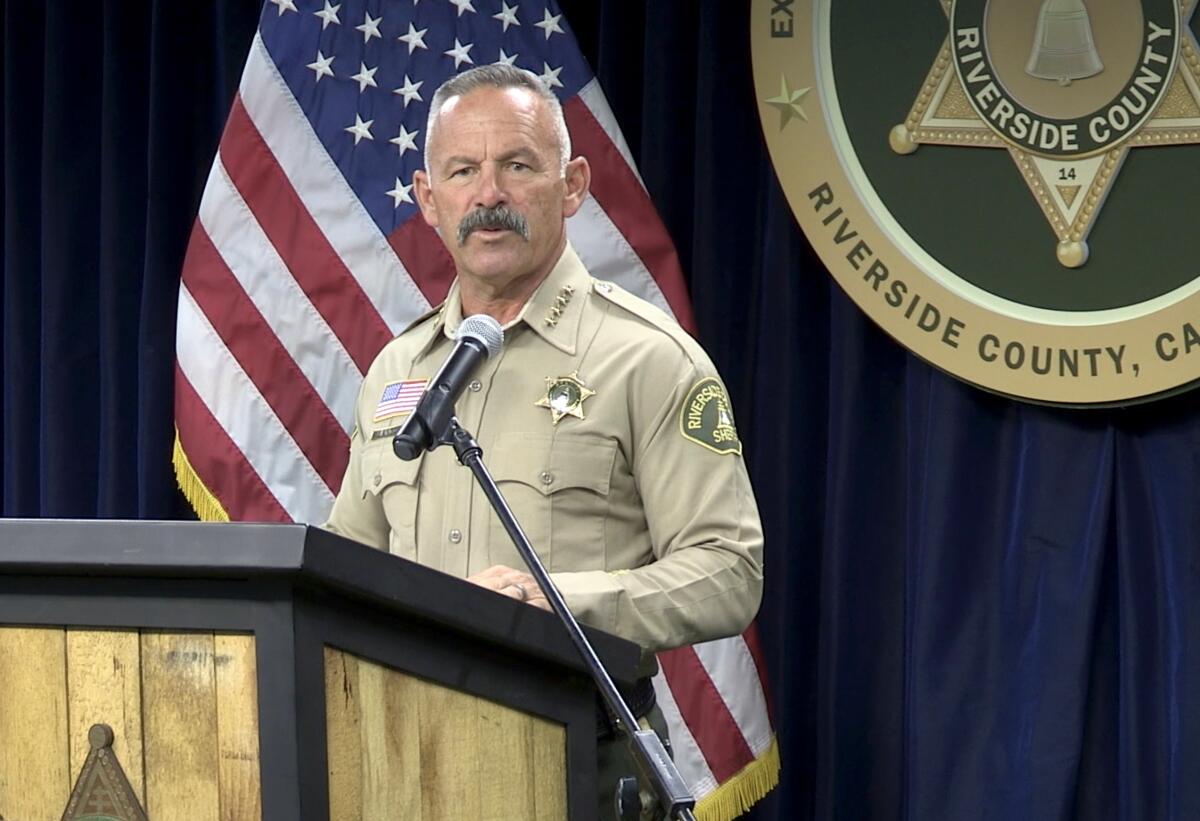
Riverside County Sheriff Chad Bianco has seized thousands of ballots for an investigation that California Atty. Gen. Rob Bonta called “unprecedented.”
(OnScene.TV)
‘Fraudulent’ ballotsRiverside County Sheriff Chad Bianco, a leading GOP candidate for governor, says his investigators are looking into allegations that the county’s tally of votes for Proposition 50, which temporarily redrew the state’s congressional districts, was falsely inflated — a claim that local election officials have refuted.The investigation, which includes all the ballots cast in Riverside County in November, raises questions about how he would handle the election denialism movement if he is elected governor.L.A. mayor’s raceYear-round mosquitoes in L.A.An invasive, disease-carrying mosquito is thriving in Southern California, possibly staying active year-round and proving difficult to control.L.A. County officials are testing a solution — releasing sterilized male mosquitoes — with early results showing population declines.What else is going onCommentary and opinionsTrump attacking Newsom’s dyslexia proves the president’s incompetence, argues columnist George Skelton.Republicans fearing a midterm rout have revived Islamophobia as a political strategy, writes columnist Robin Abcarian.California can have both easy voting and quicker election results, writes columnist Mark Z. Barabak. Here’s how. The Dodgers and their fans are geared up for a three-peat. Here’s why columnist Bill Plaschke says the quest will fall short.This morning’s must readOther must readsFor your downtime 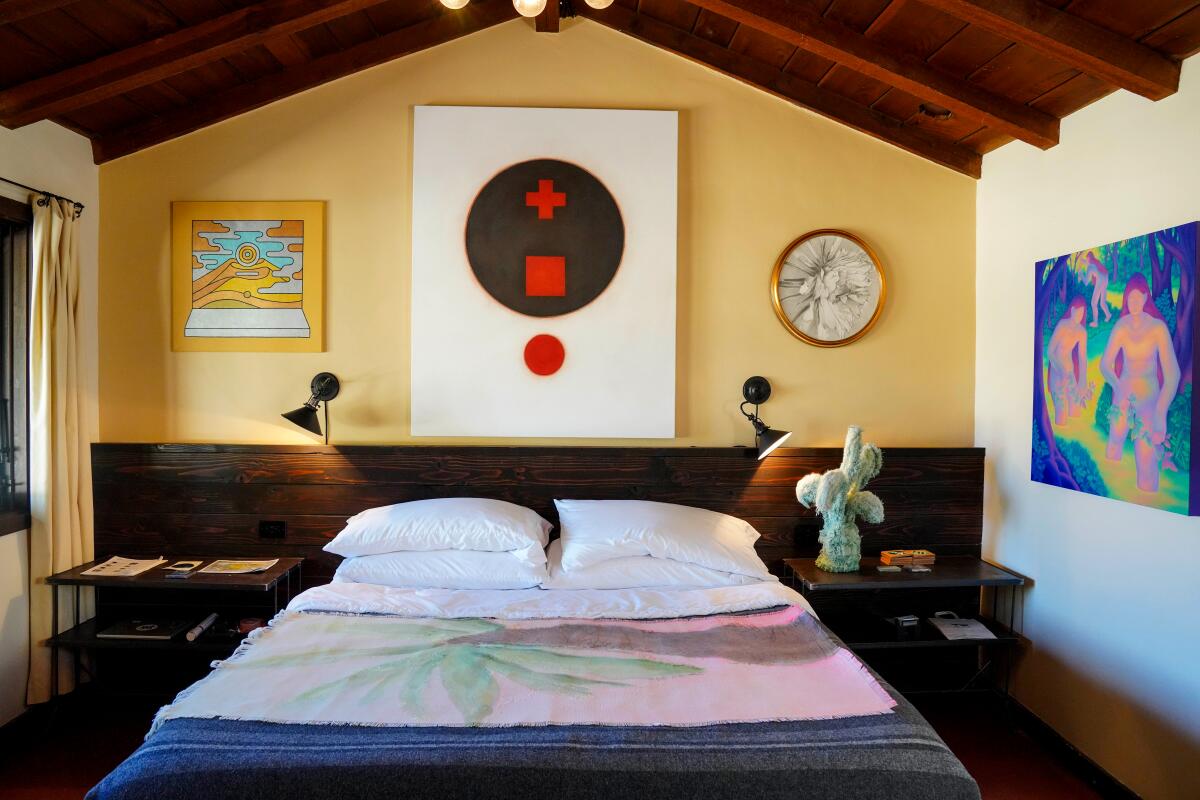
Rooms at the Pioneertown Motel are temporarily transformed into gallery spaces during the High Desert Art Fair, now in its fifth year outside Joshua Tree.
(High Desert Art Fair)
Going outStaying inAnd finally … your photo of the day 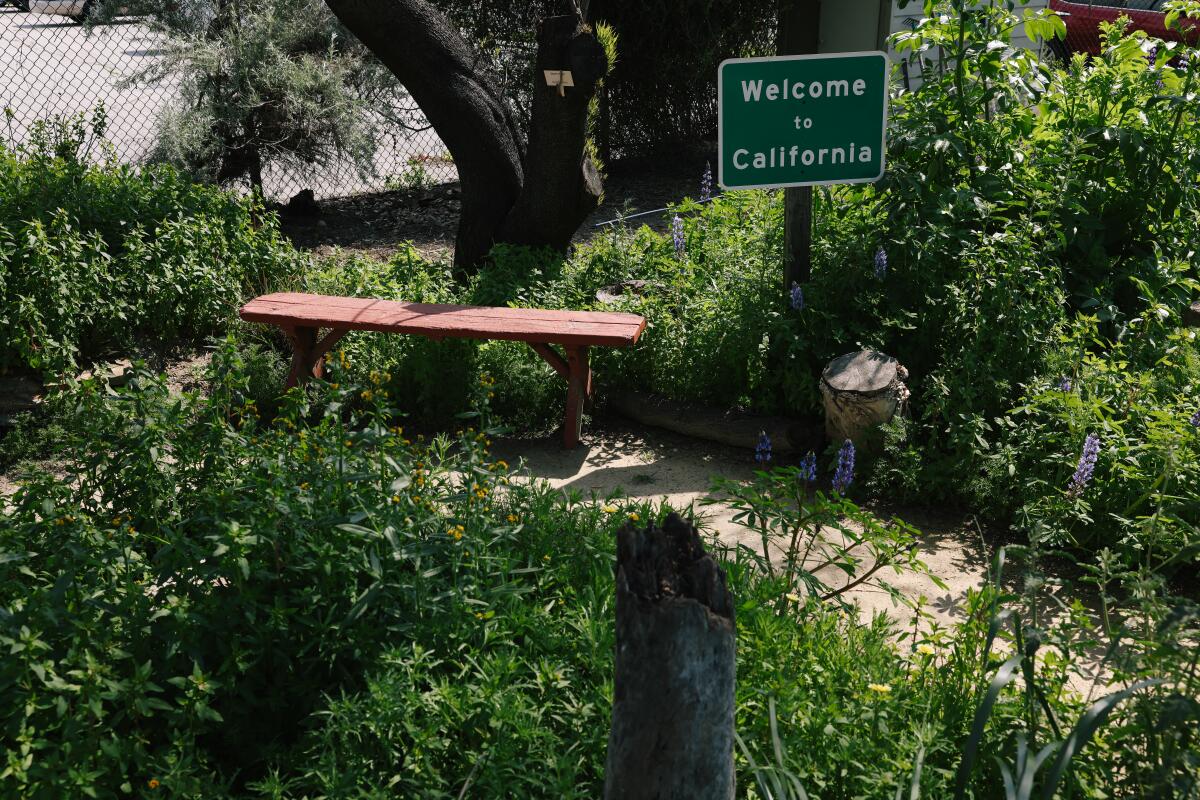
A “Welcome to California” sign is seen at Prisk Native Plant Garden in Long Beach.
(Dania Maxwell / Los Angeles Times)
Today’s great photo is from former Times photographer Dania Maxwell at Prisk Native Plant Garden, one of 19 spring garden tours happening around L.A.
Have a great day, from the Essential California team
Jim Rainey, staff reporter
Hugo Martín, assistant editor, Fast Break desk
Kevinisha Walker, multiplatform editor
Andrew Campa, weekend writer
Karim Doumar, head of newsletters
How can we make this newsletter more useful? Send comments to essentialcalifornia@latimes.com. Check our top stories, topics and the latest articles on latimes.com.