
I’m starting to feel bad about being so critical of our local government. But would it stop giving me so much ammunition?
So what, you ask, am I going to whine about today? (So many choices, so little space.)
Lid lifters. Yup, those $70,000-a-year-plus-benefits folks the city of San Diego has hired to creep around in the early-morning hours before the garbage trucks come and look for miscreants who have put plastic bags in the blue recycling bins or greenery in the black-now-gray trash bins.
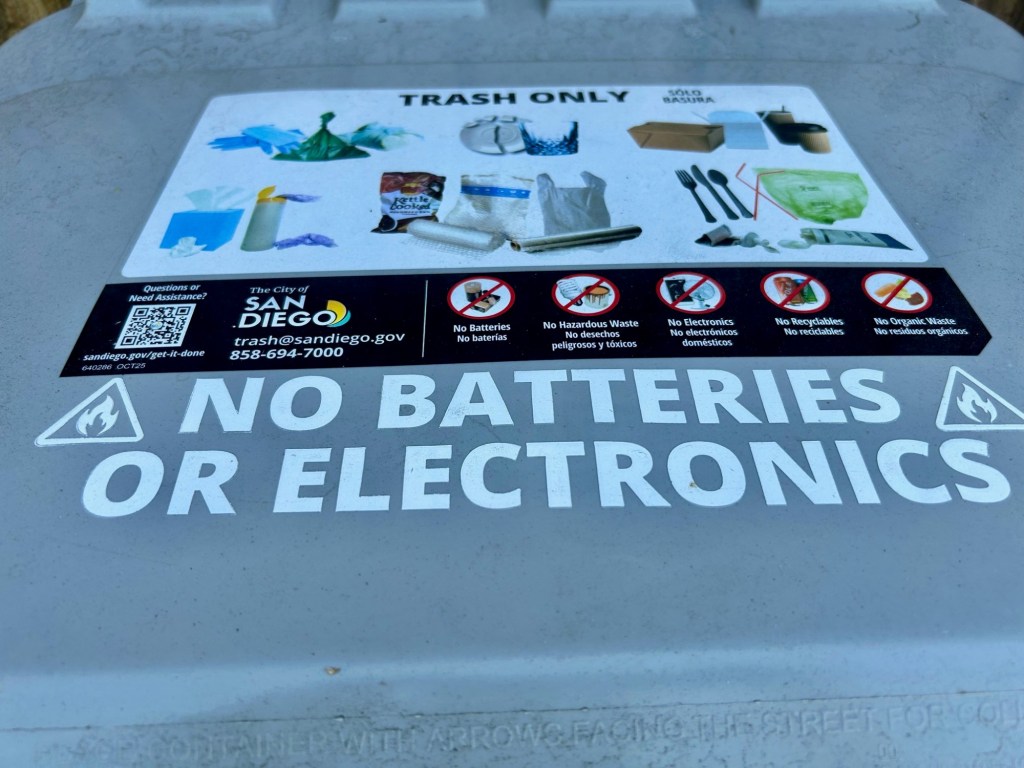
But especially to look for discarded batteries that have caused some 25 trash truck fires in the past year alone. This is a really big deal. Those trash trucks are expensive.
Lithium-ion and other rechargeable batteries can ignite when crushed or punctured inside collection trucks, which can ignite sparks and fire, potentially destroying the truck, never mind jeopardizing the safety of the driver.
While regular single-use batteries (C’s, D’s, AA’s, etc.) aren’t designated as hazards in some cities, they are considered hazardous waste in San Diego and are not permitted in the black-now-gray bins. They apparently can still spark if mishandled, especially lithium types.
A trash truck in San Diego typically costs $350,000-$450,000, but the exact price depends on the type of truck (side-loaded, rear-loaded, front-loaded).
Whether a truck is rendered irreparable by a fire or can be fixed and returned to service, it’s obviously costing the city a bunch of money if we’re multiplying by 25 trucks. And again, that’s just in the past year alone.
So I can see why the city would really want to prioritize doing something about this. But paying people $70,000 a year to see if someone left used batteries sitting atop plastic trash bags (they won’t actually open your bags) seems an inefficient way to do it. Especially since the goal is to have everyone’s trash examined only once per year.
You’d have to get really lucky to catch the week the battery scofflaws choose to discard those AA’s in plain sight.
Even if they’re not going to open my trash bags, many people — I would be one of them — find it very creepy to have someone rooting through their black-now-gray trash bins.
The city maintains that the lid lifters, besides trolling for batteries and propane tanks, are part of an education program to help residents understand the city’s totally insane trash-sorting rules.
Should they see an item in an inappropriate bin, they will put an “oops” tag on the bin, alerting you where you’ve gone wrong. If they catch you putting in something dangerous — a propane tank, for example — they will put a “Do not collect” tag on it for the trash folks and you’ll have to remediate the problem, then call to get your trash picked up another time. (And good luck with that.)
I would like to mention here that once bins are on the street, residents have no control over what other people put in them. In my case, the public has access to our black-now-gray and green bins all the time since the bins are too big to fit through our back gate. People putting dog poop bags in our green bins (or even the recycling bins if on the street) makes me nuts.
But they could be putting batteries, paint cans or other hazardous waste in our bins and, if appropriately disguised, we’d never know.
If I were in charge of trying to save the city the cost of repairing or replacing 25 pricey trash trucks per year by discouraging people from putting batteries in the trash, I’d take the Swedish approach, which can be summed up in three words: Make it easy.
Clean air, clean water and recycling are all very central to the Swedish ethos. When we lived in Sweden, our apartment complex of 32 units had exactly three 30-gallonish bins that were serviced perhaps once a week. That was because every few blocks, there would be an entire bank of big green recycling bins for every type of recycling you can imagine: clear glass, colored glass, every type of paper and plastic and, yes, one just for batteries.
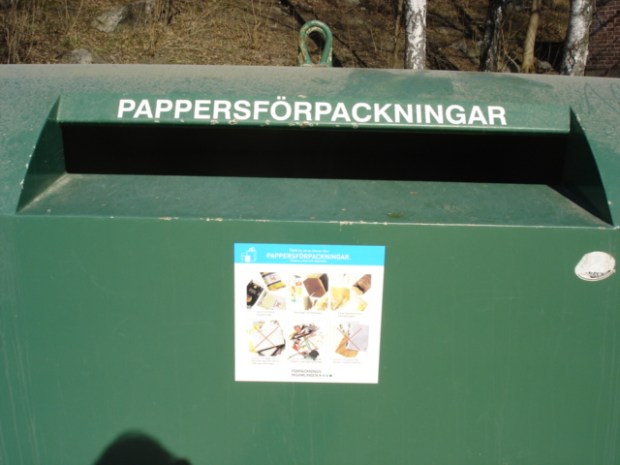 In Stockholm, Sweden, there are recycling bins for every type of recycling — including batteries — every few blocks. This one is for cardboard and packing materials. (Inga)
Such is the Swedish priority for recycling that when an American friend decided to try to sneak a few empty wine bottles into her building’s trash bins, she found the bag outside her apartment door the next morning with a note full of Swedish umbrage. Swedes can smell recyclables in a trash bin from 30 yards.
My friend sent an email to the rest of us warning not to attempt this. But if we did, she said, be sure not to include mail with your address on it.
Now compare this with San Diego’s battery recycling program.
Batteries can be recycled at the city Household Hazardous Waste Transfer Facility at the Miramar Landfill from 9 a.m. to 3 p.m. Saturdays. The service is free for city residents but requires an appointment (italics mine) and proof of residency (italics mine again). All types of home (alkaline, rechargeable) and automotive batteries are accepted.
An appointment? Proof of residency? How many people realistically are going to do that? They’re going to dump them in a trash bag in their black-now-gray bin, knowing the lid lifters won’t see them.
Now, there are other ways to recycle batteries in San Diego besides the city dump. How much time have you got?
There are various recycling events around the county during the year, but none tends to be near here.
As for anything that might be even remotely convenient to anyone in our area, Staples stores accept rechargeable and single-use (alkaline) batteries.
O’Reilly Auto Parts at 1501 E. Garnet Ave. in Pacific Beach accepts used car, marine, lawn care and motorcycle batteries for recycling, but not household, non-rechargeable flashlight batteries (like alkaline), i.e., the type Staples accepts.
A little farther afield, Dream E-Waste in the sports arena area (4009 Hicock St.) accepts all household, rechargeable and specialty batteries.
Got all that?
Frankly, if I had $10 million (25 x $400,000) in trash trucks at stake each year, I’d be working hard to make sure it was really, really easy for people to dispose of anything that could destroy them.
Having a six-hour window only one day a week by appointment seems, well, lacking. While the Swedes strive to make recycling so easy that you’d be embarrassed not to do it, our local government seems to ask, “How can we make this incredibly complicated, expensive, annoying and largely ineffective?” (Balboa Park parking fees, anyone?)
Because if we want to keep batteries out of the city’s trash, the lid lifters aren’t the answer.
Inga’s looks at life appear regularly in the La Jolla Light. Reach her at inga47@san.rr.com. ♦