
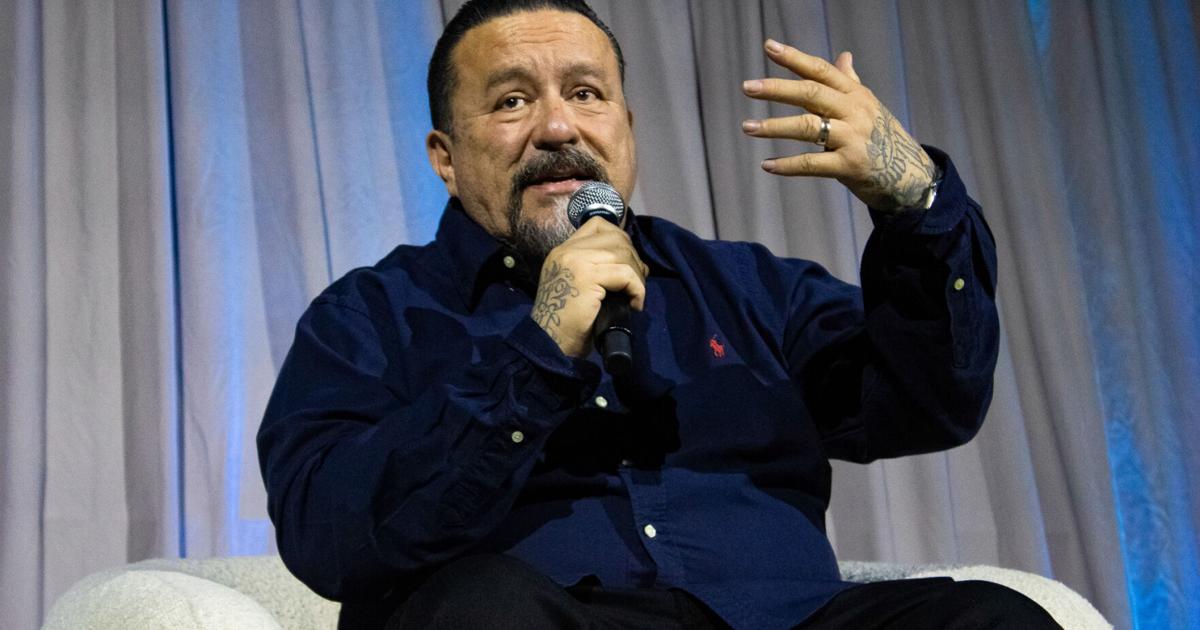
Applause spread across the Titan Student Union Pavilion as Los Angeles-based tattoo artist and illustrator Mark Machado, also known by his stage name Mister Cartoon, took the stage for Associated Students’ Beyond the Conversation, drawing in the audience for a discussion on culture, community and art.
Serving as the keynote speaker for ASI’s Social Justice Week event, he shared insights on art, mentorship and cultural representation. He highlighted the origins of Chicano art and the importance of community support in creative development.
Machado described his introduction to art as something instinctive, recalling how he began drawing at a young age simply by sketching what he saw around him. Rather than approaching art with a structured plan, he explained how creativity came naturally, something he followed without overthinking.
“I felt that the more I kept doing it, the more obsessed I became,” Machado said. “Art made me feel good. So I just kept doing it.”
Over time, that raw initiative and approach evolved into a career that brought Chicano culture into wider visibility, ranging from neighborhood walls and T-shirts to album covers, tattoos and international collaborations.
That dedication carried his work beyond Los Angeles. Over time, the visual language rooted in graffiti and lowrider culture appeared in collaborations with brands such as Nike, Major League Baseball, the National Hockey League and most recently Supreme and Pro-Club.
“It’s definitely a process when your work goes from impressing your homies to other people that recognize it from other parts of the world,” Machado said.
What once lived on walls and sketchbooks now exists on T-shirts, sneakers and global campaigns often without widespread recognition of its cultural origins.
Even as his work reached global audiences, he emphasized that his process never became formulaic, instead remaining rooted in personal expression and individuality.
“I just kept going it my way, even if it was a little off or it was a little weird, I just kept doing it because I liked it and my friends liked it,” Machado said.
He also discussed the influence of incarceration on Chicano visual culture, noting that creativity persisted even in spaces where it was not expected.
Much of the visual language now associated with Chicano art originated in these contexts, forming a foundation for contemporary artists. He noted that he himself had spent time in jail for graffiti vandalism, which shaped his perspective.
“Art is one of the few things respected in jail,” Machado said. “I believed that a lot of the artwork was born in those cells. It was the guys dreaming about the outside.”
In a discussion about representation, he referenced the recent 2026 U.S. Postal Service collection that featured custom lowrider cars — a form of American car culture rooted in Chicano communities, as a sign of cultural recognition appearing in unlikely spaces.
The moment reflects how imagery tied to Chicano identity has moved from subcultural expression into broader institutional visibility.
“The world is starting to recognize what we’ve always known, that Chicano art and Latinos period are very creative, and our art goes across the world,” Machado said.
That same mindset informed discussion of mentorship and community. Guest panelist Ricardo Pitones of the Latinx Community Resource Center emphasized that representation shapes students’ experiences, explaining how visibility encourages inclusion and a sense of belonging in educational spaces.
“These stories matter,” Pitones said. “They make the space welcoming, they make it inclusive. They make it so that you want to learn.”
During the audience question-and-answer session, alumni in attendance raised questions about navigating self-doubt and comparison while staying true to one’s creative path.
Machado acknowledged that those feelings are a natural part of the process, encouraging individuals to stay grounded in their purpose and reflect on their motivation when facing uncertainty.
Across the discussion, one idea remained consistent: progress requires continued effort. The focus stayed on maintaining cultural visibility and creating opportunities for future generations.
“We just keep pushing forward,” Machado said. “And the next generation will take us even farther.”