
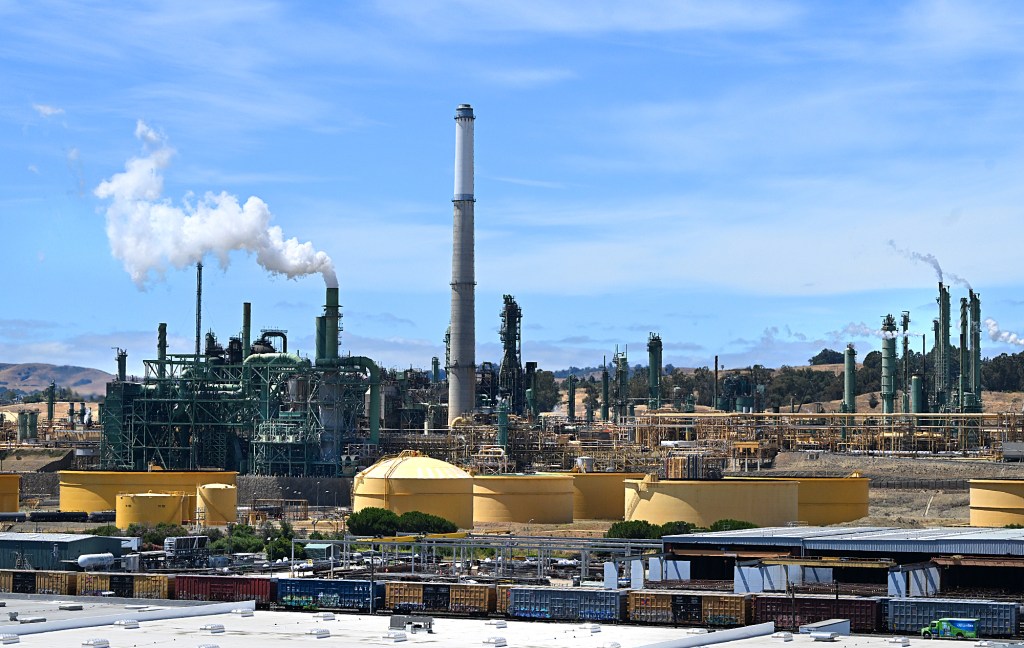
Proposed changes to California’s Cap-and-Invest Program have prompted complaints from oil refiners in the state, rattled more than a few Democrats in the Legislature, and spurred environmental groups to urge the California Air Resources Board to go full-speed ahead.
Any revisions to the Cap-and-Invest Program come as California’s already-high gasoline prices have climbed to even more eye-watering levels since the start of the war in Iran.
RELATED: Could California pause the gas tax or start charging drivers fees based on mileage?
Oil companies warn that suggested changes released earlier this year could lead to more refinery shutdowns across the state. Environmental groups say the petroleum industry just wants to protect its profit margins. But 15 Democrats in the Assembly recently sent a letter to the head of the Air Resources Board, saying CARB needs to make a U-turn.
For its part, CARB officials say the proposals are merely that — proposals that are being considered — and the agency’s board is not scheduled to make any final decisions until late May.
What is Cap-and-Invest?
A cornerstone of California’s climate strategy, the Cap-and-Invest Program has been in place for 13 years. It used to be called Cap-and-Trade, but the name was changed last fall after lawmakers in Sacramento and Gov. Gavin Newsom joined forces to pass legislation extending the program through 2045.
Cap-and-Invest requires power plants, natural gas providers and large industries that emit greenhouse gases to buy permits on the carbon pollution they produce.
It’s designed to send price signals that encourage investment in cleaner energy and more efficient technologies to help California meet its ambitious climate goals — such as deriving 100% of the state’s electricity from carbon-free sources by 2045 and eliminating sales of all new gasoline-powered passenger vehicles throughout the state by 2035.
Cap-and-Invest adds about 24 cents to the price of a gallon of gasoline — not counting other state taxes and fees, plus the federal excise tax of 18 cents a gallon — that California drivers pay at the pump.
The program has raised $34 billion for climate investments, CARB says. It also funds the California Climate Credits that customers of investor-owned utilities receive twice a year on their billing statements.
The dollar amount of the credits varies each year, depending on how much revenue the program generates. For example, San Diego Gas & Electric customers received a discount of $81 on their electricity bills in April 2025 and another $81 in October of last year. SDG&E customers with natural gas hookups also received a climate credit of $54 last spring.
RELATED: California warns on price gouging as some gas stations charge $8 a gallon
Under the legislation passed last year, Cap-and-Invest rules are about to be updated. Drafts released by CARB in January aimed at bolstering the program include removing allowances for companies emitting greenhouse gases “on an ongoing basis.”
CARB’s economic analysis estimated the total cost of compliance at $124 billion over 20 years, which the agency described as “negligible relative to California’s current annual $4 trillion economy.”
Why oil companies oppose
To help meet climate targets, the proposed update calls for removing 118.3 million metric tons of carbon allowances from the Cap-and-Invest program between 2027 and 2030. Industry groups estimate that complying with the proposed changes will cost refiners $1.5 billion a year by 2035 — compared to the $357 million they pay in 2026.
Chevron sent a letter to Newsom and other state legislative leaders on March 9, saying the “proposed legislation will cripple the survivability of the state’s remaining refineries, which will result in California losing the entire industry to this misguided program.”
Chevron President Andy Walz described “an increasingly adversarial policy environment” in California and alluded to a pair of recent refinery closures.
Phillips 66 completed the shutdown of its twin refinery in the Los Angeles area late last year and Valero expects to wrap up the closing of its 145,000-barrel-per-day refinery in the Northern California city of Benicia by the end of April.
The Valero and Phillips 66 facilities combine to account for about 18% of the state’s total refining capacity to process gasoline, diesel, aviation and other transportation fuels. Imports from foreign countries can help pick up the slack, but the shuttering of the two refineries may leave the state more vulnerable to price spikes.
Marathon Petroleum wrote a similar letter. “California refineries are already among the most expensive refineries to operate in the world,” Marathon Vice President Michael Henschen wrote, adding that the CARB proposal, as written, “would further widen the cost disparity, forcing refineries to reconsider whether operations in California remain viable.”
Some 63.5% of oil in California refineries in 2024 came from foreign sources, according to the California Energy Commission. By having California rely on imported fuel from refineries with less-stringent regulations, Henschen said, the “net effect will be an increase in global greenhouse gas emissions.”
In a filing with CARB in late February, fellow refiner PBF Energy told a similar story, saying the proposed amendments would make costs “skyrocket” and “drive in-state refining capacity to zero,” according to Argus Media.
Democrats weigh in
Democrats maintain a supermajority in the California Legislature, holding a 30-10 advantage in the Senate and a 60-20 edge in the Assembly.
But 15 Democrats in the Assembly wrote to CARB chair Lauren Sanchez, echoing the concerns raised by the oil company executives. “Our communities are increasingly concerned the Cap-and-Invest regulatory update … will further destabilize California’s fuel supply, economy, and working families,” the March 9 letter said.
They went on to say that it is “now evident that California’s regulatory environment has driven out actors necessary for an affordable energy consumer market. This crisis is not a fallacy nor a thinly veiled threat. It is a reality borne by consumers today, who are historically and empirically least able to afford it.”
It should be noted that last fall all 15 of the Assembly members voted for the legislation empowering CARB to draft the revisions.
A couple of Democrats running for governor have also said the agency needs to go back to the drawing board.
Antonio Villaraigosa last week vowed that if elected, “I will reform and overhaul CARB because we can no longer allow bureaucrats who live in a bubble — with no accountability for the harm they are causing our economy and our people — to have so much power over the lives of every Californian.”
Gubernatorial candidate Matt Mahan, current mayor of San Jose, took to X, saying, “This might be well-intentioned, but closing our refineries destroys good jobs, drives up costs, and means that we have to import gas from farther away, which isn’t exactly environmentally friendly.”
Nevada’s governor, Republican Joe Lombardo, has also chimed in.
Describing the Silver State as “structurally dependent on California’s refining system,” Lombardo in a letter to Newsom called on CARB and the Newsom administration to “carefully evaluate the regional consequences of the draft Cap-and-Invest regulation before final adoption.”
Green groups want tougher rules
Environmental organizations waved off the complaints from the petroleum industry.
“The oil industry is trying to slow our transition to cheaper, cleaner energy in order to protect its billions of dollars in profit,” said Caroline Jones of the Environmental Defense Fund.
Those organizations contend the proposed revisions to Cap-and-Trade don’t go far enough.
In a letter to Newsom and CARB, representatives from 15 green groups say removing 118 million metric tons of carbon allowances amounts to a retreat from earlier indications that the Air Resources Board would eliminate allowances of 265 million metric tons by 2030.
“We are looking to CARB to pass a strong rulemaking this spring to tighten the program — a weak regulation will not drive the affordability benefits or the emissions reductions that we need,” said Chloe Ames, policy adviser for NextGen California. “Meanwhile, energy price volatility caused by geopolitical conflicts reaffirms why California must continue its transition away from unstable fossil fuels to clean, reliable, renewable energy.”
What CARB says
CARB’s director of communications, Lindsay Buckley, said in an email, “It’s important to note that we are in the middle of a process” and staffers are evaluating all the input the agency has received and will determine “if any changes need to be made.”
Staff will present its proposal to CARB board members in a public hearing at the end of May.
“We like to emphasize the balance that was struck between affordability and ambition,” CARB chair Sanchez told KCRA-TV’s Ashely Zavala, and that “we have built in enough time for changes, should those be deemed necessary before bringing this proposal to the board.”
Sanchez said the current proposal put forth by CARB staff is $20 billion less costly than scenarios initially analyzed in April 2024.
“Our board and our staff (are) really being responsive to concerns about the cost of our regulations,” Sanchez said, while also mentioning that 18 million Californians “still breathe unhealthy air every year.”
The Union-Tribune sent an email with multiple questions for Newsom about the letters from the oil companies, environmental groups, the 15 Assembly members and Nevada’s governor. The governor’s press office referred the questions to CARB.
Spokesperson Buckley said CARB reached out to the office of Nevada’s governor, as well as officials in Arizona, “and reiterated our commitment to working with them as we have for the past several years.”
Going forward
At the end of last year’s session in Sacramento, Newsom signed into law Senate Bill 237, which included provisions easing permitting requirements in and around Kern County, the heart of California’s oil patch, in an effort to boost in-state oil production.
While California Energy Commission vice chair Siva Gunda said the state’s loss of refining capacity will be met largely by imports, he told a Senate committee hearing last month that “as we go down, this is not going to be a smooth transition.”
The debate over CARB rules has many California Republicans taking shots at Newsom, rumored to be a 2028 presidential candidate.
“We are exactly where we are because these agencies have responded (to) direction from the governor,” said Senate Minority Leader Brian Jones, R-Santee. “He appoints these commissioners and regulators and bureaucrats. He created this situation.”
“These aren’t accidents,” Sen. Suzette Valladares, R-Santa Clarita, said on X, “they’re the results of failed energy policies.”
Gas prices in California are often the highest in the nation and they’ve gone into hyper-speed since U.S. and Israeli forces commenced airstrikes against the regime in Iran on Feb. 28.
The average price in San Diego for a gallon of regular gas came to $5.841 on Sunday, according to AAA. That’s $1.16 higher than it was when the war started.
The national average on Sunday stood at $3.942 per gallon.