
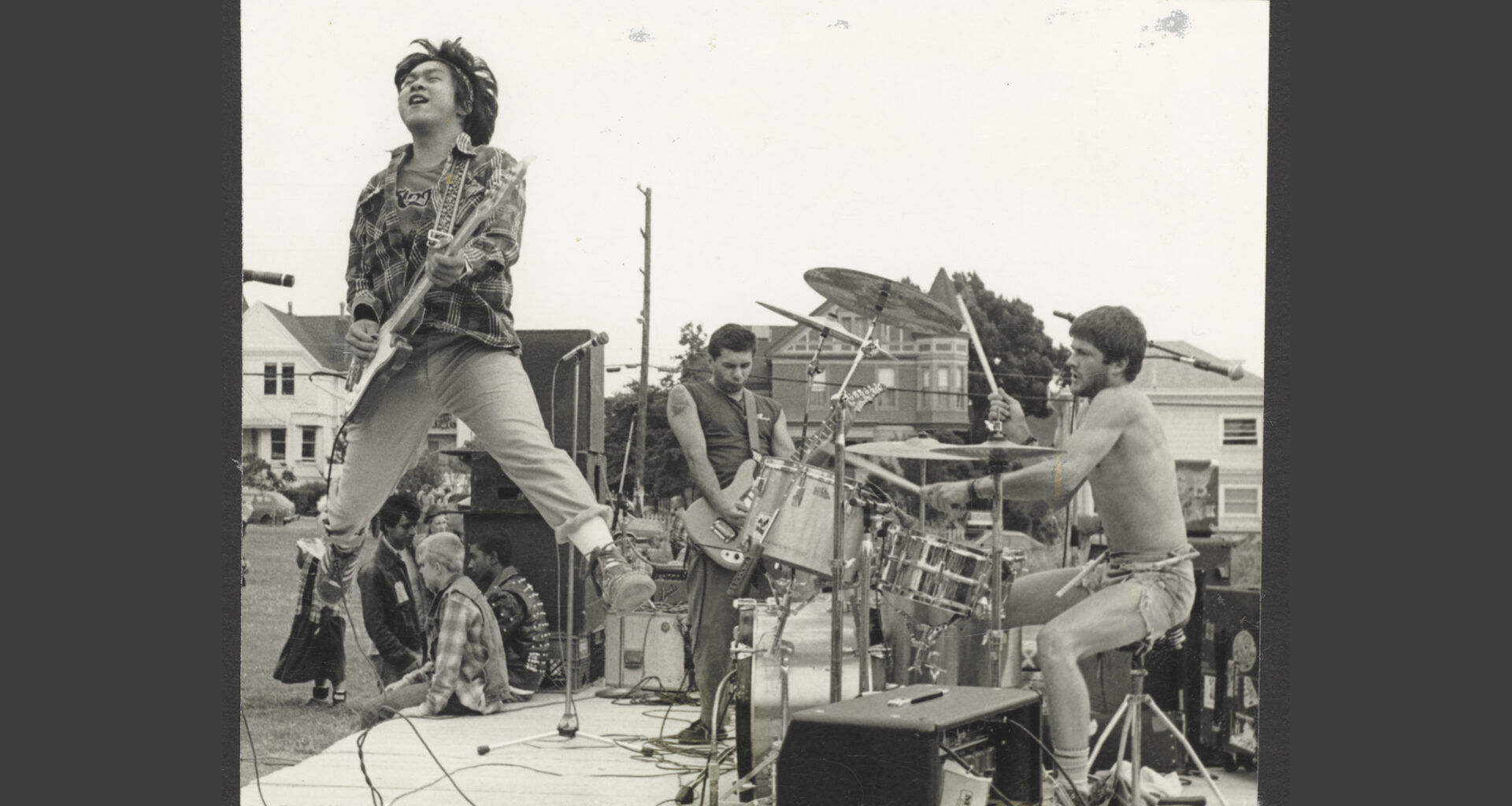
As a newly minted assistant professor at Cornell University in 2014, Tom McEnaney decided to launch a new course on punk music.
“The only thing that I knew about Cornell was that Greg Graffin from Bad Religion had done his Ph.D. in zoology there,” McEnaney said. “So I thought I would teach a class about punk and maybe invite Graffin.”
 Tom McEnaney is a UC Berkeley associate professor of comparative literature and of Spanish and Portuguese.
UC Berkeley
He soon learned that the Cornell University Library was already home to a substantial punk archive, assembled by the chief curator of rare books and manuscripts Katherine Reagan. His punk class would soon help infuse the archive with substantial new material from the Bay Area, where McEnaney grew up.
“A student from that first class went to New York and stumbled into a bookstore where Aaron Cometbus, a Berkeley native who has been writing fanzines about the East Bay punk scene and worlds far beyond it since the early 1980s, had an affiliation,” said McEnaney. “She told him that she’d just been taking this class at Cornell where they were reading the Cometbus fanzine. Later, I got an email from him, and after we talked, he decided to send his collection to Cornell.”
A year later, McEnaney asked his colleague, Professor Judith A. Peraino, if she’d like to reimagine the class and teach it together. After two more versions of the class, and inspired by the enthusiasm of their students, McEnaney and Peraino curated an exhibit of the newly expanded punk archives in 2016. Ten years later, their new book We’re Having Much More Fun, published this month by Cornell University Press, makes their work accessible to the wider public.
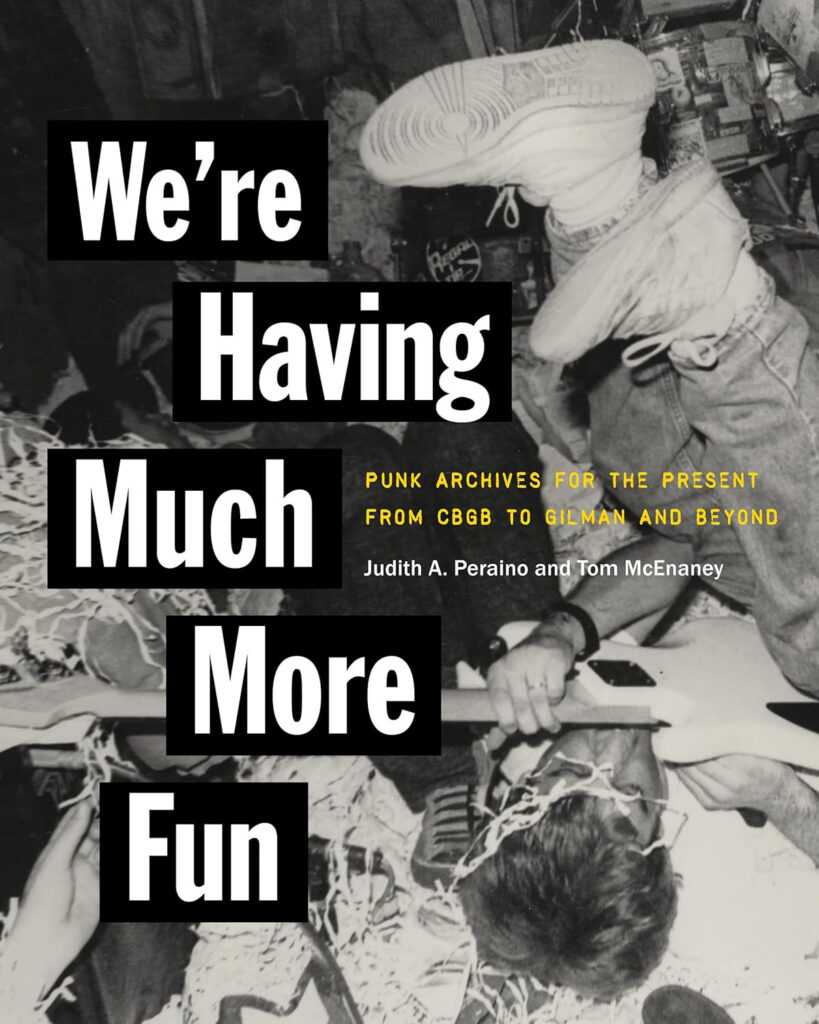 We’re Having Much More Fun is a new book by UC Berkeley Professor Tom McEnaney and Cornell University Professor Judith Peraino.
The volume presents more than 400 objects from the Cornell University punk archives alongside interviews and essays by punk artists, foregrounding the influence of women, queer people and people of color on the movement. It includes a section on Bay Area punk, featuring zines, flyers and photos from iconic local venues including 924 Gilman Street, the Berkeley Aquatic Center and even UC Berkeley’s Sproul Plaza.
In a conversation with UC Berkeley News, Peraino, who received her Ph.D. from the UC Berkeley’s Department of Music, and McEnaney, now an associate professor of comparative literature and of Spanish & Portuguese at Berkeley, spoke about the role of the Free Speech Movement and the wider Bay Area counterculture in shaping the punk movement, the importance of diverse voices in the punk scene and the ongoing power of “misfit collectives.”
Events with the authors and featured guests will be held at Moe’s Books on March 30 at 6 p.m. and at City Lights Books on March 31 at 7 p.m.
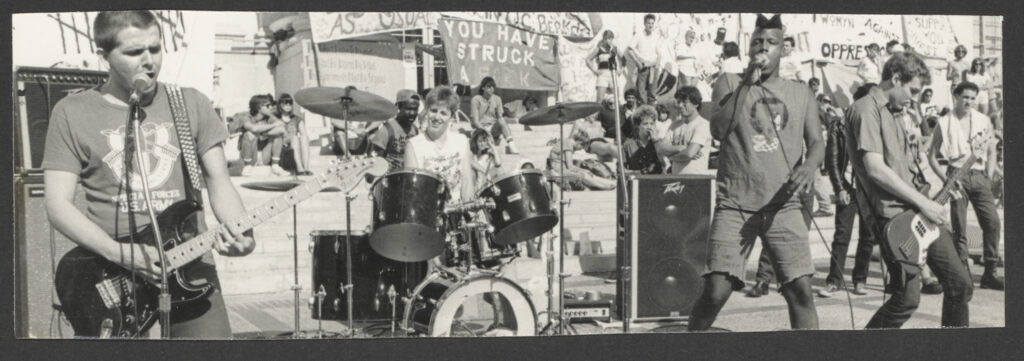 The band Special Forces performs at Biko Plaza, circa 1986. Students temporarily renamed UC Berkeley’s Sproul Plaza in 1985 as part of weekslong protests against the university’s investments in apartheid South Africa.
© Murray Bowles
What motivated you to put together this book?
Judith Peraino: When teaching these courses on punk music, we found that our students were really hungry for different ways to connect with and utilize the tools created by the punk movement.
And, of course, 2016 was the first Trump election. That sent shockwaves through our class. It amplified the politics of the material we were looking at and the tools we were trying to teach them about how to articulate rage, rebellion and resistance. So the inspiration is partly this very cool collection, but partly the fact that we saw with our own eyes — and heard with our ears — punk coming alive in the projects of our students.
We think of this as a primary source book. We wanted to present all these different resources in the form of new interviews, images with substantial captions, and documentation of how you do punk and what it means to do punk for different political moments. That really is what an archive allows for; it allows people to think about history and pull that history into the present.
How do you hope people connect with these materials? What lessons can they bring from learning more about this movement that had its heyday in the 1970s and 1980s?
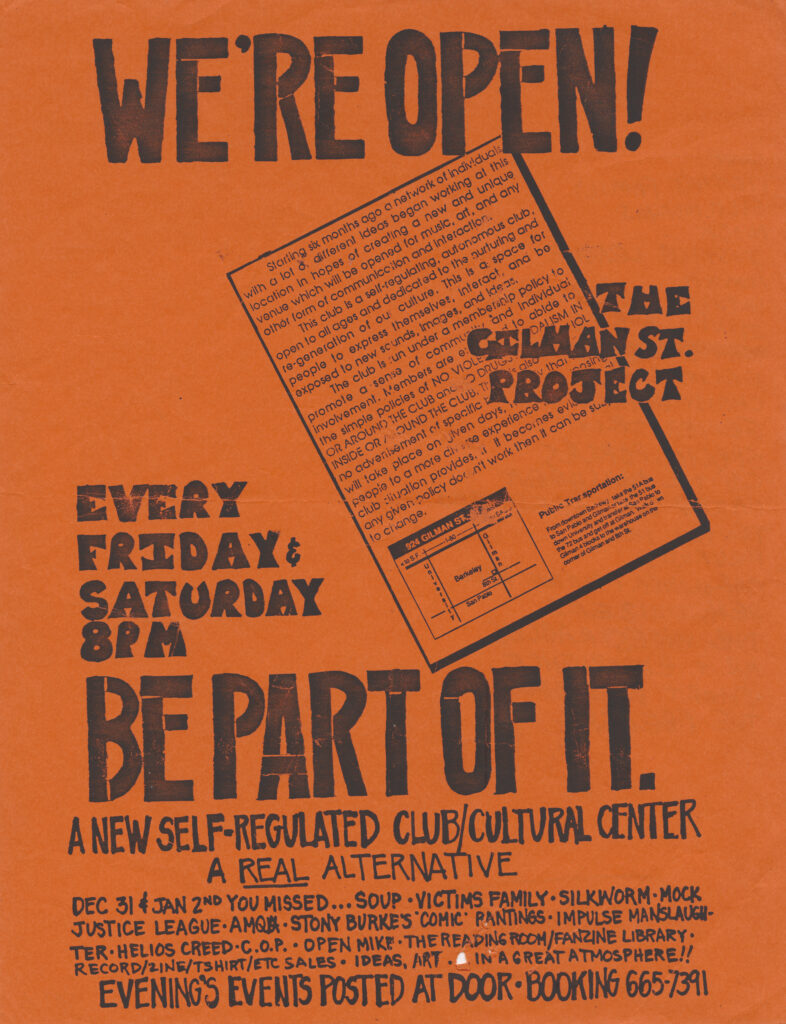 A flyer for the opening of the Gilman Street Project in Berkeley, 1987.
McEnaney: Part of the point of the book is to demonstrate the continuity of punk as a movement. It’s not that punk had a moment in the 1970s and died out, which is one story that gets told again and again. It’s a force, a variety of movements and scenes that are deeply connected to music, but also go beyond it.
In West Oakland, there’s a group called Punks with Lunch that brings food to people, right? In so many different places across the country, people have been and continue to set up alternative social worlds built around punk as the kind of driving force or identity. Gilman is probably the most amazing example of this. We’re approaching the 40-year anniversary of this venue and it’s still going strong.
Another misconception that you tackle in the book is this idea that punk is a genre primarily enjoyed by white cis men. Why was it important to you to highlight the influence of queer people and people of color in the punk movement?
Peraino: That’s why I got into punk. I’m a generation older than Tom, and my punk was the New York punk that was much more queer-oriented. Even Debbie Harry of Blondie modeled her performance on the drag queens that she knew in and around Club 82, La MaMa Experimental Theatre and the Warhol-era Max’s Kansas City. These aren’t marginal identities; these are fundamental, foundational identities to punk rock.
McEnaney: There’s this story that I do hear repeated a lot, which is that punk rock was racially, sexually and demographically diverse in the 1970s, and then hardcore came in and it became white, straight and male. And this book shows that’s absolutely not true, and that there’s a deep diversity that continues throughout the history of punk.
Your book includes a section on the Bay Area punk scene. What makes Bay Area punk unique, and what influence has it had on the rest of the country?
McEnaney: The influence was massive, and the thing that everyone always points out immediately is the politics. The Bay Area scene was drawing on a long history of counterculture and left-wing politics, and it definitely pushed that, especially in the most emblematic bands early on, like the Dead Kennedys, but up through Whipping Boy and Frightwig and Tribe 8. And, more than anything, through MAXIMUM ROCKNROLL and the influence and politics of that magazine.
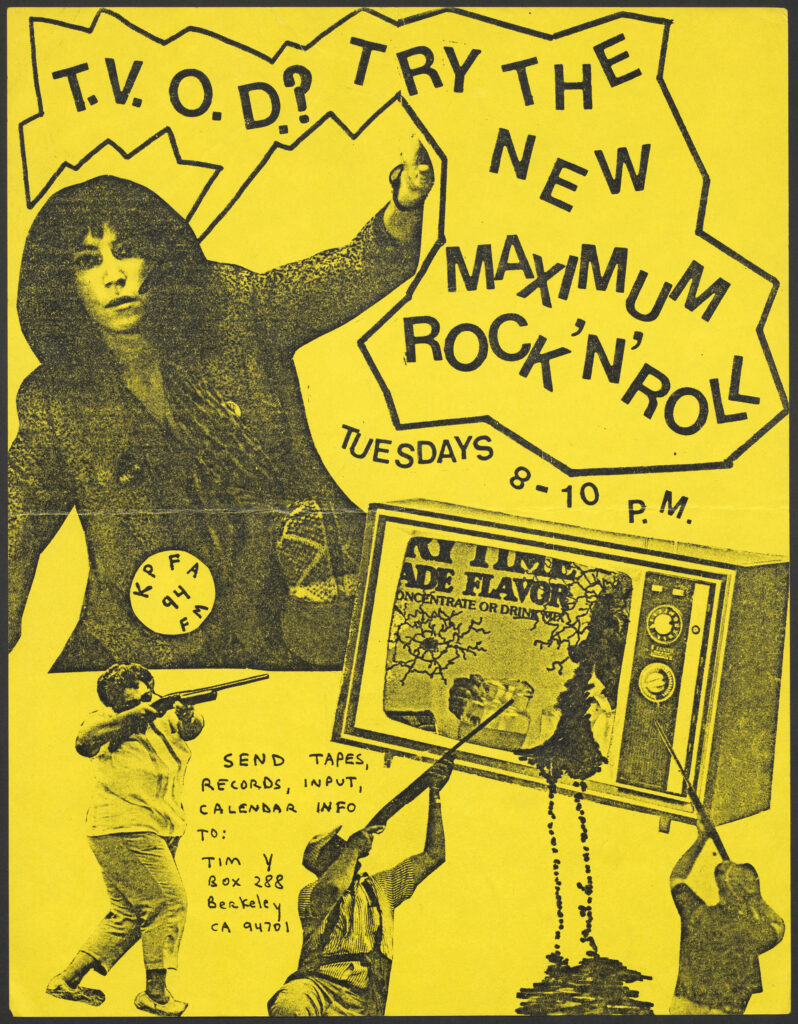 A flyer for Tim Yohannan’s radio show on KPFA, circa 1977.
People elsewhere in the country would push back and make fun of that aspect of the scene sometimes. But for other people, it was a beacon. They would come from all over the country to the Bay Area because of the politics that were represented.
And it was also, very early on, through the ‘80s and the ‘90s and up until today, a super queer scene. The founding of Outpunk was really important, and also collectives like Sister Spit.
Peraino: I think our interview with Fayette Hauser is critical in thinking through how the free speech movement at Berkeley and countercultural politics and lifestyle scene happening in San Francisco in the late 1960s transformed into a punk ethos. Punk often considers itself to be anti-hippie, a wholesale rejection of the 1960s “peace and love” idealism. But what’s beautiful about Fayette’s interview is she really talks through how, no, it’s actually an outgrowth of the counterculture, a fomentation of the alternative lifestyles, identities and anti-authoritarianism of late ‘60s San Francisco, and that becomes relocated and mingles with politics in New York, Seattle and L.A.
The book includes a diversity of materials from the punk archive, including photographs, flyers, zines, business cards and even a hand-drawn board game by the band Blatz. Did the process of assembling these materials change your understanding of punk history or reveal any surprising stories that had been lost?
McEnaney: Two things really jumped out to me. One of the really amazing parts of the Cometbus collection was all this material on Peace Punk that we have, particularly here in the East Bay. The collection showed how the Peace Punk scene drew on longer histories of East Bay counterculture and fused it with anarcho-punk from the UK, and just how important that was.
It was also really amazing to see all these materials from scenes that were less familiar to me, in places like Arkansas, Alaska, Texas and Florida. One person I didn’t know anything about before going through Aaron’s collection and putting the book together was Adee Roberson, who wrote the Finger on the Trigger fanzine which mixes images of abolitionist literature and Black poetry from the 19th century with the punk scene in Pensacola, Florida, in the early 2000s.
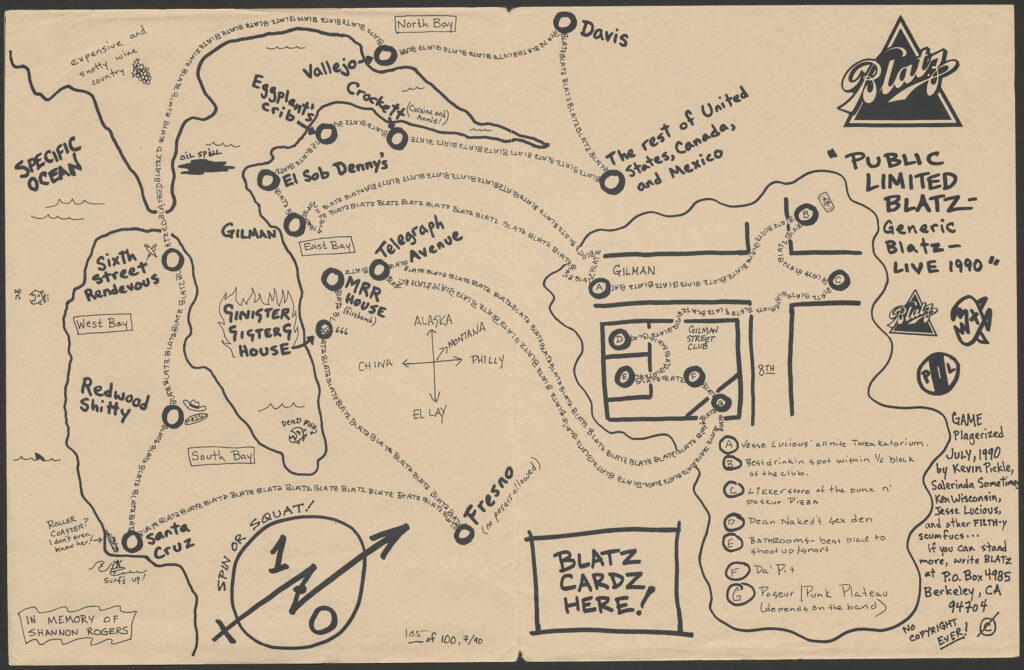 A hand-drawn board game map of the Northern California punk scene, created by the band Blatz in 1990.
Peraino: One of my biggest takeaways from working on the project and getting permissions was the stories that came out. There was a woman who photographed the Minutemen at her local club in Miami Beach, Florida. Her name is Leslie Wimmer, and I found her somehow. I just typed her name and followed those strings and she responded to me and she was so thrilled. And then she just spontaneously gave me a beautiful story of how much it meant for the Minutemen to come and play not one but two nights in this little scene and that she was fortunate enough to have a camera at that moment.
That’s the kind of priceless story that emerged, and I captured as many of them as I could as captions because we want these images to mean something. They’re not just images of the band, but they’re images taken by a fan who was there and that was their point of view. It really brings the photos alive, but it also pays tribute to all these punk fans who have done the legwork.
What do you think punk has to teach us about the value of physical media and in-person interactions in an era when so many of our art and communities are digitized and online?
McEnaney: A point that Aaron often makes, and that a lot of other people have made, is that as much as we talk about punk as a musical movement, music is really only a piece of what makes a punk scene. It’s also hanging out together and people falling in love and writing letters to each other and making patches and putting up flyers and then building punk houses and passing tapes around. Gilman had swap meets for clothes and zines, for instance. The music sometimes is the alibi for these other ways to connect.
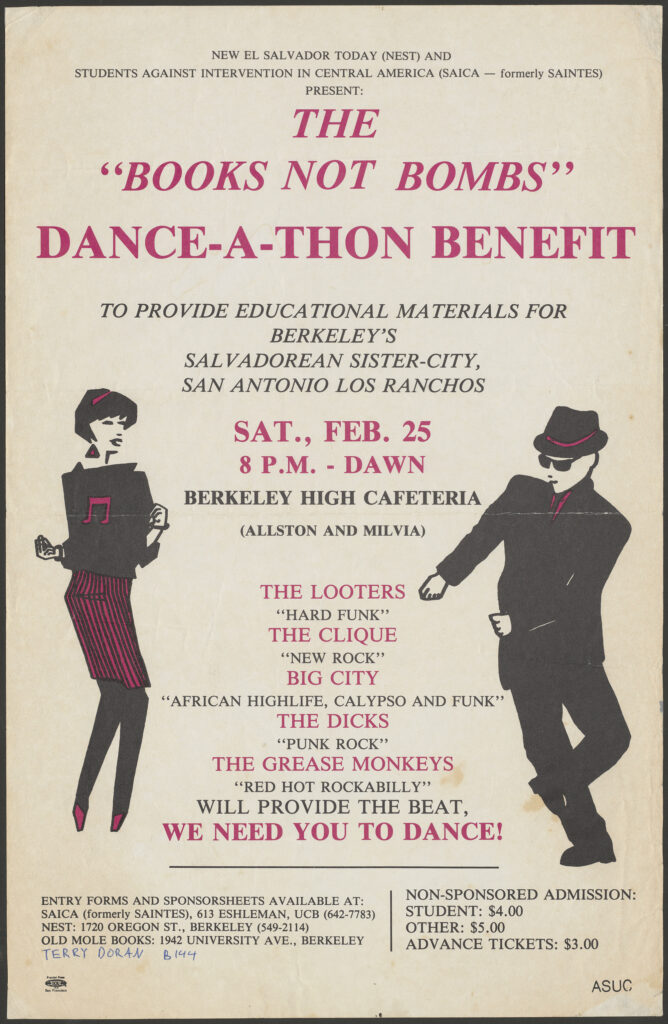 A flyer for a dance-a-thon benefit at Berkeley High School, 1984.
When you go to some stadium show, you go there, you listen to the music and you leave. That’s not what happens when you go to a punk show. You go and listen to a bunch of bands, but you’re also hanging out talking to people. Maybe you read some strange political tract from Ghana and learn about some new band from Milwaukee. That social connection, both in the present with people at the show, but also through the things that you trade and pass around, is so important.
What do you hope people take away from reading this book?
Peraino: We want this to be a road map for people, youngsters and oldsters alike, to feel inspired. Not only to form a band — that’s the classic cliche, and it’s great — but also enabling action and being self-motivated. Let go of your ego and superego and just do it, whether it be hashing out an expressive song or creating an expressive zine.
Suzanne Onodera has a beautiful line in the introduction where she says, “Our bodies were action.” We are action, whether it’s flinging ourselves around in a mosh pit or walking in a protest. That’s one of the key things we wanna try to inspire: Don’t just think about it, get up and do it.
McEnaney: I think that point about action is so central. The whole emphasis is to not wait around for someone else to tell you how to do something or if you can do something, but to make it happen. And not in the DIY cliche of “just do it yourself,” but make it happen with other people and form communities. It’s more about interdependence than it is about independence.
Growing up in the East Bay scene, that’s been the biggest lesson of Gilman. Gilman is about collectivity. It’s not that I’m gonna just do whatever I want and turn my back on the world. It’s about finding that other group of misfits that you can make something with.
This interview has been condensed and edited for clarity.