
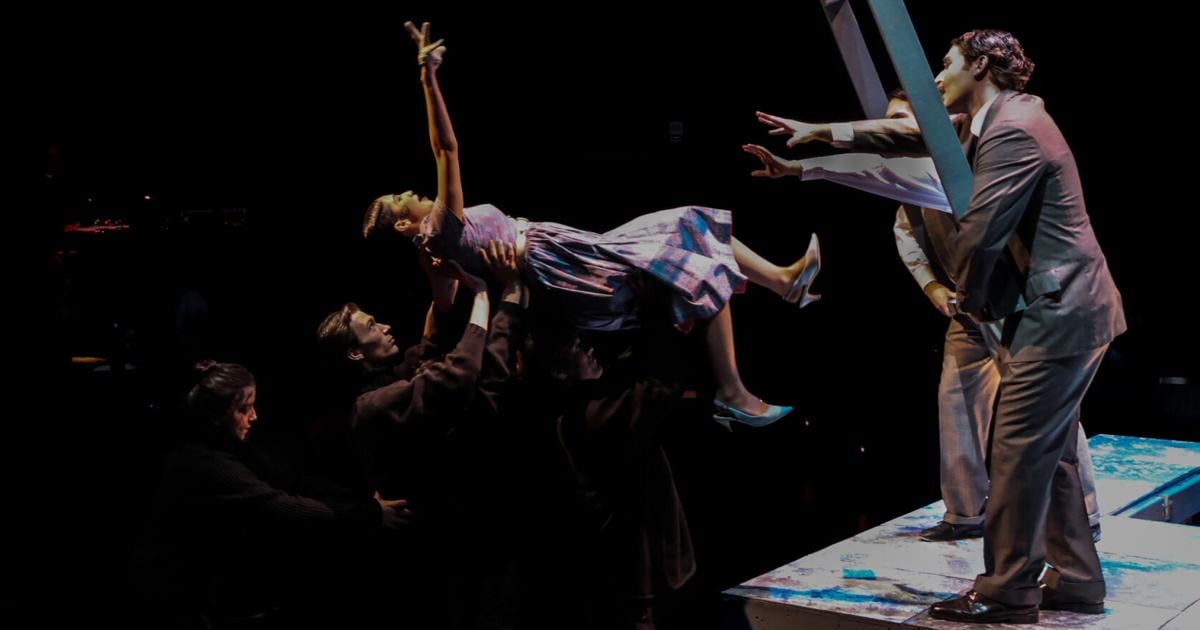
With strategic fourth wall-breaking and humor that connected to the audience amidst deep and sorrowful messaging, the Cal State Fullerton Theatre Department’s production of “Rhinoceros” saw undoubtable success as the audience radiated with an array of emotions Thursday night.
Taking place in the James D. Young Theater, the 1959 absurdist play “Rhinoceros” by Eugène Ionesco takes place in a small French town. Its citizens slowly morph into rhinoceroses throughout the performance as a symbol for the rise of fascism during the time of Nazi infiltration.
The play follows Gabriel Hernandez’s character Berenger, as all of his friends slowly conform to societal norms, eventually leaving him alone, lost and in a state of vulnerability.
Although the messaging of the story has a melancholy tone, there are hilarious comedic elements of dialogue and stage choreography to break the tension and allow for an overall enjoyable viewing experience.
Will Collins, a third-year theater directing major and assistant director of “Rhinoceros,” shared his thoughts after the conclusion of the play while watching from the audience.
“My favorite thing is just literally watching the audience on opening night,” Collins said. “I’ve just been excited for that all week, just to see what we’ve all been caring about and working on for the past, you know over a month; and these actors, most of whom are not a day over 21, they care so much about what they’re doing and to see their work come together is ultimate gratification.”
The most notable and memorable aspects of the production stems from the set design by Fred Kinney, working in tandem with props by Aiden Contreras and lighting by Crystal Shomph.
The set imagery possesses numerous projections, moving pieces and interactive elements that help bring the story together. Along with these elements, they teleport the audience into environments such as Parisian cafes, office buildings and homes.
“The use of the set was pretty insane,” said Abby Shannon, a fourth-year BFA theater major. “Especially at the end with all the set pieces falling off and the use of the ladder, which I was shocked about.”
Close
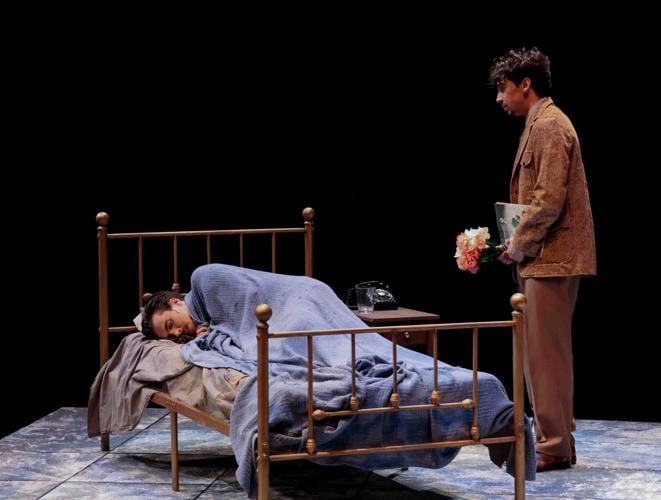
Berenger, played by Gabriel Hernandez, visits a bedridden Jean, played by Leo Van Bindsbergen, to apologize. (Sophie Bright / Daily Titan)
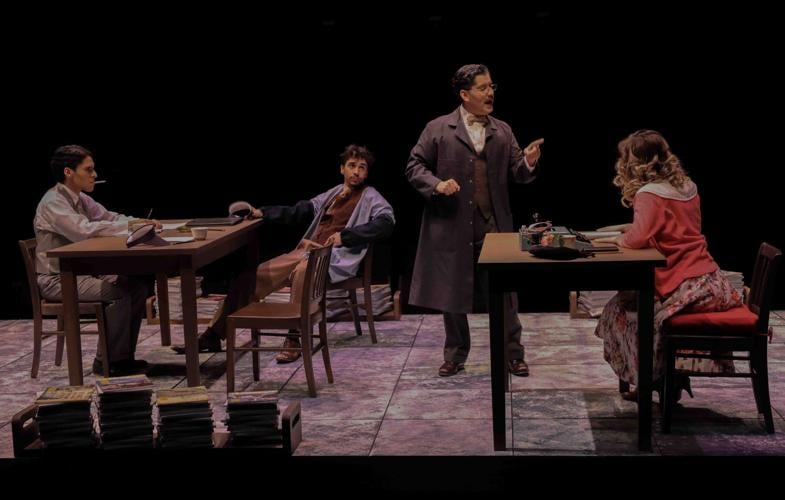
Nathan Camacho as Dudard, Gabriel Hernandez as Berenger, Braden Michael as Botard and Mariia Tumasova as Daisy discuss the rhinoceros problem at work. (Sophie Bright / Daily Titan)
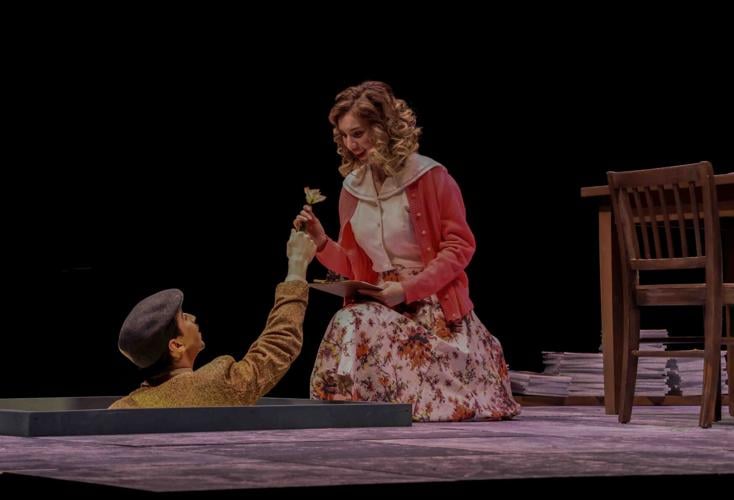
Berenger, played by Gabriel Hernandez, offers Daisy, played by Mariia Tumasova, a rose as he arrives late to work. (Sophie Bright / Daily Titan)
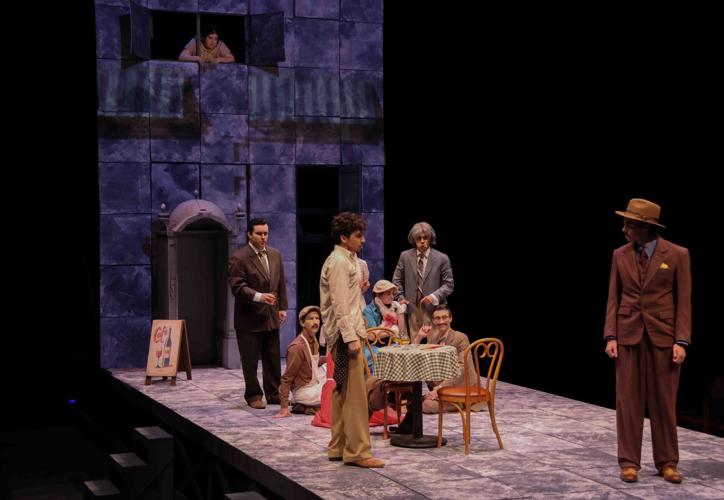
The cast of Act 1 gathers during an argument between Berenger and Jean, played by Gabriel Hernandez and Leo Van Bindsbergen. (Sophie Bright / Daily Titan)
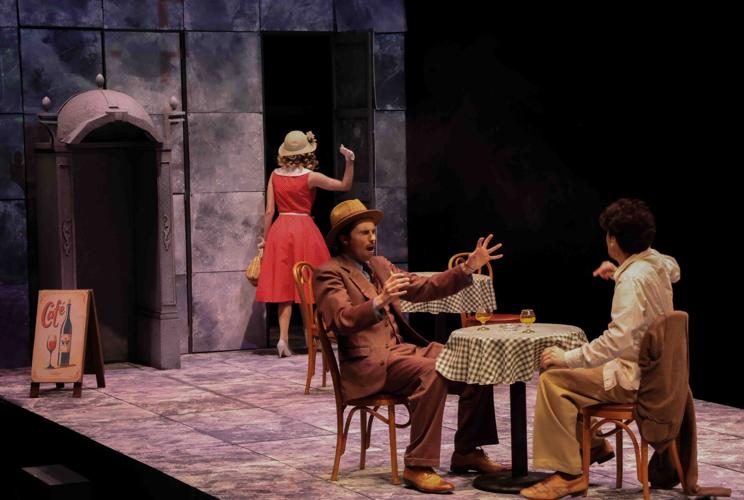
Gabriel Hernandez as Berenger expresses shock to Leo Van Bindsbergen’s character Jean about the appearance of Daisy, played by Mariia Tumasova. (Sophie Bright / Daily Titan)
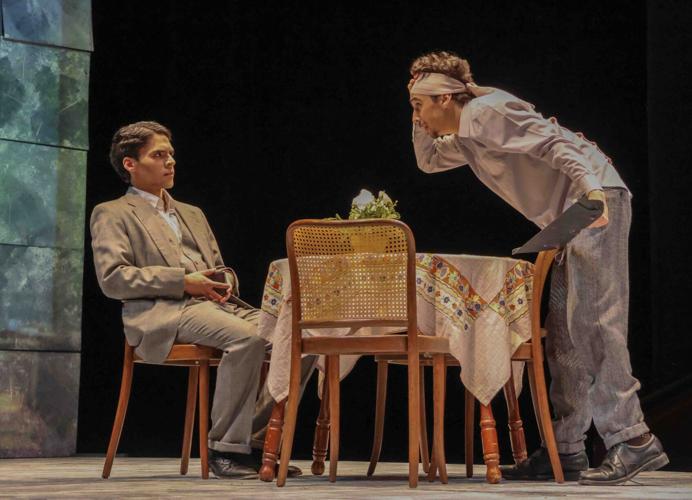
A paranoid Berenger, played by Gabriel Hernandez confides in Dudard, played by Nathan Camacho, to check on his wellness. (Sophie Bright / Daily Titan)
Berenger, played by Gabriel Hernandez, visits a bedridden Jean, played by Leo Van Bindsbergen, to apologize. (Sophie Bright / Daily Titan)
Nathan Camacho as Dudard, Gabriel Hernandez as Berenger, Braden Michael as Botard and Mariia Tumasova as Daisy discuss the rhinoceros problem at work. (Sophie Bright / Daily Titan)
Berenger, played by Gabriel Hernandez, offers Daisy, played by Mariia Tumasova, a rose as he arrives late to work. (Sophie Bright / Daily Titan)
The cast of Act 1 gathers during an argument between Berenger and Jean, played by Gabriel Hernandez and Leo Van Bindsbergen. (Sophie Bright / Daily Titan)
Gabriel Hernandez as Berenger expresses shock to Leo Van Bindsbergen’s character Jean about the appearance of Daisy, played by Mariia Tumasova. (Sophie Bright / Daily Titan)
A paranoid Berenger, played by Gabriel Hernandez confides in Dudard, played by Nathan Camacho, to check on his wellness. (Sophie Bright / Daily Titan)
The back wall of the set is covered in tiles that, at the conclusion of the play, begin to fall off as a representation of Berenger’s breakdown as he is the only human left remaining.
Other interactive elements that take place in Act 2 include manipulations of point of view and perspective as characters in the office use a square frame to appear as though the audience is looking from below the set.
Equally as notable as the set design is the costume design and makeup elements that are attributed to Dianne Graebner and Kieran Tierney. They are responsible for managing the transformation of Leo Van Bindsbergen’s character Jean, as he morphs into a rhinoceros in Act 3.
As to not spoil the main imagery of the production, pictures of the rhinoceros are being withheld until the closing of the play. However, depictions such as the Hulk transforming can allude to what audiences can expect to see as the rhinoceros takes the stage.
“I think it was wonderful. I think all the hard work of the actors and the design team really came together and was able to tell the story for an audience for the first time,” Collins said. “I think that paid off in people being affected by the story and seeing all those elements come together.”
The play’s themes hold current messagings, as many of the aspects explored in 1959 hold true to elements that can be seen in politics in the United States and around the world now.
By bringing “Rhinoceros” to the broader CSUF population, the play not only provides the audience with evening entertainment coupled with extravagant acting, but also delivers strong and important messaging that relates to current societal issues.
“Rhinoceros” will continue to run until March 28. Details of ticket pricing, times and dates can be found on the Clayes Performing Arts Center website.