
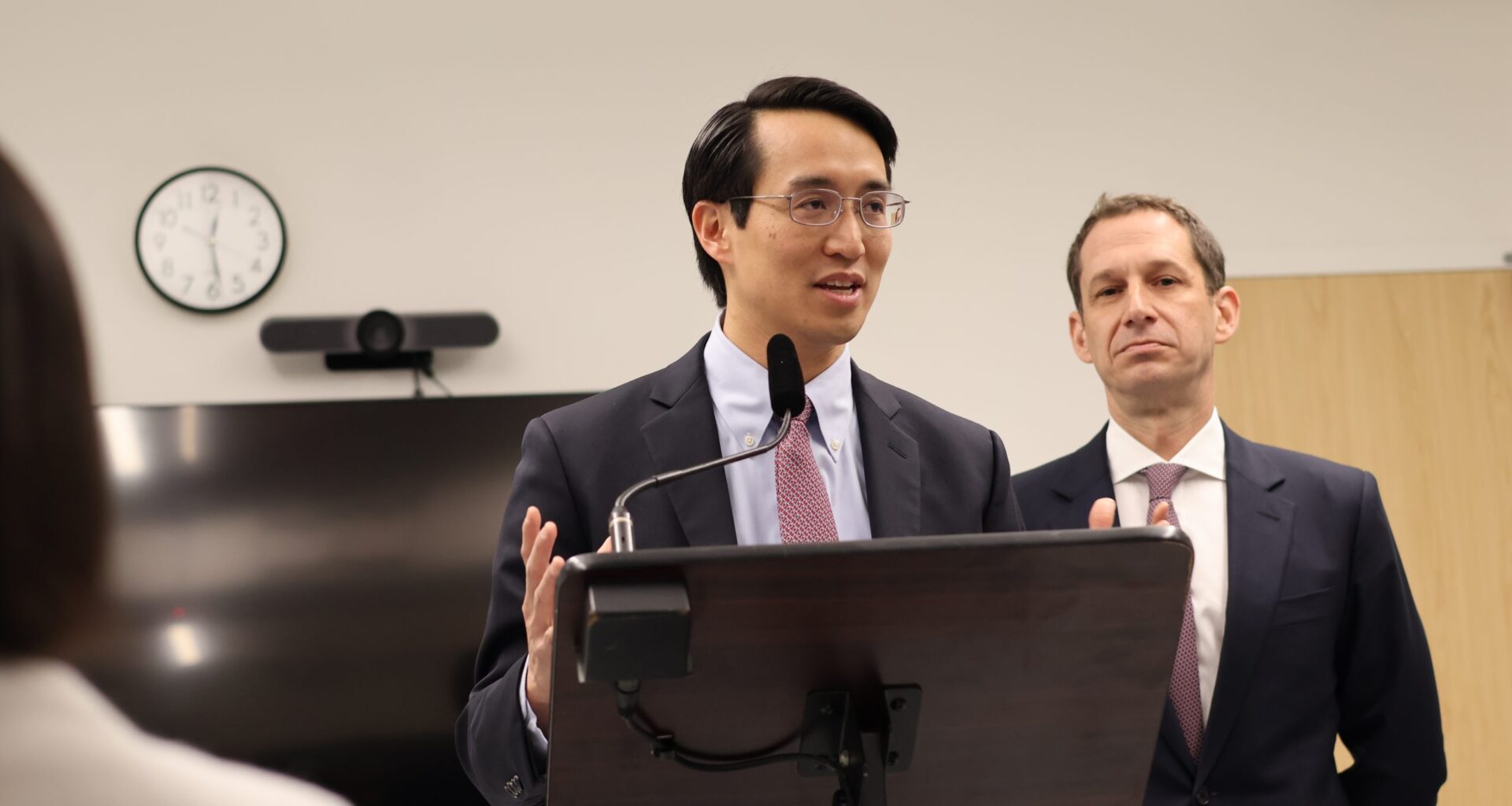
Department of Public Health director Daniel Tsai told staff at San Francisco General Hospital in a private meeting last week that inadequate protocols led to the recent stabbing of a social worker in a clinic hallway, Mission Local has learned.
Tsai said a “root cause analysis” also confirmed that clinic workers intervened to stop the attack — directly contradicting early claims made by the sheriff’s union that a deputy had done so.
While previous statements by DPH in the aftermath of the December killing indicated a need to improve policies, workers saw the meeting as the first time the department has appeared to take responsibility for the incident.
At the March 16 meeting with staff, Tsai and other officials presented initial findings from a “root cause analysis,” and outlined multiple ways that insufficient protocols led to the fatal attack at the Ward 86 HIV clinic.
Social worker Alberto Rangel was at Ward 86 the afternoon of Dec. 4 when a patient, Wilfredo Tortolero Arriechi, arrived with a knife. Wilfredo Tortolero Arriechi, 35, had allegedly threatened his doctor at Ward 86, and the day of the stabbing, DPH had requested additional security, which arrived in the form of a sheriff’s deputy who began shadowing the doctor.
But when Tortolero Arriechi arrived, no one was monitoring the elevator entrance to the clinic. He entered the clinic and began stabbing Rangel in the middle of the hallway. Rangel died two days later.
Tsai noted a “lack of a sufficiently robust, consistent, see-the-whole-picture, make a threat evaluation.”
“Even once a threat was identified,” Tsai said at the meeting, there was a lack of protocol around “what exactly is supposed to happen and what everyone is supposed to do.” Communication back to staff who raised concerns was also lacking, he said.
There “should have” been a protocol, Tsai added, assessing entry and exits to Buildings 80-90 where Ward 86 is located as well as to the ward’s entrance on the sixth floor. Hospital leadership also should have considered where the sheriff’s deputy would be most effectively stationed, he said.
Tsai said that DPH’s head of security and the sheriff’s office had done an “assessment of priors” for Tortolero Arriechi and, finding “no priors,” determined that deploying a single deputy would suffice.
Mission Local revealed that Tortolero Arriechi’s social media, for weeks prior to the stabbing, showed a man who was mentally unstable. He made incoherent rants, rehearsed confronting his doctor on video, and even posted a photo of a kitchen knife stabbed through one of the summaries of a Ward 86 clinic visit.
Staff at Ward 86 had repeatedly told hospital leadership in the weeks leading up to the stabbing that they felt unsafe around Tortolero Arriechi.
Tsai said that increased staffing for threat assessments are now in place.
“We have substantially increased the staffing for threat escalation so that if it’s an emergency, there’s a very clear response time,” Tsai told staff at the meeting. He noted a single phone number was now available to call in other cases, and acknowledged “specific instances” when that call process had failed.
A source who attended the meeting said Tsai acknowledged that response time was another issue. The source said Tsai acknowledged that medics didn’t arrive for nearly 15 minutes, despite the stabbing taking place on the campus of the city’s main trauma center.
Conflicting narratives
Tsai reassured Ward 86 staff that the “root cause analysis,” confirmed their version of events — that clinic workers intervened in the attack and did first aid.
In the days after the stabbing, the sheriff’s union had put out a statement — since deleted — claiming that the deputy on site had stopped the attack and “likely” prevented a “mass casualty stabbing.” The statement, posted on Dec. 9, said that the “deputy responded, intervened to stop the attack, helped secure the individual, and allowed medical staff to begin lifesaving care.”
“If the assailant had been able to move freely down the hallway, we could be talking about multiple staff and patients stabbed,” sheriff’s union then-president Ken Lomba added at the time.
Tsai said that it was staff, not the deputy, who responded first.
“The first responders to actually intervene and pull the assailant off Alberto was Ward 86 staff,” Tsai told staff at the meeting. “The things that you have said are well documented and also corroborated with multiple primary sources and not just interviews, but bodycam footage and detailed call timestamps.”
Mission Local first reported an eyewitness account from a Ward 86 worker who separated Tortolero Arriechi from Rangel, while the deputy was seen nearby petting a dog. Multiple witnesses said Tortolero Arriechi stood still and did not move after staff pulled him off Rangel and began trying to save Rangel’s life.
The deputy was described by clinic staff as moving to apprehend Tortolero Arriechi “several minutes” later.
“Staff had to repeatedly direct the deputy to remove the attacker from the scene,” read a January statement from Ward 86 workers outlining the attack and inconsistencies, and demanding public acknowledgement of the inaccuracy and an apology from the sheriff’s department.
In the days after the stabbing, Tsai announced that DPH would contract with a third-party security firm to review the circumstances that led to the incident. It is unclear whether that review is complete or separate from the review presented to staff last week.
An inspection by the California Department of Public Health found last month that the hospital had “no deficiencies” with respect to state and federal requirements, though it also stated that the inspection did not include a “full inspection of the facility.”
Staff have raised safety concerns at the hospital for years. UPTE, the union representing workers at the hospital and in the UC system, found in a survey about outpatient behavioral health settings that 90 percent of workers experienced “some type of threat, assault, or intimidation.”
Over 80 percent reported feeling “unsafe at work from at least once a month to every day.”