
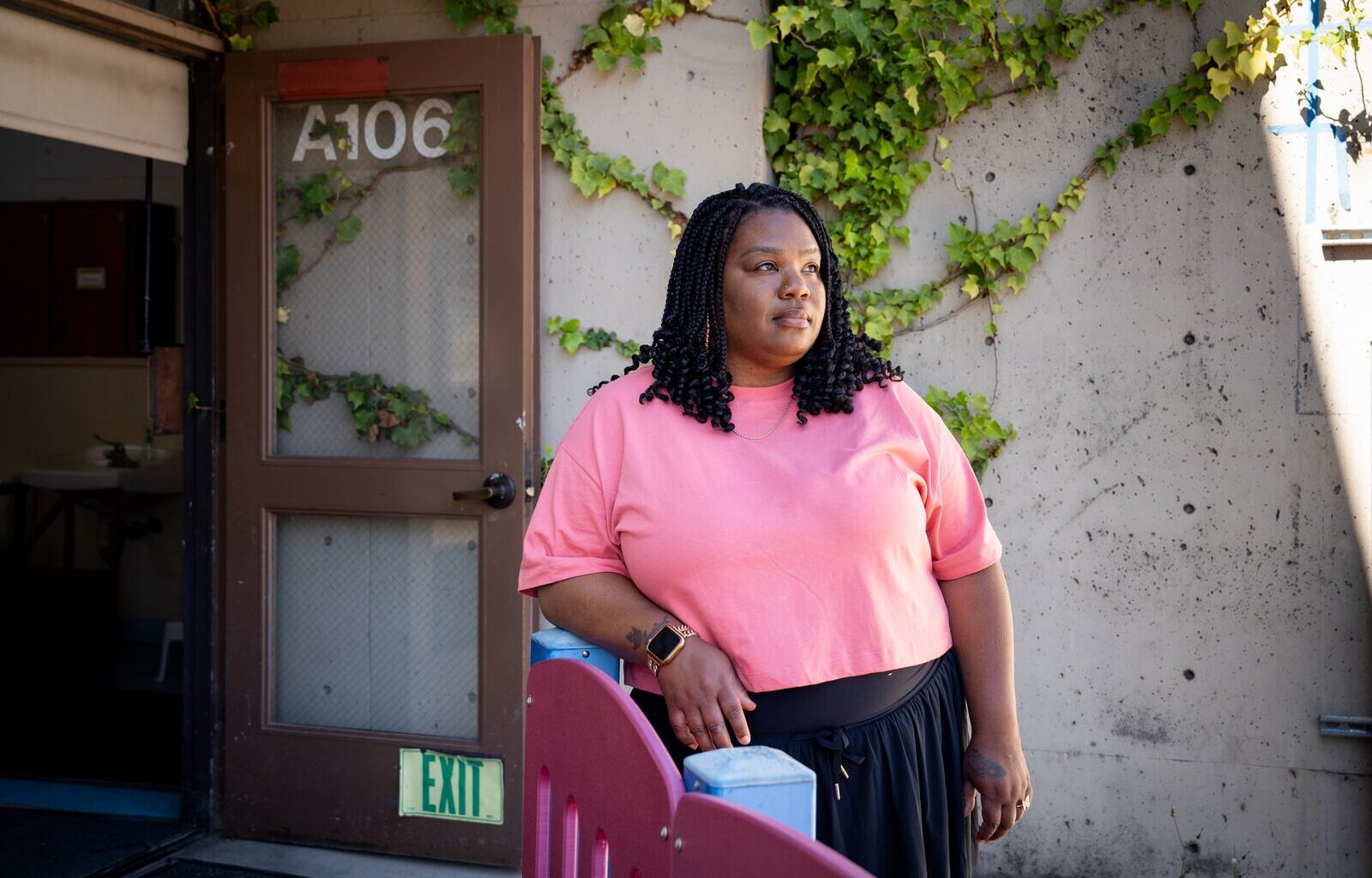
The preschool at Merritt College, in the Oakland Hills, occupies what was once the school’s auto shop, a hulking but light-filled structure on the south end of campus. The classroom opens into an outdoor play space where, on a bright winter day, one boy is attempting to water the plants, drenching his pants, while a group of children on tricycles spin wobbly circles on the asphalt. In the middle of the action stands Marquitta Eddings, a 42-year-old student with two kids of her own. “You were riding really fast,” she calls to a boy who has come to an abrupt halt. He looks up at Eddings, smiles, and zooms off.
Eddings is among a group of student teachers completing a preschool practicum, the capstone course for an associate’s degree at Merritt in child development. In May, if all goes as planned, she will walk across the stage at Oakland’s Paramount Theater with her fellow graduates. After that, who knows? On good days she can picture herself transferring to Cal State East Bay, in Hayward, earning her bachelor’s and then pulling in a middle-class salary as a teacher or case worker. “I’d like to maybe work with new moms,” she says. “That was something I never had.”
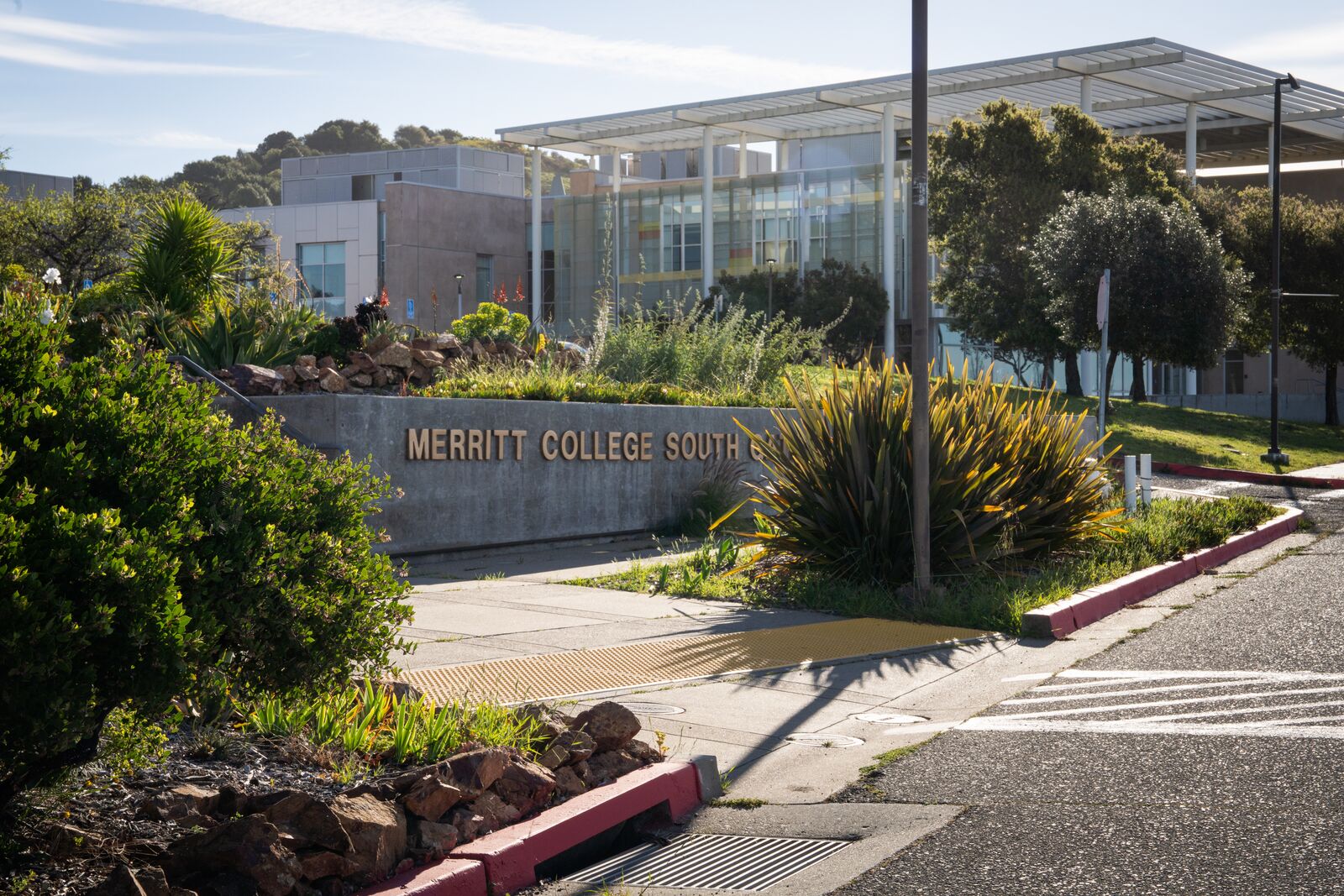 Merritt College, in the Oakland hills. Credit: Sarahbeth Maney for The Oaklandside
Right now, though, it’s hard to think too far into the future. As she keeps an eye on the kids, she is worried about her own son. Josiah, her eldest, is 21, autistic, and lives at home. After months of looking, Eddings finally connected him to a disability employment service that had an opening for a dish washer. The job begins tomorrow, and he’s been calling all morning in a panic. “The company sent him documents he can’t fill out, with information he can’t process, and to a place he can’t get to,” she says.
During a break Eddings receives a call from her son’s caseworker at the Regional Center of the East Bay, a nonprofit that contracts with the state to provide services to people with developmental disabilities. She had heard the center offered free Uber rides for clients, which she hoped would be a way to get Josiah to the job site, located on Coast Guard Island. It turns out they only reimburse rides after the fact. “I have no money,” she tells the caseworker. “I’ve been unemployed for 18 months — what money am I gonna find to give him a ride?”
After the call, Eddings looks deflated. “Part of having an adult child that is autistic is —” she stops to wipe away tears. “He has an independent living skills worker, but he can’t come until later, ‘cause he’s got another job, since nowadays people need three jobs to survive. I’m in this place where I feel like I gotta quit doing what I’m doing so that I can do what he needs. But I’m tired of doing that. If I say I’m tired of doing that, does it make me a bad mom? He’s blowing my phone up and I’m here trying to start a new career.”
 Eddings and her daughter Malini Savoy, 14, prepare food before school drop-off at their home in Oakland. Credit: Sarahbeth Maney for The Oaklandside
 Eddings marks her community college graduation date on a calendar. Credit: Sarahbeth Maney for The Oaklandside
For Eddings, this inner turmoil is familiar. For a long time, she’s felt the pull of hope, the yearning to secure a more stable future for herself, Josiah, and her 14-year-old daughter, Malini. And then the anxiety pushes in, the fear that if she doesn’t step back their lives might unravel completely. These conflicts underscore a central challenge facing community colleges.
They can be powerful engines of social mobility, affordable bridges to four-year colleges or vocational programs that lead to living wages. In a city like Oakland, with its stark racial, educational, and economic disparities, community college has the potential to transform the lives of students like Eddings, who often arrive facing significant hurdles on their path to a degree, like being single parents, first generation college students, or already juggling full-time work.
Never miss a story. Sign up for The Oaklandside’s free daily newsletter.
But in a city like Oakland — where a high cost of living coexists with high poverty rates — can students like Eddings manage to make it through?
 Eddings arrives at Merritt College for her Child Development Lab practicum course. Credit: Sarahbeth Maney for The Oaklandside
Community colleges don’t receive the attention elite universities do, but their footprint is vast, particularly in California, where a system of 116 community colleges serves 2.2 million students.
Merritt, in the Oakland Hills, is part of the Peralta Community College District, along with Laney College in downtown Oakland, Berkeley City College, and the College of Alameda. The district’s student body of more than 21,000 is as diverse as the East Bay. One in four students is 35 or older. Asians, African Americans, and whites each make up about 20% of the population. Latinos make up nearly one-third.
Students tend to carve their own paths: the caretaker training to become a carpenter, the former music executive turned landscape architect, the daughter of Latino immigrants who transferred to the University of California at Berkeley. Most students, like Eddings, are female (55%) and attend part-time (74%).
Nisalda Gonzalez, 36, has spent more than two decades as a caregiver, mostly as a nanny, while taking other gigs to get by. “I’m working three jobs, all the time,” she says, seated at a table at Laney College. Now she’s on her way towards a two-year advanced carpentry certification. On the lawn nearby, her class is learning how to lay out a foundation. “I’ve always loved working with my hands, and I’m looking for something that brings stability,” she says. “And I learned it was only 3% women in construction — I thought it was higher! I’m like, ‘Put me in, coach.’”
Oakland resident Minerva Ramirez began at the College of Alameda and graduated from UC Berkeley in December 2025, becoming the first in her family to earn a bachelor’s degree. The 23-year-old now does fundraising and communications for St. Vincent de Paul of Alameda County, the largest emergency shelter in the county, which serves more than 600 hot meals a day. “I volunteered at nonprofits throughout high school and college,” she says. “I really enjoy the work because I get to see the results every time I come into the office.”
After many years in the music industry, Alexis Davis Millar, like Gonzalez, came to community college in pursuit of a new career. The 60-year-old earned her associate degree in landscape architecture from Merritt in 2016. Merritt is one of only two community colleges in the state that offer the two-year degree. Most other pathways to becoming a licensed landscape architect require a bachelor’s degree in the subject. Millar says she needed to continue working full-time as she studied, and Merritt was both affordable and flexible enough to make that feasible. “Merritt does a great job of making it accessible.” Millar now runs her own firm in El Cerrito.
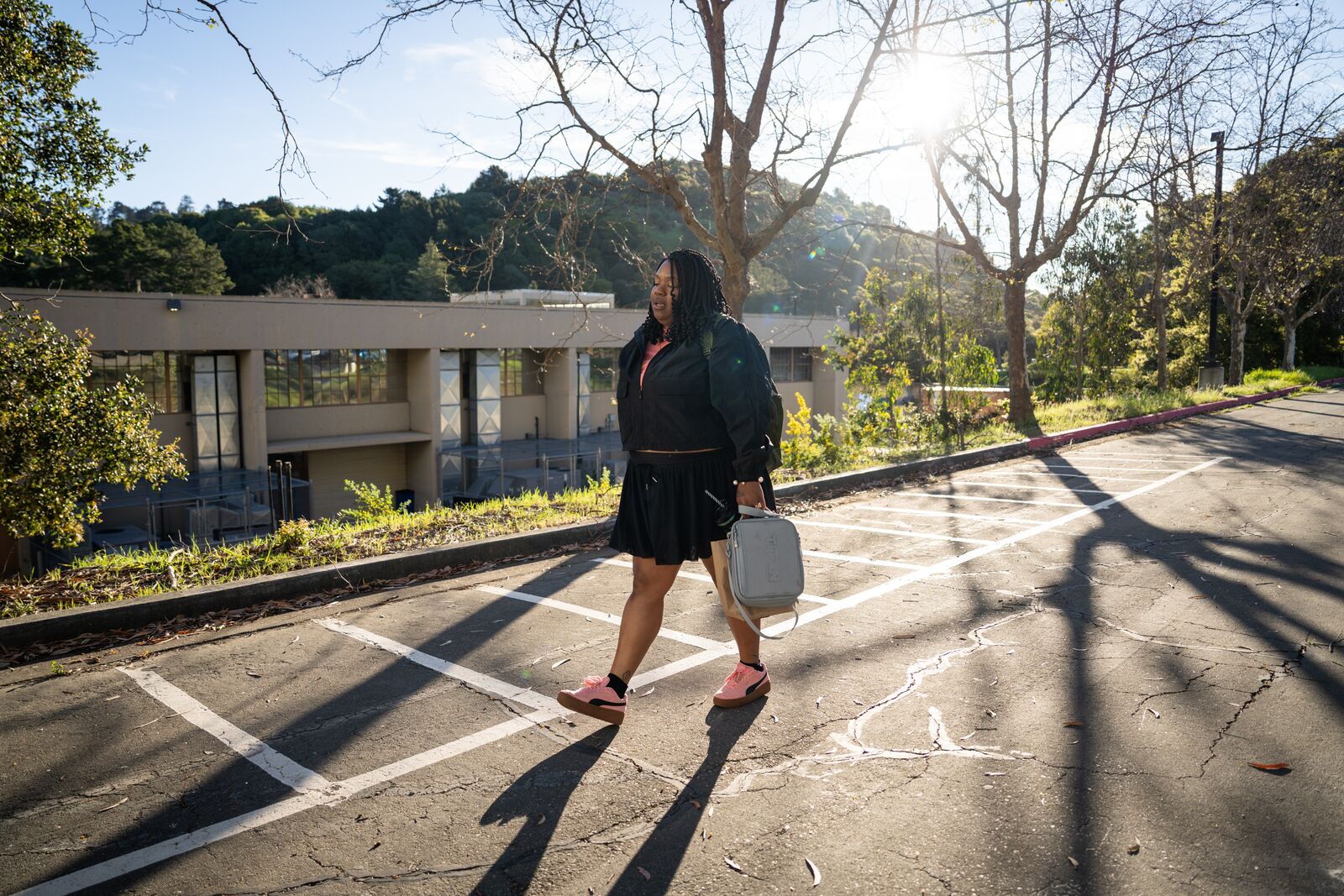 Eddings walks to Merritt College’s Child Development Lab. Credit: Sarahbeth Maney for The Oaklandside
For the past three years, Tammeil Gilkerson has been the chancellor of the Peralta district. From 2017 to 2020 she served as the president of Laney College, which was where she really got to know the community college student population, and noticed how many were struggling. “We started to see high levels of students living in their cars, students who said they couldn’t get access to stable meals,” she told the Oaklandside recently, seated at a conference table at district headquarters, across the street from Laney. As she had conversations with other community college presidents across the state, she learned they were seeing similar trends.
In 2017, the California Community Colleges chancellor’s office surveyed administrators, faculty, and staff from 105 campuses, asking how often they interacted with students facing housing and food insecurity. More than half said such interactions occurred several times a week or daily. In 2018, Gilkerson joined a newly createdstatewide taskforce that has conducted surveys on the wellbeing of community college students, which found that many were barely able to meet their basic needs. One report released in March 2019 found 50% of the state’s community college students reporting food insecurity and 60% reporting housing insecurity.
Spurred in part by these findings, the California legislature passed a law in 2021 that allocated $100 million to establish and support “basic needs centers” on each campus, where students can receive food, clothing, healthcare, assistance with transportation, and referrals for other services. The most recent of the taskforce’s surveys, released in 2025, included responses from 77,000 students across 102 colleges. It found that the needle has barely moved, with 46% reporting food insecurity and 58% reporting housing insecurity, including 20% who had experienced homelessness in the past year. Gilkerson, who now chairs the taskforce, said that Oakland students reported even higher levels of insecurity.
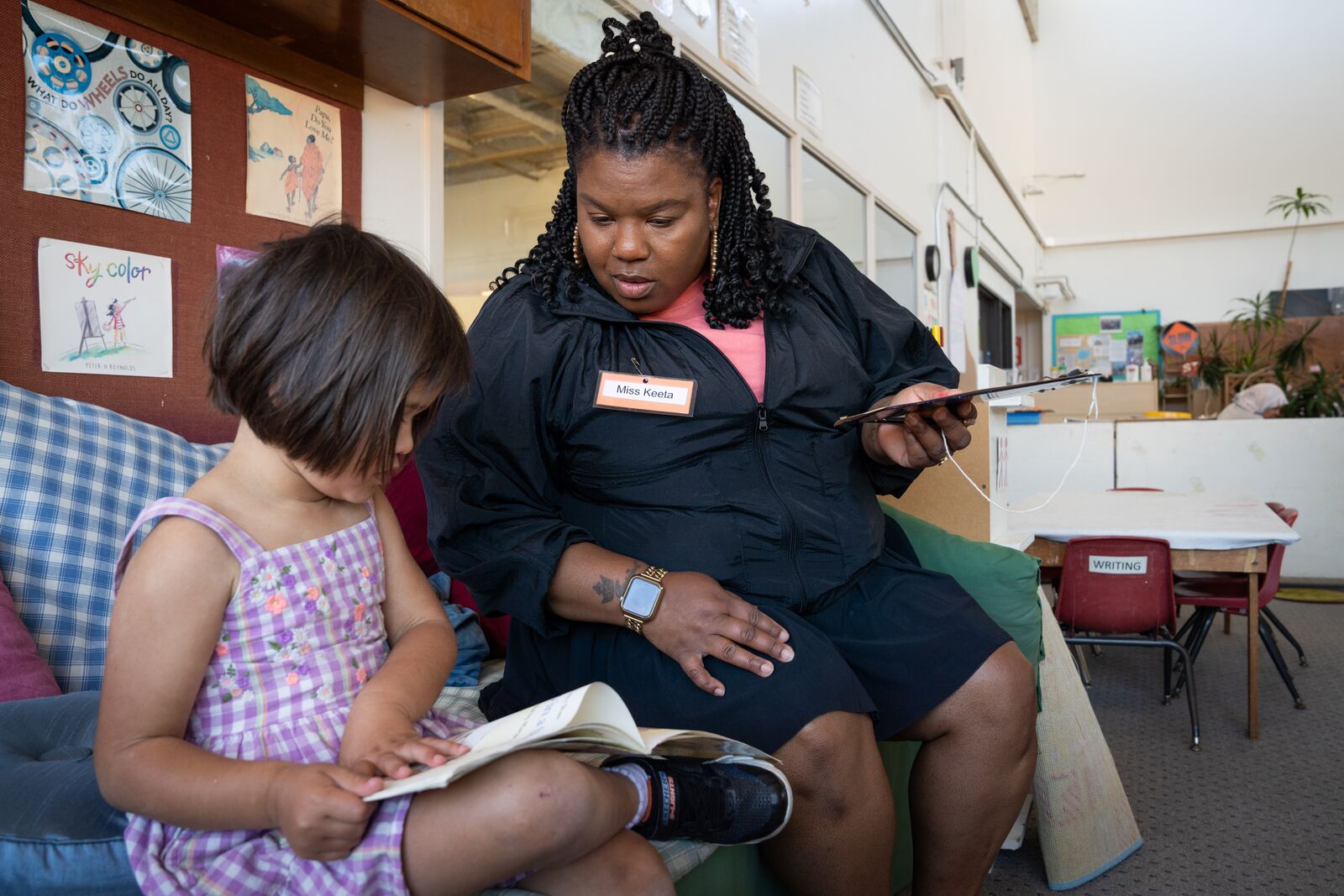 Eddings assists a child with reading while writing a report during her practicum course. Credit: Sarahbeth Maney for The Oaklandside
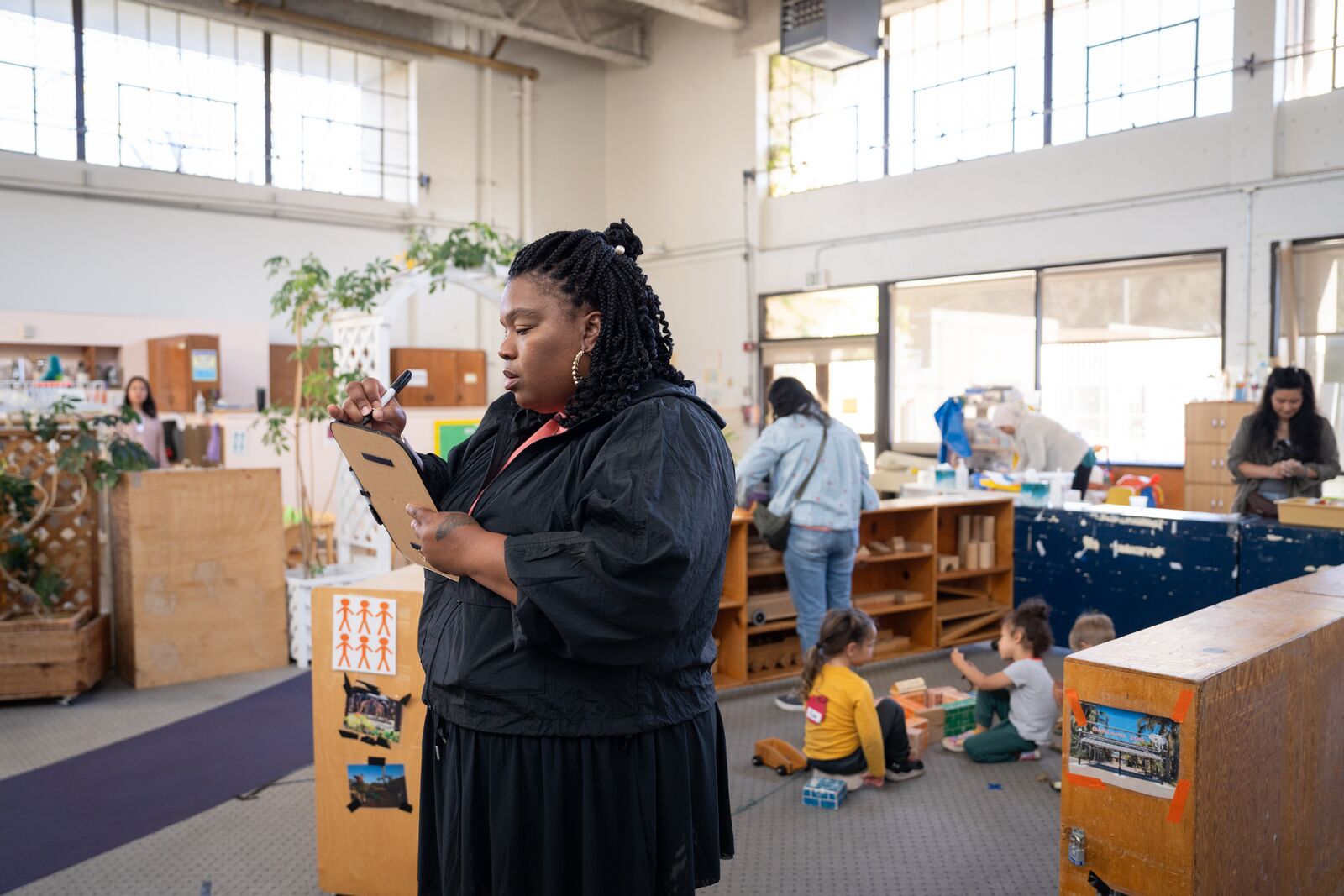 Eddings reviews her checklist while working as a classroom floater during her practicum. Credit: Sarahbeth Maney for The Oaklandside
“It’s a throughline for humans: you can’t learn if you don’t have stability,” she said.
One key metric for community colleges is called the “persistence rate”: the percentage of students, excluding those who earn a degree or transfer to a four-year college, who continue their education. In the Peralta district, nearly two-thirds of students tend to stick it out. For example, 62.9% of students who were enrolled in at least one class in fall 2024 were enrolled again in spring 2025. Over the past few years, Peralta’s persistence rate has been about 5% lower than the statewide average.
Each year, California’s community colleges serve as a pipeline to four-year universities for tens of thousands of students, many of whom would otherwise never be able to attend. More than half of the students who graduate from the state’s 23 California State Universities began at community college, along with nearly 3 in 10 graduates of University of California campuses.
Students who earn an associate degree but don’t continue to a four-year college still earn about $11,300 more a year than those with only a high school diploma. And in a time of skyrocketing college tuition, the average tuition for a full schedule at a California community college is just $1,390 a year. Many students, like Eddings, receive financial aid and pay far less.
 Eddings works on a lesson plan and reflection assignment during the practicum. Credit: Sarahbeth Maney for The Oaklanside
Opportunity Insights, a nonpartisan organization based at Harvard University, has compiled extensive data on social mobility based on millions of anonymous tax records, looking at the financial health of 35-year-olds, which is the age when relative income tends to stabilize, and unpacking how they got there. The data includes a social mobility index for colleges, which explores how successful they are over time at boosting the incomes of students from poor families. Of students at Peralta’s four campuses who were born in 1988, about 1 in 8, or 12%, came from families in the bottom fifth of income nationally and jumped to the top fifth as adults. That kind of radical economic mobility is far less common than it used to be in the United States, the Harvard researchers have found, and puts Peralta in line with other community colleges nationwide.
Opportunity Insights has more extensive information on Cal State University, East Bay, one of the colleges students frequently transfer to from the Peralta district — and the place where Eddings hopes to earn her bachelor’s degree. Cal State East Bay is among the top 7% of colleges nationwide in terms of economic mobility. Poor students there — those raised in families in the bottom fifth of household income — have a 44% chance of earning incomes in the top fifth as adults. The campus also attracts a large number of students from low-income families, putting Cal State East Bay in the top quarter of all US colleges in Opportunity Insight’s “overall mobility index.” (By contrast, 54% of poor students at Cal Poly San Luis Obispo become rich adults, but Cal Poly’s percentage of poor students is only 3.1%, compared to Cal State East Bay’s 12%.)
For these reasons, Gilkerson views community colleges as frontline institutions for social mobility. “Students will get through our doors and transfer to a CSU or UC, but it can take them quite a while,” she said. “We are the access point. We’re not only a first chance for a lot of people, but a second chance.”
But Gilkerson says the bare bones funding for community colleges can make it difficult to meet the needs of a student body whose educational journeys often face roadblocks. Most of the funding for community colleges comes from the state. This year, per pupil funding for community college students in California was $11,923. That compares to $22,991 for CSU students and $37,475 for UC students.
“A fundamental issue for me is that we are underfunded as the largest pathway to careers and education while serving the most fragile but resilient and under-resourced students,” she said.
Eddings’ community college journey began 21 years ago, when she was pregnant with Josiah. She signed up for a child development class at Los Medanos College, in Pittsburg, hoping to learn more about parenting.
Eddings was born in Oakland. When she was three, her mother was murdered, and she was mostly raised by an aunt; she grew up in Oakland and San Leandro before moving to Antioch when she was 12. After graduating from high school, she was working at Safeway when she got pregnant. “I had no real parents to show me what to do, or any guidance,” she said. “So why not take some classes?”
Her son didn’t start speaking until he was four and found it nearly impossible to sit still. In kindergarten he was diagnosed with ADHD; later that year he was expelled. As a young Black single mother, Eddings felt the weight of judgments being passed. That mom must be doing something wrong. Of course her kid is causing trouble, without a father in the picture.
 A photograph of Eddings with her son Josiah Eddings, 21, left, and Marquitta’s cousin hangs above Josiah’s honor roll certificate at their home in Oakland. Credit: Sarabeth Maney for The Oaklandside
Eddings moved back to Oakland when Josiah began first grade, at Martin Luther King Elementary in West Oakland. She volunteered at the school, and the next year began working for the school district with children in special education as a substitute para-educator, which she did for six years, earning the minimum wage, then $9 an hour. For the next six years, she was an employee of the Alameda Unified School District, where she worked as a student support provider; Eddings had followed Josiah to the district, whom she had transferred because she felt dissatisfied with the services he had received in Oakland.
“It was so hard to get people to believe that something was wrong, that he needed more help,” she said. The breakthrough occurred when she finally switched pediatricians; the new doctor listened to Eddings’ descriptions of how her son behaved and agreed that Josiah needed more support. The doctor referred Josiah to a specialist, who referred him to another specialist, who, she said, eventually diagnosed him with autism.
During his senior year, at last at a school designed to handle his learning differences, Josiah earned a 3.7 GPA.
In 2023, Eddings was working in a temporary position as an administrative assistant with the city of Oakland’s Head Start program when she met a woman named Alice Chinn, from Merritt’s child development department, which had a training partnership with Head Start. Eddings learned from Chinn that the city would cover the costs of her classes, and the next year she enrolled and began taking classes. Later that year, however, her position at Head Start wasn’t renewed, leaving her without income — or tuition support.
 Eddings pins on her name tag for her Child Development Lab practicum. Credit: Sarahbeth Maney for The Oaklandside
“I felt lost,” Eddings said. “It had been the first time in my life that I had been earning enough money to survive.” Chinn passed along the name of a college counselor in the child development department, Marlo Beall. They sat down together and looked over Eddings’ transcripts. Over the years Eddings had taken a class here and there but never with a plan. “I had a one-point-something GPA,” she said. “It didn’t look like there was an end in sight.”
With Beall’s help, Eddings was able to remove some of the poor grades from her transcript. Beall also convinced Eddings to take classes year-round, including during the summer. “I didn’t want to do that,” Eddings laughs. “But she sparked so much life in me. She told me, ‘If you’re ever feeling down, just send me a text.’ Some nights I’d say, ‘Marlo I don’t think I’m gonna make it.’ She’d put me on her calendar and we’d talk it through. It got to a point where I could finally see the light.”
Last summer, Eddings earned her first associates degree, in social science. Eddings said she undertook a second degree, in child development, in honor of Beall.
The prospect of graduating from Merritt on May 20 is exciting for Eddings, but also anxiety provoking. She was drawn to child development because of her experiences with her own children and her years working in Oakland and Alameda schools. “The first five years of your kid’s life are the most important,” she said. “The foundations of empathy, regulation, everything.” But she knows that even with an associate degree, it can be difficult to find work in the field that pays a living wage in a high-cost city like Oakland.
“One of the greatest challenges is low compensation,” said Michelle St. Germaine, chair of the child development department. “We lose people all the time that would love to remain.” An associate degree opens the door to teaching in preschool and Head Start. According to Indeed.com, the average preschool teacher wage in Oakland is $26.08 an hour, or about $54,000 a year working fulltime. That’s more than $9 an hour above the minimum wage but still well below what MIT has found is a living wage for a single parent of two living in Alameda County, and a reflection of this country’s historic underinvestment in early childcare, whose workers, like Eddings, are predominantly women of color.
Eddings knew other fields could be more lucrative. At Laney, the machine technology department has a 100% job placement rate for graduates, with starting salaries ranging from $55,000 to $87,000. Graduates in Merritt’s Radiologic Science department can become radiologic technologists — whose duties include performing X-rays and CT scans — and earn an average salary of $114,715 in the Bay Area.
 Eddings with her children Josiah and Malini outside of their home in Oakland. Credit: Sarahbeth Maney for The Oaklandside
Eddings also knew, however, that she wanted to work with families and children — and that her ultimate goal was a bachelor’s degree. She has talked to Beall about what it would take to transfer to Cal State East Bay. “It would open up a lot of possibilities,” Eddings said. It could allow her to get a teaching credential, or become a case worker. If she could design her dream job, she said, she’d work with new mothers, helping them navigate the overwhelming challenges a baby can bring.
“But it’d be hard because I’m barely paying my bills now,” she said. “Even if I had a full ride, I still don’t have my day-to-day needs met. Sometimes the phone’s not on. Sometimes the wifi’s not on.” Although she is about to earn her associate degree, she still needs to take four more classes to meet the transfer requirements for a Cal State University. After this semester, her financial aid runs out, so she’ll likely have to find a new job to pay for the classes.
Then she reconsiders. “I’m the worst-case scenario and the best-case scenario,” she said. “I’ve been through homelessness, children with disabilities, depression. Weight gain and hair loss. Parent loss. Just day-to-day survival. No gas. Everything I’ve been through, I didn’t give up. Even when I wanted to.”
This article is part of a national initiative exploring how geography, policy, and local conditions influence access to opportunity. Find more stories at economicopportunitylab.com/ .
…We rely on you support
Hey, we know that most readers only scan a headline and a couple of paragraphs. Thank you for reading to the end of our story. Since you clearly appreciate the in-depth approach we take in reporting the stories that matter to Oaklanders, please consider chipping in to supercharge our newsroom.
“*” indicates required fields