
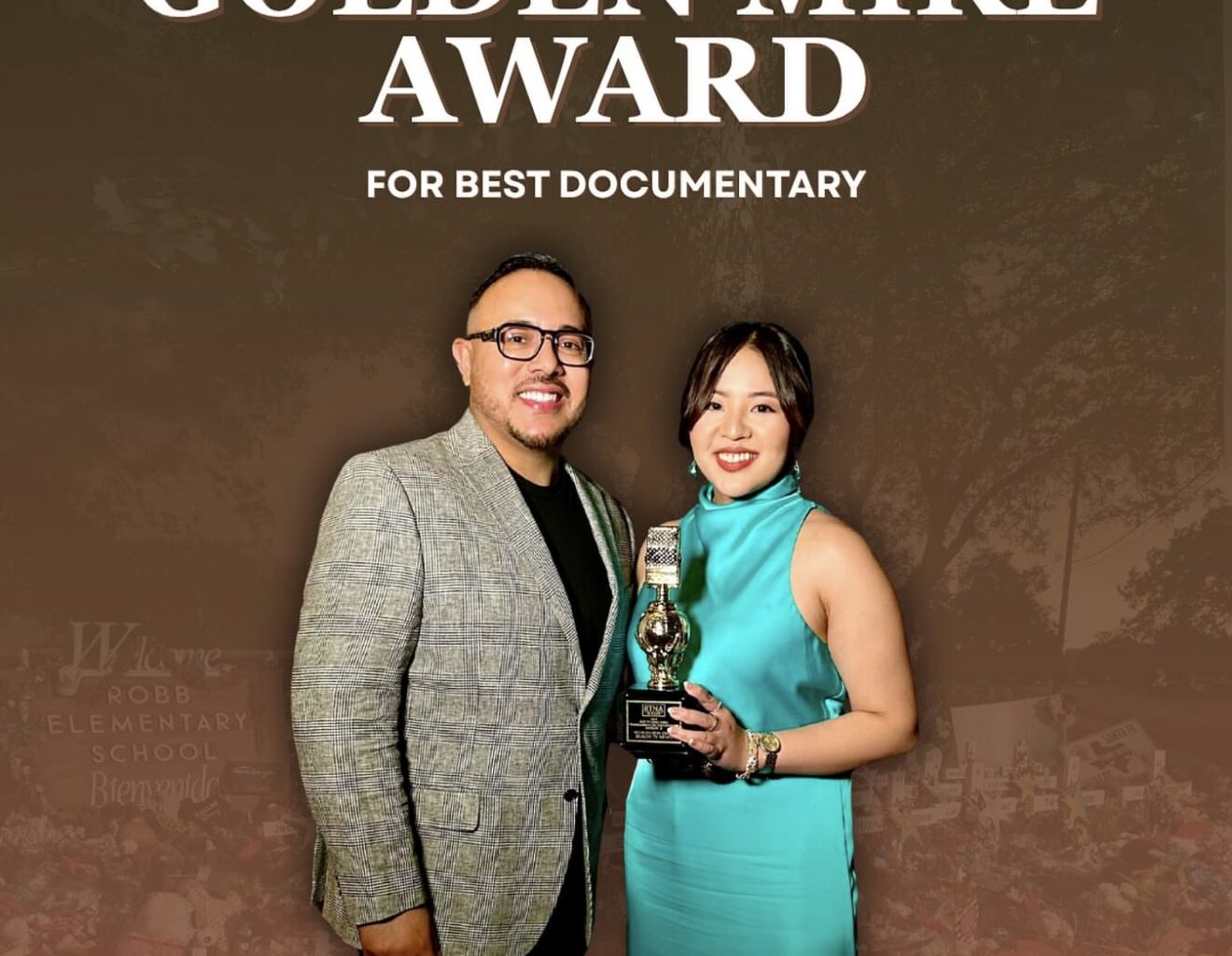

Director Raya Torres, CSULB alumnus and producer Jesús Ayala, a journalism professor at Long Beach State honored with the Golden Mike Award for Best Documentary got Reporting from Uvalde. | Photo courtesy of Jesús Ayala.
“Lessons from Uvalde” is a one-night campus event screening of the award-winning documentary film titled “Reporting from Uvalde,” on Oct. 30. The event will feature a panel discussion with the journalists behind the film, moderated by ABC7 Eyewitness News reporter Sid Garcia.
Directed by Long Beach State alumna and KOLD Tucson reporter Raya Torres, and produced by Jesús Ayala, a CSULB journalism and public relations professor with over 20 years of experience.
The film follows the story of news reporters who reported on the 2022 mass shooting in Uvalde, Texas, that claimed the lives of 17 students and two teachers at Robb Elementary School.
For Ayala, producing this film hit close to home because of his own experiences as a news reporter.
He covered several tragic events throughout his career, including Hurricane Katrina, the 2012 Aurora, Colorado theater shooting and the war in Afghanistan, all of which have deeply affected him.
Ayala emphasized that covering traumatic events often takes a significant toll on the mental health of journalists, a topic that is not sufficiently addressed within the industry.
“When first responders witness a traumatic event, they are not allowed to return to work until they have a debrief with a psychologist,” Ayala said. “When journalists witness these events, we don’t have that. Because we don’t have this, we have to give ourselves that debrief.”
Awarded the 2025 Gold Mike for Best Documentary, “Reporting from Uvalde” explores how covering traumatic events, such as mass shootings, can affect journalists’ mental health.
Ayala said covering Uvalde was especially difficult for many journalists who reported on it, as they had personal connections to the tragedy’s victims.
“One of the things that was so hard about Uvalde is that it happened in such a tight-knit community,” Ayala said. “The reporters had this happen in their backyard. As a journalist, you’re expected to be impartial, fair and balanced, but how can you be expected to do that when your neighbor’s kid was one of the people that was gunned down?”
Ayala hopes that through documentaries like these, students interested in journalism will learn about the toll that the profession can take on their mental health.
“As journalists, you might end up at a mass shooting, and you don’t realize that you’re going to be interviewing parents who just lost their kids. There’s really nothing that can prepare you for that,” Ayala said. “These aren’t the types of things that necessarily get addressed in journalism school. They teach you how to write a lead or to produce a TV story, but not about the mental component.”
The Oct. 30 event, hosted by the CSULB Journalism and Public Relations department, will begin at 5:30 p.m. in Lecture Hall 151.
The evening will include a red carpet ceremony, a screening of the film, a Q&A session with the filmmakers and a reception afterward.