
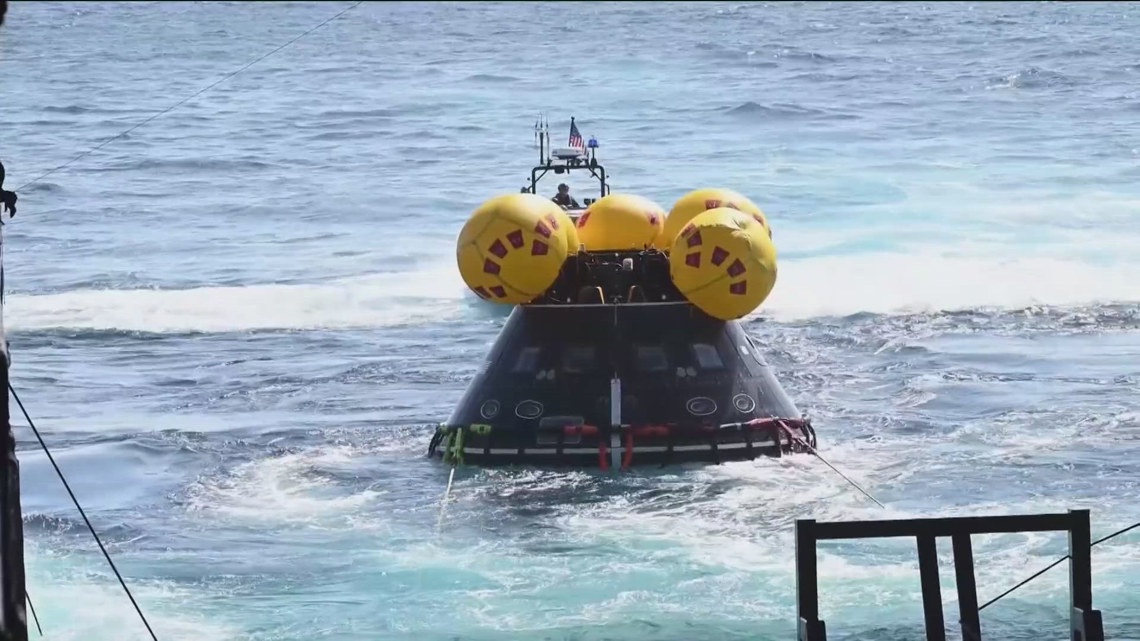
NASA’s Artemis II mission will send astronauts around the moon for the first time in decades, ending with a splashdown off the San Diego coast.
SAN DIEGO — It’s a mission that will take astronauts around the moon and bring them back down just off San Diego. NASA’s Artemis II is set to launch soon, marking the first time humans have traveled into deep space in more than 50 years.
Four astronauts will spend about ten days orbiting the moon before returning to Earth, with a planned splashdown roughly 60 miles off the San Diego coast.
NASA is targeting an April first launch from Kennedy Space Center in Florida, pending weather and final checks. Once the crew returns, a coordinated recovery effort in San Diego will already be in place.
Daniel Florez, a rescue test director for Artemis II, is helping to lead recovery planning, working closely with the U.S. Navy in San Diego.
“We also utilize resources, you know, helicopters from Naval Base North Island. We have medical teams from Camp Pendleton, from the Marine units up there,” Florez said.
A Navy vessel based in San Diego will retrieve the capsule after splashdown, while Navy divers out of Coronado will be the first to reach the astronauts in the water.
“They’re going to be the ones that are going to be opening the hatch and greeting the astronauts as they come home,” Florez said. “That team is comprised of specialized divers. They have doctors, they have a medical team, undersea medical officers.”
San Diego has already played a role in preparing for the mission.
About a year ago, crews conducted a full recovery test off the coast, sending a capsule 60 miles into the Pacific with four people inside. Teams had just two hours to locate the capsule, retrieve the crew and bring them safely back to the ship via helicopter.
“To exercise our operations, our concepts, our procedures and to train our personnel, to train Navy, Air Force personnel as well on the sequence of events,” Florez said.
The mission will also test how NASA’s deep space rocket performs with astronauts onboard, while the crew collects images and data for future exploration.
“They’re going to be taking a lot of pictures, a lot of imagery, collecting a lot of data to support some of the NASA science and to support future missions where we will be landing on the moon,” Florez said.
Artemis II is a key step forward, paving the way for future missions aimed at landing humans on the moon.