
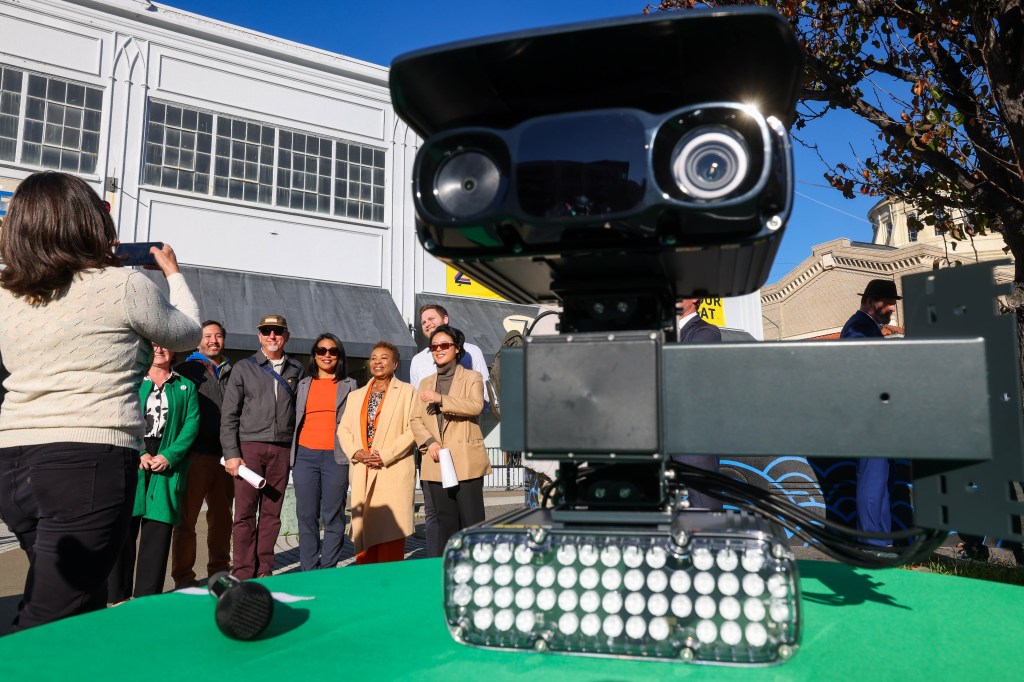
OAKLAND — City leaders made clear earlier this month that speeding drivers clocked by dozens of new cameras surveilling Oakland’s streets would face real penalties, following a brief stretch in which those individuals received only warnings.
All along, however, they have quietly acknowledged that the city currently lacks the ability to enforce those penalties in any meaningful way.
In other words, drivers who ignore the fines, which begin at $50 for those going 11 to 15 miles above a posted speed limit, can avoid real consequences. The civil penalties won’t be elevated to criminal charges. The Department of Motor Vehicles will not withhold the registration renewals of vehicles caught on the cameras.
Lower-income residents can apply for financial relief for these fines, which top out at $500 for those driving 100 mph over the limit. But they could also simply choose not to pay their penalties.
“These tickets are performative art — they tend to be boondoggles,” said Brian Hofer, a local privacy advocate who researches camera surveillance. “You’re kind of relying on people to be honest and pay.”
The network of 35 cameras was installed at 18 locations around town, including International Boulevard between 40th and 41st avenues in East Oakland; 7th Street between Broadway and Franklin Street downtown; 7th between Adeline and Linden streets in West Oakland and Hegenberger Road between Spencer and Hawley streets near the Oakland Coliseum.
The city will pay $4.8 million to Verra Mobility to operate the camera devices over the next five years.
It is unclear how much revenue city officials believe the speed enforcement program will generate. During the so-called grace period, the city said it issued 140,445 warnings to vehicle owners. Drivers caught on the cameras were traveling 14 miles per hour above the speed limit, on average.
“Speeding is a choice,” Josh Rowan, the city’s transportation director, said at a news conference when the cameras were first installed. “We make these choices every day.”
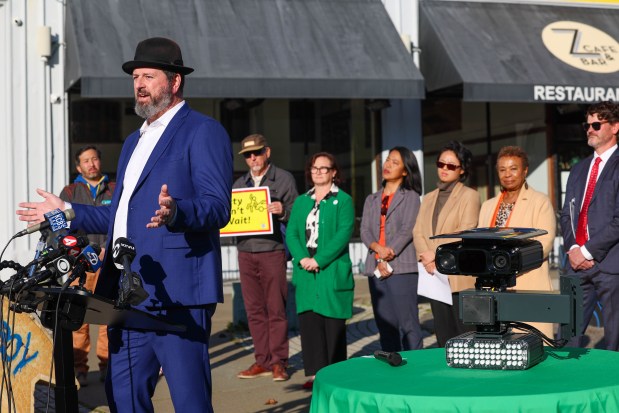 An automated speed safety camera is displayed on a table as Oakland Transportation Director Josh Rowan speaks during a news conference at the intersection of 27th Street and Broadway in Oakland, Calif., on Friday, Jan. 16, 2026. 18 cameras have been installed at different locations throughout the city and began issuing warnings on Jan. 14, 2026. They are scheduled to begin issuing speeding tickets in mid-March 2026, according to city officials. (Ray Chavez/Bay Area News Group)
Rowan and other city officials did not respond to requests for comment about the enforcement capacity of the city’s new program.
Even beyond the city’s public messaging, its ability to more harshly enforce speed penalties is handicapped by California law.
AB 645, signed by Gov. Gavin Newsom in 2023, does not allow speed camera violations to be anything other than civil penalties. The law has restricted cities from more forceful consequences, such as withholding DMV registration.
San Francisco similarly began operating its own speed-camera system last summer with limitations that mirror Oakland’s lack of enforcement. It has proven effective, with San Francisco transportation officials reporting last October that speeding had dropped by 72% at key locations around the city.
Oakland has had a sometimes contentious history with traffic enforcement, as when Stanford researchers found in 2016 that Black men were four times as likely to be the target of traffic stops as white men in the city.
Oakland police have reported a reduction in stops since 2019, recording 11,794 last year. Police leaders cite an ongoing officer shortage for the decline.
“We do not have — and will never have — enough police officers to flag everyone who is driving recklessly,” said Henry Gardner, a former city manager, in reference to Oakland’s ever-declining police staffing.
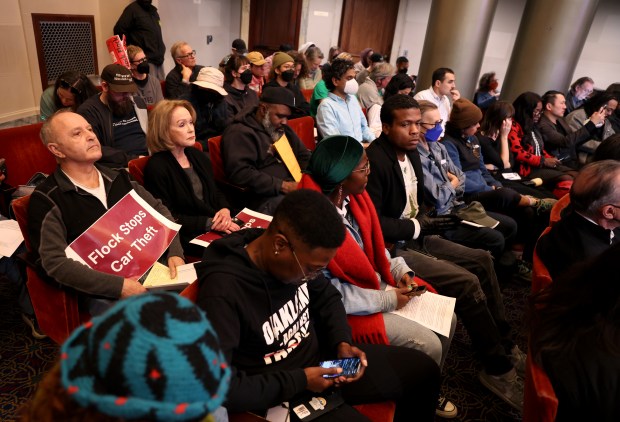 Community members listen during an Oakland City Council meeting at City Hall in Oakland, Calif., on Tuesday, Dec. 16, 2025. The Oakland City Council voted 7-1 to award Flock Safety a new contract to maintain an existing network of 300 cameras in the city. (Jane Tyska/Bay Area News Group)
Hofer, the privacy advocate, has sued the city over its use of Flock Safety cameras, from which data held by the Oakland Police Department was allegedly shared with Immigration and Customs Enforcement last year.
Flock cameras, which have gained notoriety around the Bay Area for the company’s potential ties to ICE, utilizes technology that reads license plate information and can analyze other footage it captures.
The speed cameras installed throughout Oakland last December do not use such technology. That may put concerns about surveillance to rest at a time when ICE has ramped up aggressive enforcement efforts, but it could also hamper the city’s attempt to deter egregious driving speeds.
Oakland has long struggled with unsafe streets, a problem that appeared to get worse during the pandemic, according to police data.
The segment of 7th Street in West Oakland where a camera is now mounted sees 14.6% of drivers travel above the 30 mph speed limit, a city Department of Transportation report stated last year.
At the newly surveilled Hegenberger corridor near the Coliseum, the 40 mph limit is topped by over 10,000 vehicles a day, or 43% of the total number of drivers, per the same report.
When previously questioned about the new speed cameras, city officials — including Rowan, the transportation director — have maintained they want to take an educational approach to deter reckless driving.
Those wary of traffic fatalities hope the mere presence of cameras can remind drivers to slow down.
“If this program can prevent even one six-year-old from being killed on the street due to reckless driving,” Gardner said, “it’s worth it.”
Shomik Mukherjee is a reporter covering Oakland. Call or text him at 510-905-5495 or email him at shomik@bayareanewsgroup.com.