
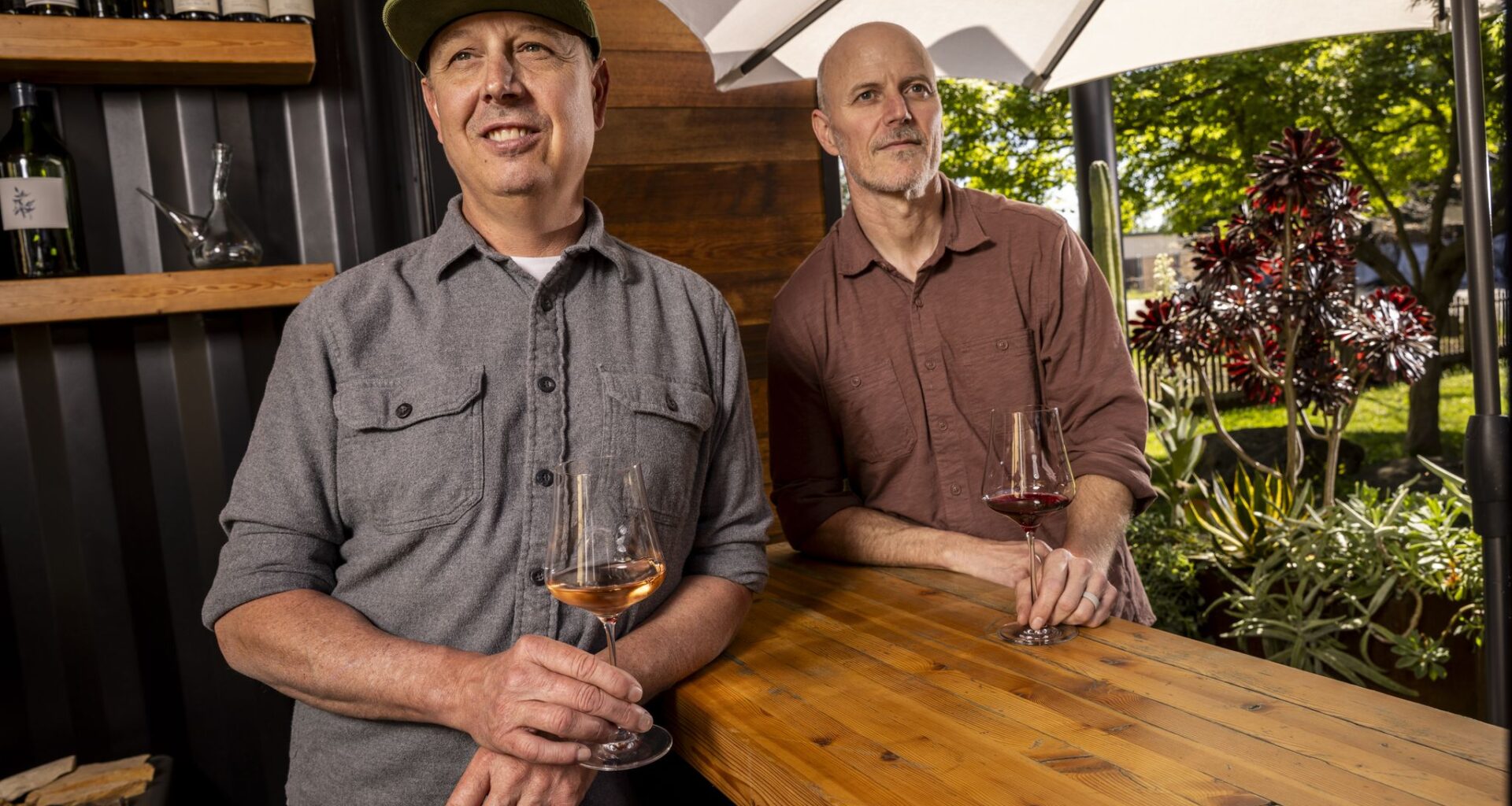
Arnot-Roberts was once the poster-child radical of California wine. The Sonoma County winery was sourcing fruit from sites widely believed too cold to grow red wine grapes, seeking out arcane varieties like Trousseau years before Bay Area wine bars were going nuts for them and putting out daringly low-alcohol wines in an era when drinkers clamored for 15% ABV reds.
Twenty-five years after its first vintage, we live in the wine world that Arnot-Roberts created. The features that made the winery so groundbreaking — esoteric grapes, modest alcohol levels, a minimalist approach to chemical intervention — are common. What counts as radical in California wine today is on a whole different level: natural-wine extremists who eschew any sulfur whatsoever, who blend reds and whites and even other fruits, who embrace volatile, even mousy flavor profiles.
Arnot-Roberts’ pristine Chardonnays and structured Cabernets feel downright quaint compared with today’s wild fringes. But radicalism has never been the goal of co-winemakers Duncan Arnot Meyers and Nathan Lee Roberts. They haven’t changed the fundamentals of their approach to restrained, terroir-driven winemaking, even as that approach changed the world around it.
Meyers and Roberts know that they are in a delicate position. “How do we navigate this changing environment” — referring to the wine industry’s ongoing crisis — “and stay relevant without totally reinventing ourselves?” Meyers said. It’s a conundrum that comes eventually for all radicals, or at least for those radicals successful enough to see their bold ideas become mainstream.
Article continues below this ad
Arnot-Roberts was among the first in California to produce an orange wine — a skin-fermented Ribolla Gialla aged in amphora, a ceramic jar popular in the ancient world.
Stephen Lam/S.F. Chronicle
Meyers and Roberts had not originally set out to shake up the wine world. The childhood friends grew up in Napa, where they both came from entrenched wine-industry families. Meyers is the son of a lawyer who worked for wineries; Roberts, the son of a cooper (barrel maker) and the grandson of Margrit Mondavi, Robert Mondavi’s wife. Their old-school Napa cred lent gravitas to their project. These were insiders with a deep understanding of California’s establishment wine culture. They grew up on the old-school, 1970s-style Napa Cabs made by their inner circles — Roberts, on the Mondavi wines; Meyers, on Clos du Val.
San Francisco Chronicle Logo
Make us a Preferred Source to get more of our news when you search.
Add Preferred Source
The buddies made their first batch of wine together in 2001, in a garage. At dinner with Roberts’ grandmother one night, they opened up a bottle of their homemade hooch, and Robert Mondavi expressed his approval. “You guys should keep going,” Roberts recalled him saying. Margrit Mondavi drew the understated, wispy flower that became their front label.
Those early wines, however, were anything but understated. Like everyone in that period, Meyers and Roberts were drinking boozy Zin and jammy red blends. When they made their first commercial wine in 2002, a Cabernet from Sonoma Mountain that tasted like “16% alcohol syrup,” Meyers said, they were happy with it. (That syrupy style, a departure from the old Mondavi and Clos du Val styles they’d trained their palates on, was cutting edge then.)
Article continues below this ad
The turning point came in 2006, when Roberts and Meyers were looking through grape classified ads in a binder at a Santa Rosa supply store and saw that some Syrah was for sale from Clary Ranch, a vineyard near Tomales Bay. The winemakers loved Syrah — they were making some from Hudson Ranch in Carneros — and decided to give it a try.
Clary Ranch, they discovered, was so chilly and gusty, located squarely in the Petaluma wind gap, that the grapes could barely get ripe. They couldn’t harvest until November, months later than is typical for some Sonoma County reds. Conventional wisdom at the time would have held that Clary was an impossible home for Syrah. But Meyers and Roberts found the resulting wine strangely delicious: savory, spicy, grippy. “That was the watershed wine for us,” Meyers said.
The revelation was that they preferred vineyards located in marginal climates, places just on the edge of viability for viticulture. “OK, why are we not working with more vineyards in this zone?” Roberts said.
A Syrah harvest from Clary Ranch — a 2022 bottling seen in the center — was the turning point for Arnot-Roberts, as the winemakers they realized they preferred vineyards located in marginal climates.
Stephen Lam/S.F. Chronicle
The 2008 Clary Ranch Syrah was the first Arnot-Roberts wine that caught the attention of tastemakers such as Jon Bonné, the Chronicle’s wine editor at the time, and Raj Parr, then the wine director of Michael Mina restaurant. “It was the first time I had a wine from such an extreme site,” Parr said. It changed the trajectory not only of Arnot-Roberts, but of California Syrah more broadly. Whereas the prototypical California Syrah until that point had been rich, dense and toasty with oak, this wine announced that another way was possible.
Article continues below this ad
After Clary Ranch, Meyers and Roberts completely recalibrated their approach to fruit sourcing, seeking out cooler sites as a rule. The wines reflect these marginal origins: There’s the Clajeaux Vineyard in Chalk Hill, from which they produce a Cabernet Sauvignon redolent of wild herbs and purple flowers; the Trout Gulch Vineyard in the Santa Cruz Mountains, whose Chardonnay is so taut and crisp that many drinkers falsely believe it has not undergone malolactic fermentation (it has); and the Que Syrah Vineyard near Occidental, which Roberts and his wife purchased in 2016, the source of an olive-forward Syrah that’s just as slight and restrained as the Clary Ranch.
The radicalism only grew from there. Arnot-Roberts was among the first in California to produce an orange wine — a skin-fermented Ribolla Gialla aged in amphora, a ceramic jar popular in the ancient world. The winemakers went after more unusual grape varieties, a move that read much more bizarrely pre-2010 than it does today. Roberts claims they were the first in California to produce a Trousseau — a delicate, aromatic red grape native to France’s mountainous Jura region — that wasn’t a fortified dessert wine.
“By 2010, (Arnot-Roberts) was a very big deal,” Bonné said. “If you went to Nopa” — one of the lucky San Francisco restaurants that always got an allocation — “you definitely wanted to grab a bottle.”
Sommeliers went crazy for the wines; Bay Area restaurants competed to buy them. Mailing-list customers were limited to a small allocation each. With their spare, wordless labels and their virtually nonexistent social media presence, Meyers and Roberts took on an air of mystery that only stoked their appeal. “They reminded me of a band,” Mark Nevin, co-owner of Tomorrow’s Wine in San Francisco, said. “They were like Lou Reed and John Cale.”
Roberts and Meyers became “the embodiment of the new California story,” Bonné wrote in an article naming them the Chronicle’s 2013 Winemakers of the Year, “proof that the state need not emulate wines from elsewhere or fall on programmatic, high-octane winemaking. It can exult in its own great possibilities.”
Article continues below this ad
Left: Co-owner Nathan Lee Roberts is the son of a cooper (barrel maker) and the grandson of Margrit Mondavi, Robert Mondavi’s wife.
Right: Co-owner Duncan Arnot Meyers is the son of a lawyer who worked for wineries.
Photos by Stephen Lam/S.F. Chronicle
Above: Co-owner Nathan Lee Roberts is the son of a cooper (barrel maker) and the grandson of Margrit Mondavi, Robert Mondavi’s wife.
Below: Co-owner Duncan Arnot Meyers is the son of a lawyer who worked for wineries.
Photos by Stephen Lam/S.F. Chronicle
Arnot-Roberts was not the only winery rejecting the so-called “hedonistic fruit bombs” that had dominated the previous era, but it was among the most influential.
Stephen Lam/S.F. Chronicle
Certainly, the duo weren’t the only ones making more restrained California wines and rejecting the so-called “hedonistic fruit bombs” that had dominated the previous era. (Bonné wrote an entire book, 2013’s “The New California Wine,” about this shift.) But they were arguably the best. “They exceeded what anyone else was doing,” Nevin said.
Arnot-Roberts was so successful, in fact, that an entire generation of winemakers set out to emulate their ideals. Their ultra-lean style of Syrah became the standard approach among progressive-minded vintners. Their Trousseau, once a risky choice, became “every young winemaker’s favorite light red grape,” Nevin said.
While some of their mid-aughts radical peers met the moment by continuing to push the boundaries of winemaking (another prominent winemaker from this time, Abe Schoener, moved to Los Angeles and began making wines that eschew basic modern equipment, like pumps), Meyers and Roberts didn’t chase novelty. “Our mission statement was always to make wines we want to drink and just hope there’s people out there who share our taste,” Roberts said.
Article continues below this ad
If anything, the wines became more mainstream: Following a couple years of making orange wine, Roberts finally admitted that he didn’t like it, and after 2013, they stopped making it. “They were getting volatile,” he said. “I like whites that are light and less phenolic,” which can refer to a bitter, astringent sensation. (He bequeathed the amphorae to Ryme Cellars.)
Bonné acknowledged that the Arnot-Roberts wines feel less revolutionary than they once did. “If there’s a concern, it’s are they too normcore?” he said. “The wines taste like what they should be” — their Chardonnays taste like Chardonnays (albeit more like French Chablis than the prototypical California butter bomb) — “and they’re not weird.”
“Our mission statement was always to make wines we want to drink and just hope there’s people out there who share our taste,” co-owner Nathan Lee Roberts said.
Stephen Lam/S.F. Chronicle
To the question of, “how to stay relevant?” Meyers and Roberts don’t have a fully formed answer. But Arnot-Roberts wines are still astoundingly good. The Trousseau is ethereal and explosively aromatic, full of crunchy red fruit and dried herbs. A Pinot Noir from the Peter Martin Ray Vineyard in the Santa Cruz Mountains feels silky and supple, tasting like citrus and licorice. Sauvignon Blanc from Mendocino County’s Yorkville Highlands is a textural, salty wonder, with an intense mineral backbone.
Certainly, in some ways (such as by giving up on orange wine), Arnot-Roberts retreated from the iconoclasm that defined its early buzz. But the more meaningful shift has been in the surrounding wine world — a world that Meyers and Roberts shaped — which has come to prize the ideals of balance and restraint that their wines embody. They avoided the flash-in-the-pan fate of other trendsetters, like the wineries who made the powerful, high-octane wines that Roberts and Meyers admired in their youth but which soon came to feel dated, overblown, passé.
Tasting the Arnot-Roberts wines today, they don’t feel radical at all. They feel classic.