
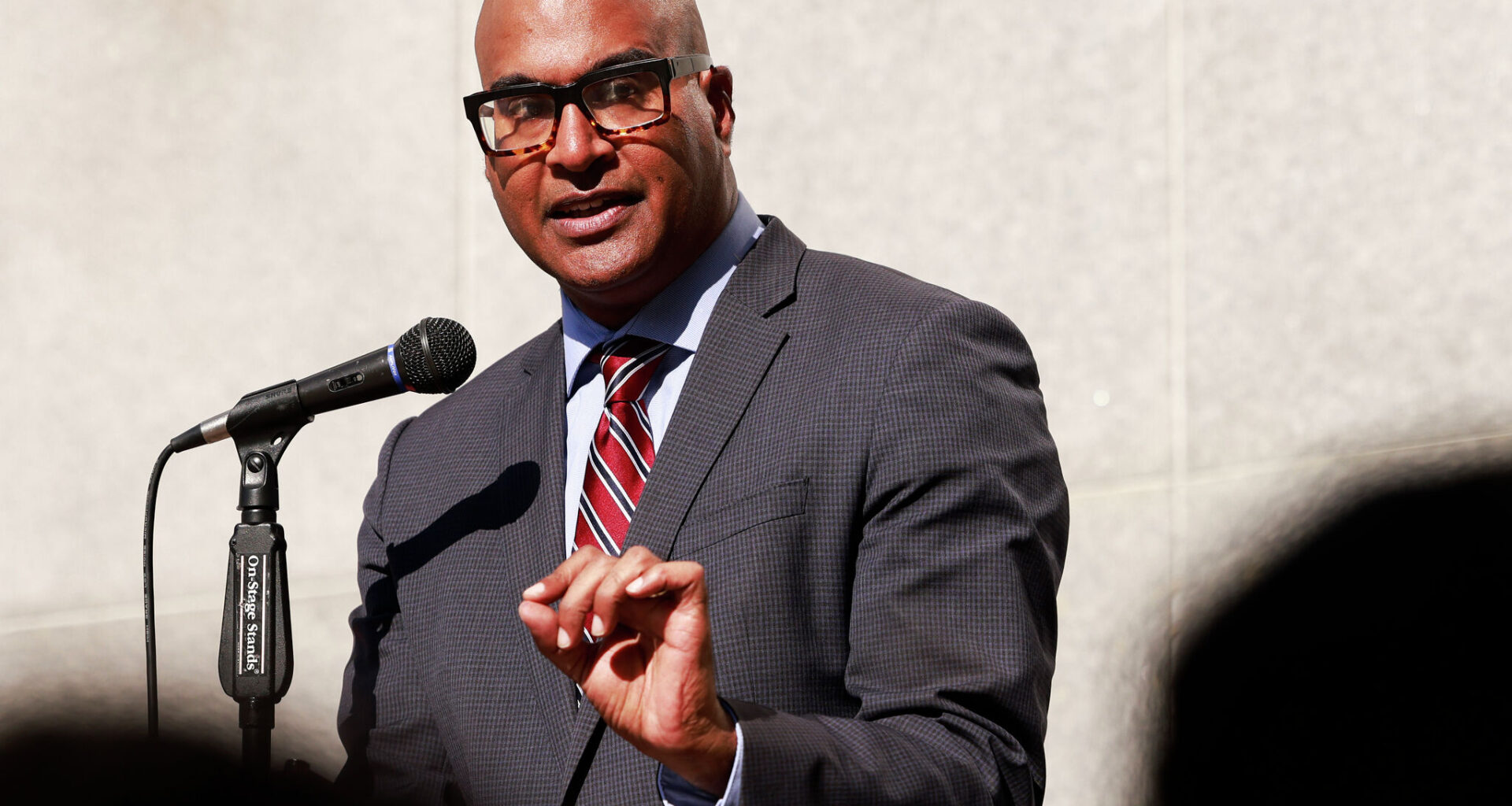
San Francisco Chief Public Defender Mano Raju, pictured in 2024, is not accepting some new felony and misdemeanor cases — a measured, legally grounded response to a long-building crisis.
Jessica Christian/S.F. Chronicle
On March 18, 1963, the Supreme Court declared that the right to counsel is critical to ensure a fair trial. Thus, if a person can’t afford a lawyer, the government must pay for one. The decision in Gideon v. Wainwright is one of the purest expressions of democratic principles in American legal history — a statement that justice is not a commodity available only to the wealthy and that the state’s awesome power to imprison could not be wielded against an unrepresented person.
Six decades later, that promise has been buried under the weight of a decades-long policy choice: to treat every social problem — addiction, mental illness, poverty, homelessness — as a criminal matter to be processed through individual prosecution. The result is cases falling onto an underfunded, understaffed public defender system that was never built to absorb them.
Since May 2025, the San Francisco Public Defender’s Office has declined new appointments on some new felony and misdemeanor cases as a measured, legally grounded response to a long-building crisis. San Francisco Public Defender Mano Raju, who was recently held in contempt for his decision not to take on new cases, has been clear: Accepting more cases than his office can handle violates his clients’ constitutional rights, transferring the crisis from the docket to their clients.
Article continues below this ad
This is not a novel legal position. Courts in California and around the country have ruled that, if a lawyer’s heavy caseload forces them to prioritize some of their clients and neglect others, that lawyer has a conflict of interest. Under longstanding ethics rules, an overloaded attorney has not only the right but the duty to decline new appointments. In addition, the American Bar Association’s Formal Opinion 06-441 makes clear there are “no exceptions” — if workload prevents a lawyer from providing proper representation, they must not accept new clients.
Despite this ethical rule, in January, a San Francisco judge ordered the San Francisco public defender to accept cases. Earlier this month, after the office continued to refuse — because the workload remained largely unchanged — the judge found Raju in contempt. Holding a public defender in contempt for refusing to provide representation they cannot constitutionally provide does not solve the crisis; it compounds it. It commands the public defender to accept more cases and provide less representation. Raju and his office are in contempt of a court order — but not in contempt of the Constitution.
San Francisco Chronicle Logo
Make us a Preferred Source to get more of our news when you search.
Add Preferred Source
The surge in San Francisco’s criminal docket can be traced to the appointment of District Attorney Brooke Jenkins. Even though crime rates nationwide, including in San Francisco, have dropped precipitously since the COVID pandemic, charges filed by Jenkins’ office have increased. Narcotics misdemeanor charges alone rose 709% from 2023 to 2024. Jenkins explained the increase as a product of police knowing she was “more willing to charge people” for low-level offenses — a candid acknowledgment that the surge reflects prosecutorial philosophy, not a crime wave. Against this surge, caseloads grew nearly three times faster than public defender staffing. The misdemeanor unit’s caseload grew 55% in just over a year, with each attorney averaging 147 open cases. The district attorney’s budget projected 2,000 more cases annually in 2025-26. The public defender was not consulted about this.
The consequences are not abstract. Overloaded attorneys triage. Clients wait longer in custody. Cases are under-investigated. The pressure to plead — regardless of merit — increases. More than half of the 214 felony and misdemeanor trials in 2025 resulted in no conviction, a striking figure that reveals a serious pattern of overcharging by the district attorney. When Jenkins applauds a contempt order against Raju for refusing to take new cases, she is applauding the punishment of another person for the problem she herself created. And the clients waiting in crowded jails for their cases to be called, no matter how weak the case, are punished the most.
Article continues below this ad
The solution is systemic. Public defender offices must be funded at levels commensurate with their caseloads. This will require state resources. Ensuring the right to counsel is a state responsibility, and the state can no longer continue to force counties to bear it alone.
Guest opinions in Open Forum and Insight are produced by writers with expertise, personal experience or original insights on a subject of interest to our readers. Their views do not necessarily reflect the opinion of The Chronicle editorial board, which is committed to providing a diversity of ideas to our readership.
Read more about our transparency and ethics policies
The Legislature and local leaders must embrace solutions such as mental health diversion, including treatment options. Importantly, district attorneys must exercise genuine restraint before charging suspects — and when they will not, county and state budgets should not subsidize their decisions.
California is now being forced to reckon with the degree to which the criminal legal system bears weight it should not carry. The Gideon ruling promised every person accused of a crime a real lawyer, not just an assigned name. That promise can only be kept if the volume of charges is proportionate to the resources available to contest them.
Kate Chatfield is executive director of the California Public Defenders Association.