
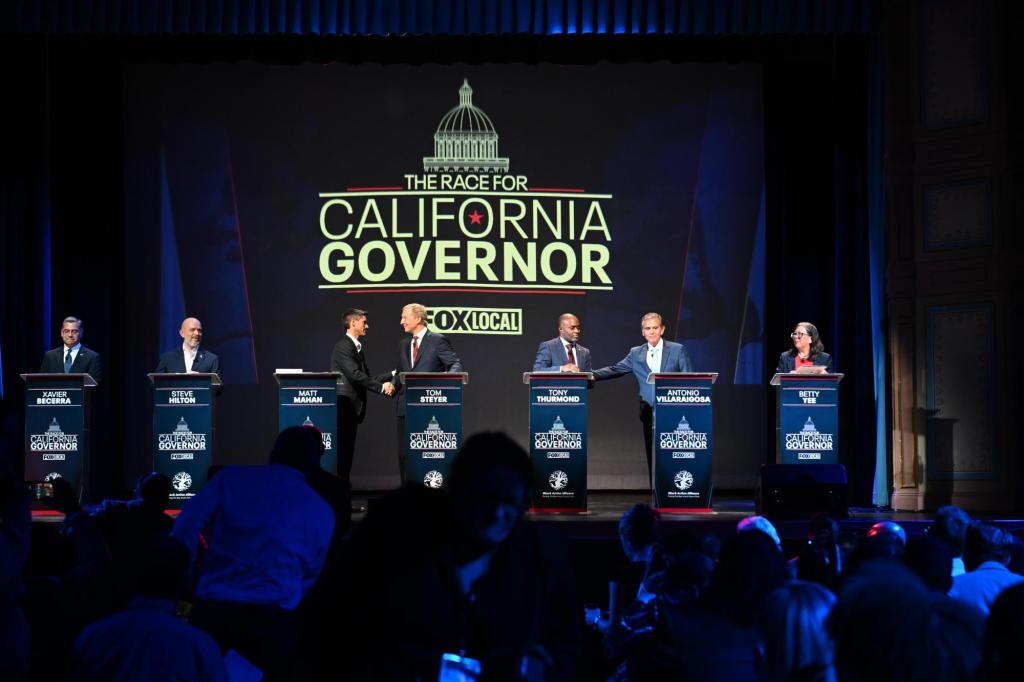
A planned California gubernatorial debate for Tuesday night was abruptly canceled less than 24 hours before the event, amid controversy that no candidates of color were among those invited to participate.
In a statement released late Monday night, a USC spokesperson said it will “look for other opportunities to educate voters on the candidates and issues.” But the debate planned with ABC for Tuesday evening was nixed.
“USC vigorously defends the independence, objectivity and integrity of USC Professor Christian Grose, whose data-driven candidate viability formula is based on extensive research and enjoys broad academic support,” said Beth Shuster, vice president of content strategy for USC.
“At the same time, we recognize that concerns about the selection criteria for tomorrow’s gubernatorial debate have created a significant distraction from the issues that matter to voters,” said Shuster, adding that USC and KABC, the television partner of the debate, could not “reach an agreement on expanding the number of candidates.”
ABC7/KABC-TV and USC Dornsife Center for the Political Future had faced backlash over the past week, since announcing the debate lineup.
The six candidates invited to participate were Republicans Chad Bianco and Steve Hilton, along with Democrats Matt Mahan, Katie Porter, Tom Steyer and Eric Swalwell.
These top six candidates were picked based on a formula created by Grose, a political science professor at USC.
Polling percentage and fundraising were used to determine a candidate’s viability formula, according to the methodology. The polling percentage was determined by the most recent Public Policy Institute of California survey, and the fundraising component took the total amount raised divided by the number of days a candidate was in the race. Polling, though, was weighted more than fundraising because that “is a snapshot measure of actual voters’ opinions,” the methodology said.
And that formula for scoring candidates, Grose said, was done blindly — meaning it was put together without looking at actual figures and how candidates would score.
According to the formula, Steyer came in first, followed by Hilton, Swalwell, Porter, Mahan and Bianco.
That meant, former U.S. Health and Human Services Secretary Xavier Becerra, Superintendent of Public Instruction Tony Thurmond, former L.A. Mayor Antonio Villaraigosa and former state Controller Betty Yee were not invited to participate.
Earlier Monday, California’s legislative leaders, including Senate President Pro Tempore Monique Limón. D-Santa Barbara, and Assembly Speaker Robert Rivas, D-Hollister, encouraged voters to boycott the debate if other candidates were not included.
“The outcry over this debate is deafening and includes legal demands from the excluded candidates’ attorneys, public calls by elected leaders across the state, concerns from the included candidates’ own campaigns and growing alarm from California voters,” the legislators said in the letter.
It included signatures of chairs of various legislative groups that represent minority communities, including the Asian American & Pacific Islander Legislative Caucus, the Legislative LGBTQ Caucus, the Legislative Jewish Caucus and the California Legislative Black Caucus, among others.
But another public letter to USC leadership on Monday included 50 signatures of political scientists and professors from across the country who defended Grose and the methodology used to determine viable candidates ahead of the debate.
“Substantive disagreement over scholarship is the lifeblood of the university,” the letter said.
“All of us expect and welcome critical engagement from inside and outside the academy. What Professor Grose has faced, however, is not substantive or methodological debate. Attacks and insinuations from members of the political classes include completely baseless allegations of election-rigging, inconsistency, bias and data manipulation. These are harmful character assassinations, not substantive debate. They are of a piece with other attempts to strong-arm or malign scholars that have become all too common in America.”
“Whatever their intent, the effect of these attacks is to diminish academic freedom and chill scholarly willingness to add their voices to the public square. It is imperative that universities defend their faculties’ integrity when it is unfairly attacked.”
Last week, Villaraigosa’s attorneys threatened to pursue “legal remedies” if he was not included. They maintained he satisfied either outright or “under any good faith analysis” the criteria to participate in the debate.
California’s legislative leaders — and other gubernatorial candidates — pointed to Mahan’s inclusion in the debate. The San Jose mayor only entered the contest earlier this year, whereas other candidates have been campaigning for more than a year.
Mahan, for his part, had said more candidates should be invited to debate.
“Just as I publicly rejected the efforts of insiders to push candidates out of this race before the filing deadline, I feel the same way when it comes to debates,” Mahan said, referring to California Democratic Party Chair Rusty Hicks calling on candidates who have struggled to gain momentum in the race to drop out, a request that came amid mounting fears in Democratic circles that two Republicans could advance in the open primary in June.
“We have a diverse pool of candidates, including several who have served our state with distinction,” Mahan said. “To solve California’s challenges, we need to hear more voices and viewpoints, not fewer.”
Porter, a former member of Congress from Irvine, said she was “disappointed” in how debate organizers handled the event.
“Debates are at the heart of our democracy, giving voters the opportunity to hear candidates discuss and contrast our visions for California,” Porter said in a social media post over the weekend. “Criteria used to determine which candidates qualify to participate in a debate must be transparent, fair and objective.”
“I’m disappointed by how USC handled the process for Tuesday’s debate. Candidates and Californians deserve answers.”
Hilton, a Republican candidate who has been enjoying relatively successful polling numbers as the June primary gets closer and several Democrats are still campaigning, said he had “no time” for the lower polling Democrats “whining about being left out of” the debate.
“Do better, and you’ll get in,” Hilton said on social media.
However, he also decried the inclusion of Mahan, alleging the debate organizers “rigged the rules” for the mayor, and criticized the exclusion of independent candidate Elaine Culotti.
The February survey of likely California voters by the Public Policy Institute of California found Hilton polling at 15% and Bianco at 12%. On the Democratic side, Porter clocked in at 13% among likely voters, followed by Swalwell at 11% and Steyer at 10%.
Becerra and Villaraigosa had 5%, as did Yee. Thurmond was polling at 2%.
Mahan came in at 3%.
(Culotti was not included. But another 10% of likely voters chose “don’t know,” 3% said “someone else and 1% said they would not vote in the race.)
Notably, more debates are scheduled next month, one with at least a similar candidate lineup.
Nexstar Media Group is scheduled to host a debate on April 22 with Bianco, Hilton, Porter, Steyer and Swalwell all invited to participate. The candidates were chosen, a release said, based on whether they had earned at least 5% in its March statewide poll and “Nexstar’s other criteria for participation.”
CBS, too, has a debate planned on April 28. The announcement doesn’t include the candidates invited, but rather says, “Participants in the debate will be selected from the top candidates in recent polling.”