

Data Shows Enrollment Challenges Across Most Oakland County School Districts
(Kurt Metzger, March 24, 2026)
Oakland County, MI – New data released by the Center for Educational Performance and Information (CEPI) in MISchoolData.org show that enrollment in Michigan’s K-12 public school system continued its downward trend this spring (24-25 school year), while enrollment increased in private schools and taxpayer-funded charter schools.
An analysis of statewide FTE K-12 enrollment shows the state has lost over 123,000 students over the last ten years, a decline of 8.2 percent. Education professionals see this as a signal that Michigan’s public education system has not fully recovered the students it lost during the global pandemic, which started in March 2020, and is exacerbated by birth trends that will mean decreasing numbers of children entering the K-12 system in coming years.

Now that the spring count is in the books, I wanted to see how Oakland County’s traditional K-12 districts have fared over this ten-year period, 2014-15 to 2024-25.
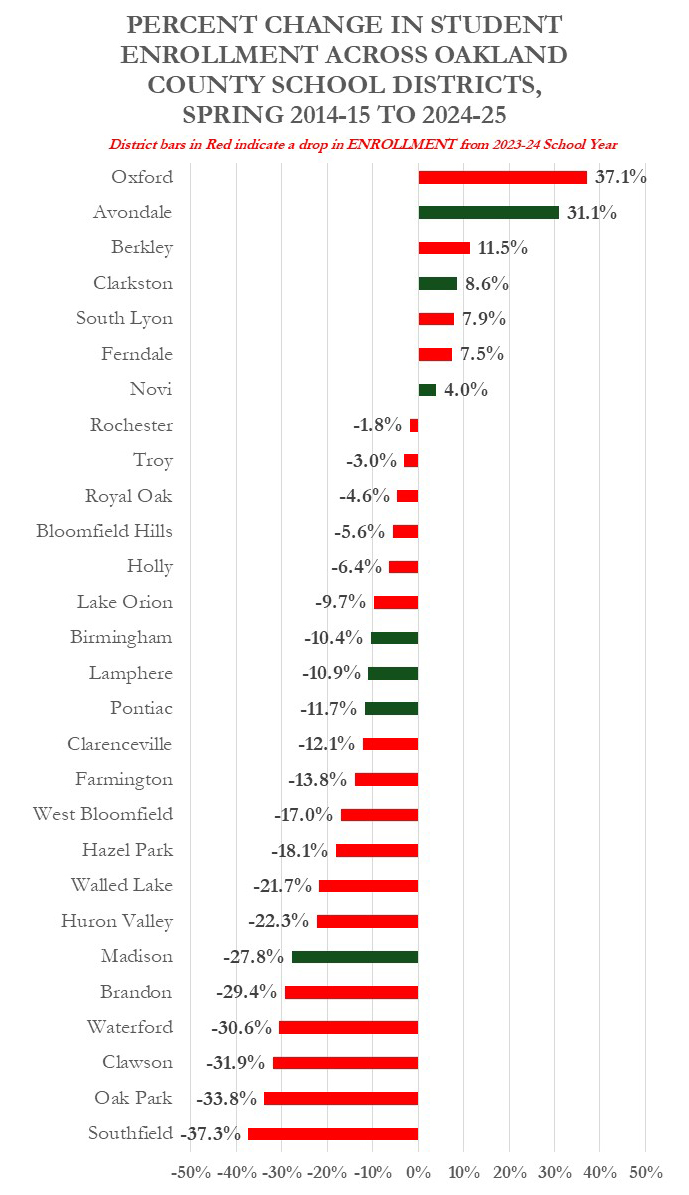
Oakland County has 28 traditional K-12 districts. Of those 28, twenty-one (21) have experienced enrollment losses, ranging from a low of 1.8 percent (Rochester) to a high of 37.3 percent (Southfield). As can be seen in the accompanying chart, those with the largest declines (over 1,000 students) – Farmington, Walled Lake, Oak Park, Waterford, Huron Valley and Southfield – showed geographic diversity, though they tended to cluster in the older population centers. The three largest increases were experienced by districts in outer suburbs – Oxford, Avondale, Clarkston, and South Lyon.
 While a decrease in the county’s school-age population is a major factor in losses, pandemic choices around homeschooling and transfers to charters, private and parochial schools have also played a key role. While data are limited on enrollment in any of these categories, I can report that Public Charter Schools (public school academies) in Oakland County have added 718 students (6.4 percent) over the period. They now account for about 12,000 students, while public districts educate just over 155,000. In addition, about 3,000 students attend the Michigan Virtual Academy.

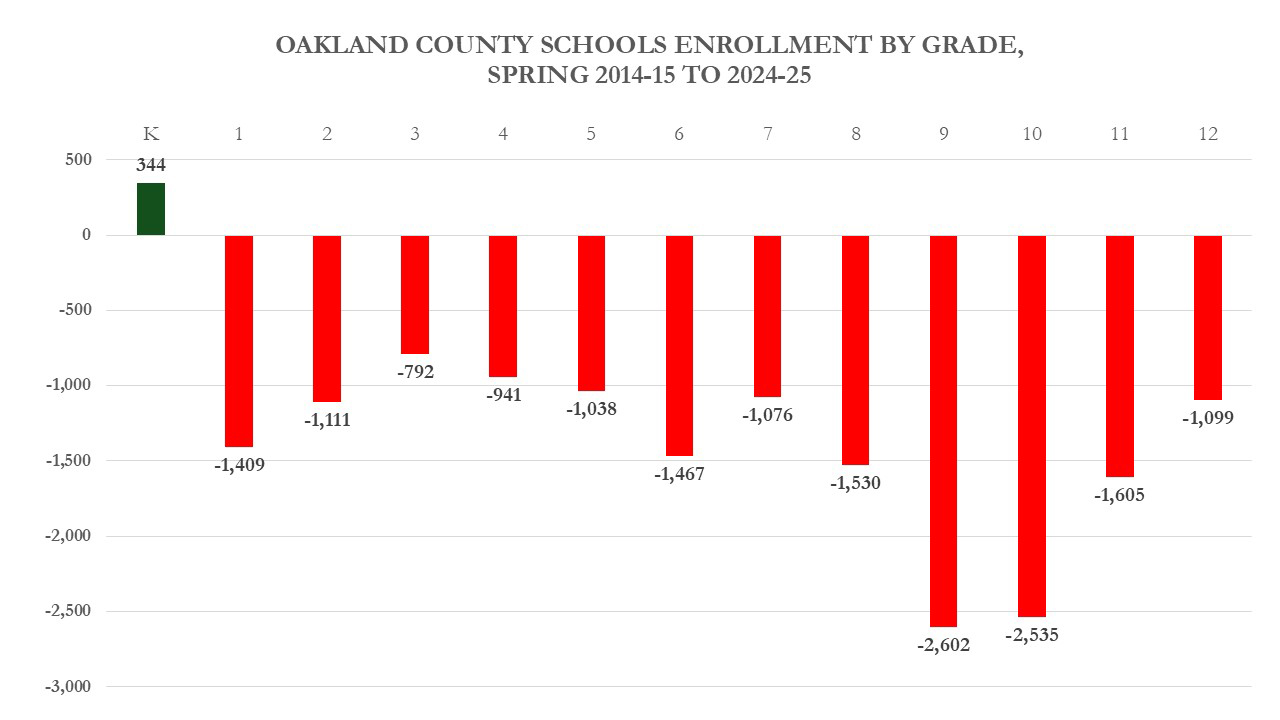
To see how these losses are spread across grade levels, as one input into enrollment trend forecasts, I compared enrollment counts across the K-12 continuum. The second chart illustrates the losses experienced at every grade level except for Kindergarten, which saw a small gain. While the largest losses were seen in grades 9 and 10, losses in the elementary school years will continue to move through the middle and high school years.
 Pandemic funding brought monetary resources to our public schools, allowing for added programming and staff hires. As some federal resources are ending, school districts are facing a variety of budget-related choices. State per-pupil funding may be increasing, but decreasing enrollment means decreasing overall revenues. School districts may turn to voters for bonds for funding infrastructure needs, but not for staffing. Another potential source of revenue would be a proposed 1.5-mill county-wide tax is being considered to boost school funding. Wayne and Macomb counties have similar taxes already in place.
But the enrollment numbers aren’t just about funding. They prompt us to look at the impact’s of population decline overall, as well as how to meet the educational needs of all Michigan’s children.
For more stories about the Census and other interesting numbers, visit the Data-Based Stories Archives on Oakland County Times. Thanks to Data Expert Kurt Metzger for this work!




 Save this post to PDF
 Print this post