
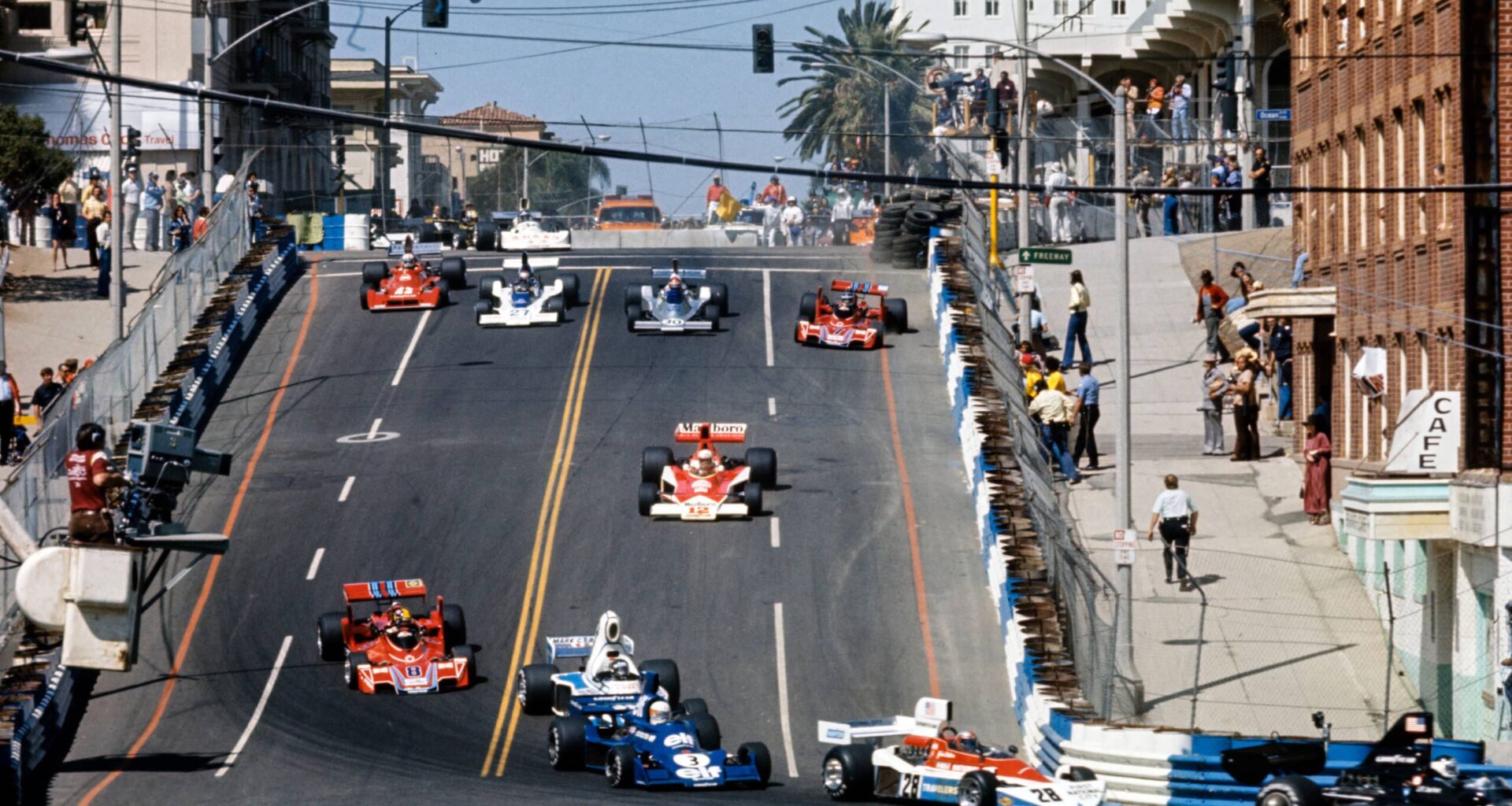
This coming Saturday, March 28, will mark the 50-year anniversary of Formula 1’s discovery of Long Beach. Regular readers of this column will know that I like anniversaries, particularly round-numbered ones, although I concede that they can sometimes feel contrived, as though we are imposing retrospective significance on events that, at the time, seemed merely part of the onward churn of history. But the 1976 United States Grand Prix West at Long Beach is a lily that requires no such gilding. It was, in ways both obvious and subtle, a race that mattered then and has continued to matter since. Indeed, it was a weekend on which spectacle, sport, and serendipity conspired to produce something not only enjoyable but also important.
The grand prix itself was won, and won magnificently, by Clay Regazzoni, whose performance that sunlit Californian afternoon deserves to be remembered not merely as a victory but as a masterclass. He started the race from pole position, he drove its fastest lap, he led it all the way, he won it by more than 40 seconds, and he thereby realised that perfect F1 holy grail, a grand chelem, the 26th scored in F1 (the total is now 70). It was the finest performance of Regazzoni’s long, mercurial, and slightly chequered career, and therefore the best of his five F1 grand prix wins.
Sun-baked concrete barriers were decked out in logos brasher than had been seen in F1 ever before
He had been quickest in the Saturday morning qualifying session, his error-free 1min 23.823sec benchmark making him the only driver to beat the 84sec barrier; then in the afternoon he produced a prodigiously impressive pole lap, shaving the walls everywhere and making no mistakes anywhere, to lower that mark to 1min 23.099sec. No-one else got close to that, and his team-mate Niki Lauda was unable to get within half a second of it.
The car that Regazzoni and Lauda were driving that weekend — for the last time as it happens — was the glorious Ferrari 312T, in its high-airbox configuration, a machine that, for me, occupies a place in the uppermost pantheon of F1 design. It was chunky — almost pugnacious in its stance — but it was elegant nonetheless, and Mauro Forghieri had drawn it with a visual coherence that spoke of purpose rather than ornamentation. Nonetheless, the result was beauty. Long Beach 1976 would be the final grand prix of F1’s high-airbox era, and that of the 312T — a white turret rising proudly above rosso corsa bodywork like a periscope, topped with a neat rendering of the Italian tricolore — lent it an architectural and stylistic chutzpah that modern F1 cars, constrained as they are by ever-tightening regulations, cannot hope to emulate.
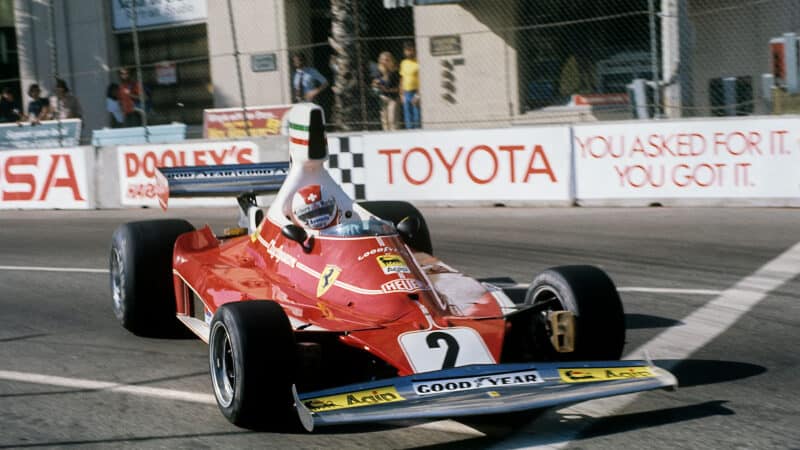
F1 design at its finest? Regazzoni heads to a crushing victory at Long Beach
Bernard Cahier/Getty Images
Then there was the engine, also designed by Forghieri: a naturally aspirated 3.0-litre flat-12, whose shrieking timbre echoed off the hotels and apartment blocks of Long Beach with operatic ferocity. It did not merely make a noise; it sang, it keened, and it proclaimed its presence in a way that stirred the spirit. Even now, half a century on, one can close one’s eyes and almost hear it, a mechanical aria carried on the Pacific breeze.
Long Beach itself, making its F1 debut that weekend, proved to be an inspired choice of venue. Set beside a shimmering expanse of the world’s largest ocean — the venerable RMS Queen Mary anchored majestically in the harbour, its three oblique funnels punctuating the horizon beside the long Shoreline Drive not-quite-straight — it offered a backdrop of cinematic splendour. As a vista, Long Beach outclassed the bucolic charm of Watkins Glen and even shaded the picturesque beauty of European circuits steeped in decades of tradition. Here in California was something altogether different, a fusion of sport and spectacle that felt distinctly and unapologetically American. The boulevards on which the race would run were lined with palm trees, fig bushes, and jacarandas; the circuit was delineated by sun-baked concrete barriers decked out in logos brasher and more numerous than had been seen in F1 ever before; and the interplay of light and shadow between the diners, dive bars, and strip clubs all combined to create an atmosphere that was at once glamorous and sleazy.
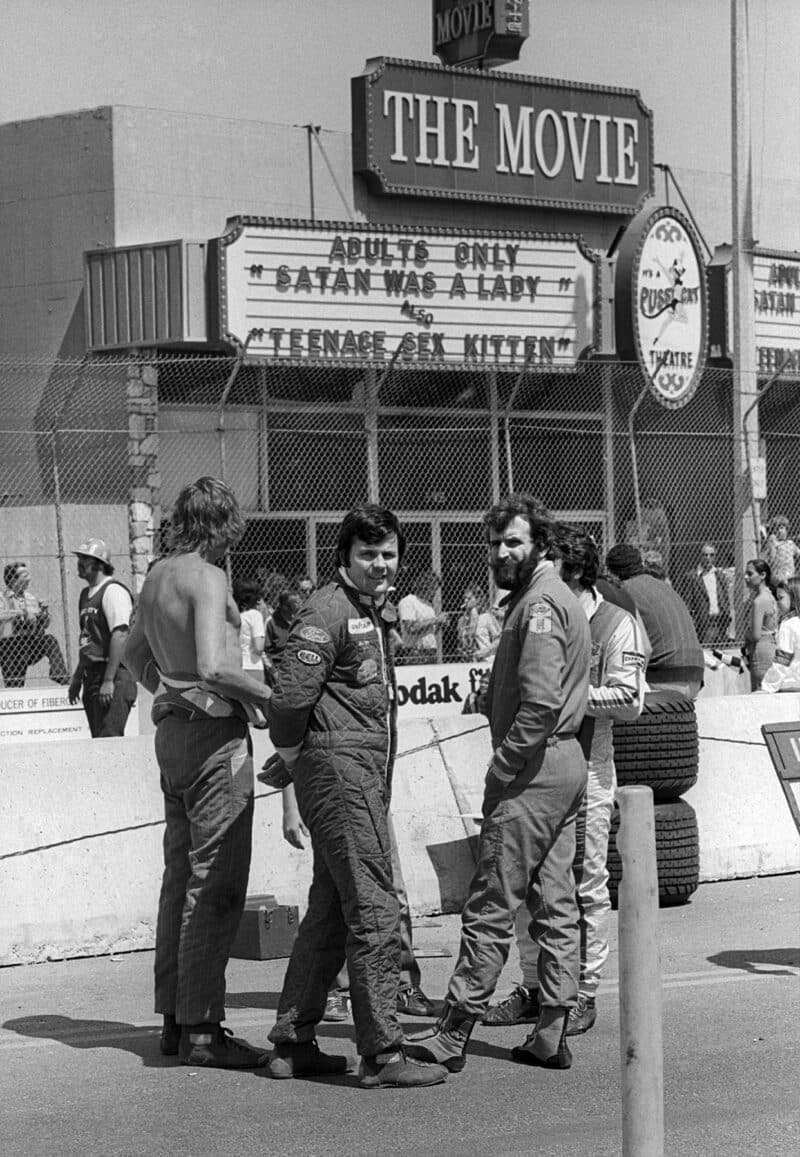
James Hunt (left) finds a distraction at the trackside cinema, standing alongside Alan Jones and Harald Ertl
David Phipps/Sutton Images
As a street circuit, Long Beach immediately established itself as one of the finest F1 had ever known. It was demanding without being capricious, and, although it was challenging, it was no more dangerous than anywhere else. Its corners required precision, its straights rewarded bravery, and its margins for error were, as ever on street circuits, unforgivingly slim. Yet it flowed; the drivers liked it; it invited them to commit themselves; and, unlike Monaco, it offered them opportunities to overtake one another. In an era when street racing was still something of a novelty at the highest level of the sport — Monte-Carlo apart — Long Beach set a standard that many subsequent venues have aspired to match but few have equalled.
The broader context of the race adds another layer of historical significance. The 1976 season marked the first time that the wild and wonderful country that we could then still confidently call the land of the free would host two F1 grands prix in a single year, for the United States Grand Prix East would be run later that season at Watkins Glen. Until then, only one other nation had ever been accorded the same honour: Italy, in 1957, when F1 grands prix were held at both Monza and Pescara. That the USA should join that exclusive club was emblematic of F1’s growing global ambitions and of its recognition that the American market, stimulated and elevated by its appetite for spectacle and scale, offered fertile ground for expansion. Half a century later Liberty Media has fully realised those ambitions — and then some.
If Regazzoni’s triumph and Long Beach’s debut provided the sporting and scenic centrepieces of the weekend, there was another element – arguably even more extraordinary – that elevated the event into the realm of the truly unforgettable. I am referring to the support act that brought together a constellation of superstars spanning multiple generations of grand prix racing. To describe it as a historic race is accurate but insufficient. It was a living and moving museum; a rolling tapestry of motor sport history.