
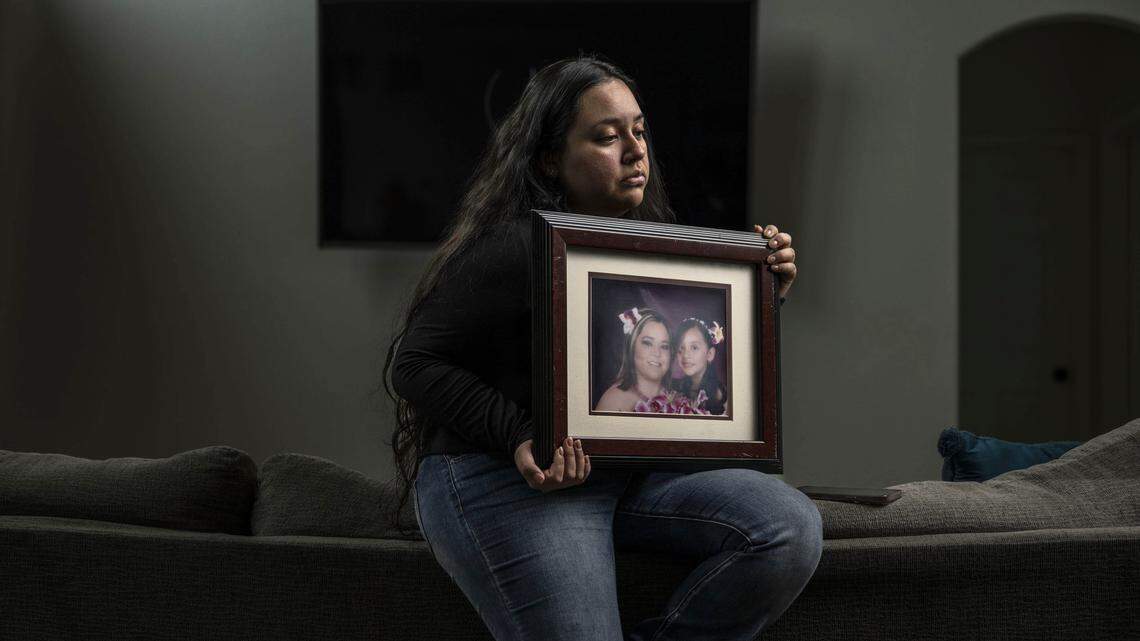
Sacramento resident Damaris Bello, 22, holds on Friday, Feb. 20, 2026, a picture of herself with her mother Maria de Jesus Estrada Juarez, who was deported to Mexico after appearing for a green card hearing at the John Moss Federal building on Wednesday.
HECTOR AMEZCUA
hamezcua@sacbee.com
A federal court has ruled that the U.S. government must allow the return of a Sacramento mother who was deported within 24 hours of arriving for her green card appointment last month.
The ruling follows reporting from The Sacramento Bee that highlighted Maria de Jesus Estrada Juarez’s removal, which occurred despite her having legal permission to remain in the country. Estrada Juarez had lived in California for 27 years and was detained at her green card appointment in downtown Sacramento. The deportation drew national attention to enforcement against recipients of Deferred Action for Childhood Arrivals.
A federal judge in the Eastern District of California, Dena M. Coggins, granted the emergency relief ruling on Monday, according to FWD.us, an immigration and criminal justice reform advocacy organization assisting Estrada Juarez. The ruling requires the government to facilitate her return to the country within seven days after “finding serious legal deficiencies” in the removal, FWD.us said in a news release Tuesday.
“I am overwhelmed with relief and hope after learning about the court’s decision,” Estrada Juarez, 42, said. “Being separated from my daughter and my home has been incredibly painful. I followed the rules and trusted the process, and I just want to return to my family and rebuild my life. This decision gives me hope that I will be able to come home soon.”
Estrada Juarez has been a recipient of Deferred Action for Childhood Arrivals since 2014. The program, which began during President Barack Obama’s administration, has shielded people from deportation if they arrived in the U.S. as children and have no criminal record.
“The court recognized what we have argued from the beginning: Maria’s deportation was unlawful because DACA status protected her from being removed from the United States,” attorney Stacy Tolchin said in a written statement. “This ruling will reunite her with her U.S. citizen daughter.”
In response to questions last month, the Department of Homeland Security said DACA “does not confer any form of legal status in this country” and said Estrada Juarez was previously issued “a final order of removal” in 1998. Estrada Juarez, who entered the country at 15 in 1998, denied ever receiving an order of removal.
FWD.us said it has since learned that the alleged “expedited removal order” was never finalized under federal regulations as it required supervisory approval. The organization said, without that approval, there is no valid order to enforce or reinstate — particularly when she received previous federal permission to leave and re-enter the country.
“This case highlights serious failures in the government’s haphazard and irresponsible attempts to remove individuals without following the law,” Tolchin said.
Enforcement against DACA recipients underscores how aggressively the administration has moved to crackdown on immigrants, including those following the established legal pathway to live in the country. It is left to prosecutorial discretion “to not pursue the removal of an individual” with DACA status, according to U.S. Citizenship and Immigration Services. The agency is also required to follow a process for terminating DACA.
Even so, DHS said last month it had deported 86 recipients and detained 261 with the status from Jan. 1 to Nov. 19, 2025. Of the people detained, the agency claimed 241 had “criminal histories,” though it did not detail the allegations or if the individuals had been convicted.
Estrada Juarez’s removal had raised particular concerns by legal experts given that she was deported in less than 24 hours and had received previous federal permission to leave and re-enter the country.
“These past weeks without my mom have been devastating,” her daughter Damaris Bello said. “Nothing has felt the same without her. We are so grateful that the court recognized what was done to her was wrong. We are counting the days until she is back where she belongs.”
This story was originally published March 24, 2026 at 8:36 AM.
Related Stories from Sacramento Bee

The Sacramento Bee
Mathew Miranda is a political reporter for The Sacramento Bee’s Capitol Bureau, covering how decisions in Washington, D.C., affect the lives of Californians. He is a proud son of Salvadoran immigrants and earned degrees from Chico State and UC Berkeley.