
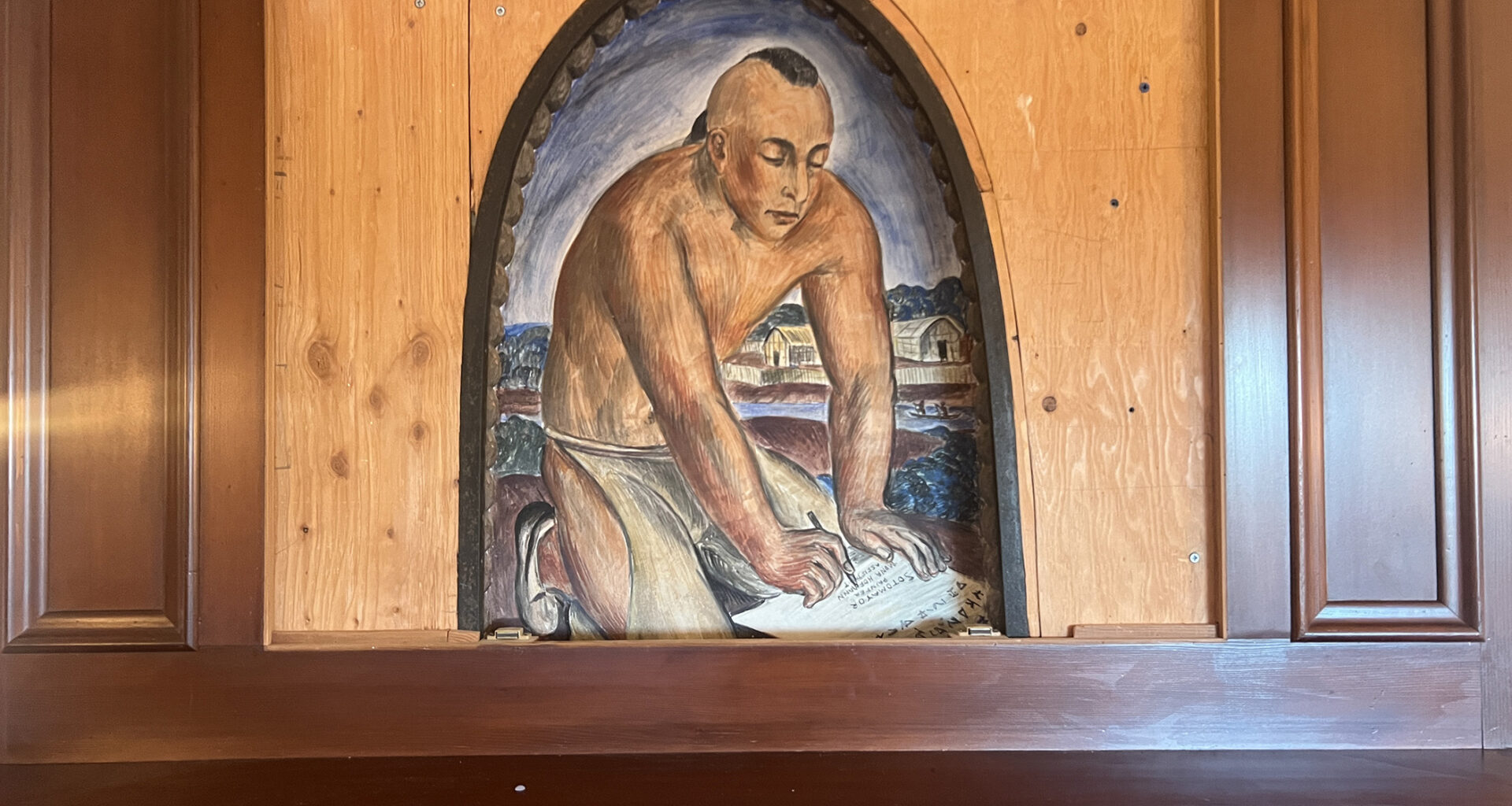
The owners of 2535 Vallejo St. in Pacific Heights got a hint of what might be hidden in their home when a stranger climbed their stairs 11 years ago.
“A historian knocked on the door and said they felt there was an important piece of art in this house,” said the property’s listing agent, Mary Lou Castellanos. “They [the owners] said, ‘we haven’t seen it, nor are we going to rip the house apart looking for it.’”
Fast forward 11 years. The owners were prepping the home for sale when painters pulled on a panel above the fireplace — and revealed a mural by Antonio Sotomayor, known as the “Artist Laureate” of San Francisco, concealed beneath it.
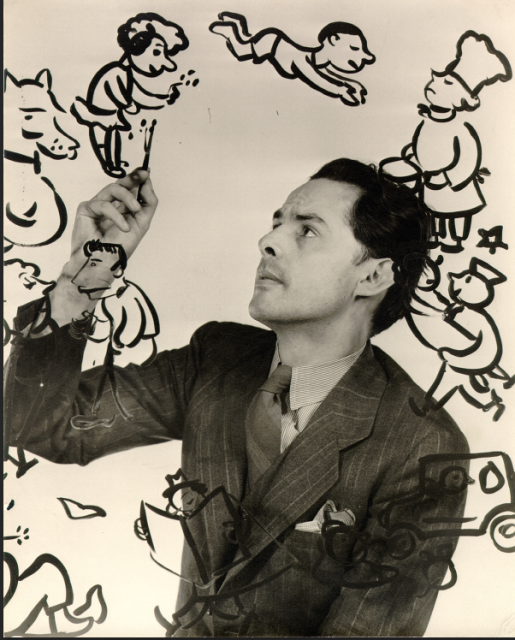 Antonio Sotomayor. San Francisco History Center, San Francisco Public Library
Sotomayor came to San Francisco from Bolivia in 1923 not knowing a word of English and found work as a dishwasher at the Palace Hotel. He held that job for only five days because after he drew a portrait of the chef, the owner’s wife hired him as an illustrator. He went from scraping plates to designing them. An archive of his work can be seen at the San Francisco Public Library’s History Center.
“His art career in San Francisco started a week after he got here and extended for 60 years,” said Will Maynez, a former City College of San Francisco faculty member and local mural expert. “In his early 80s, he did a series of murals at Grace Cathedral.”
Sotomayor’s artwork is associated with countless San Francisco places, big and small, awe-inspiring and everyday: those Grace Cathedral murals, Trader Vic’s Tiki barware, stage sets for multiple San Francisco Ballet productions, a children’s book about balloons. He kept up a lengthy correspondence with Leo Eloesser, Frida Kahlo’s famed doctor, and his caricatures appeared regularly in the newspaper.
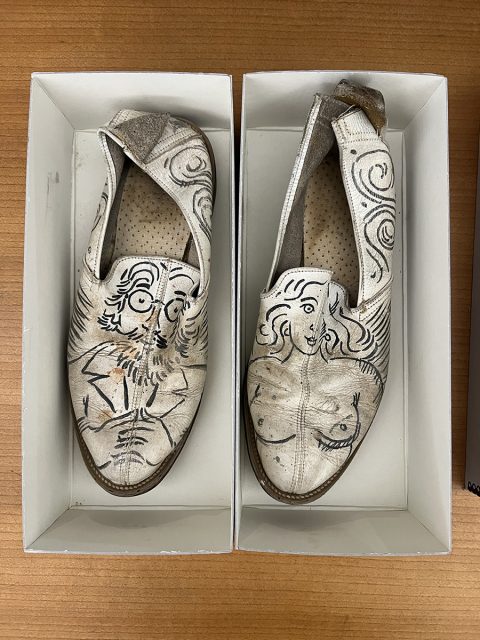 Antonio Sotomayor Papers, San Francisco History Center, San Francisco Public Library
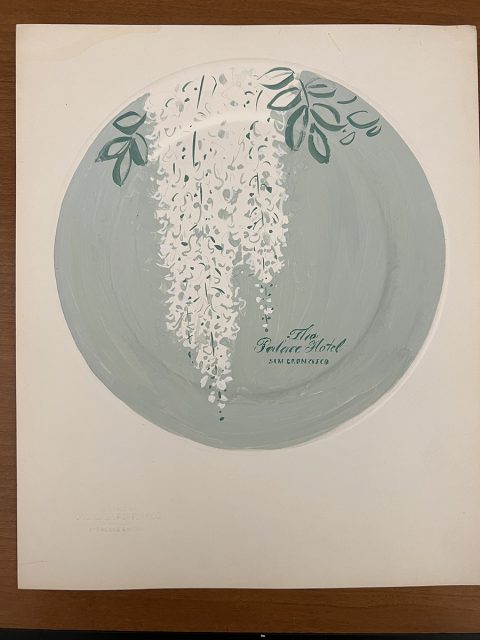 Antonio Sotomayor Papers, San Francisco History Center, San Francisco Public Library
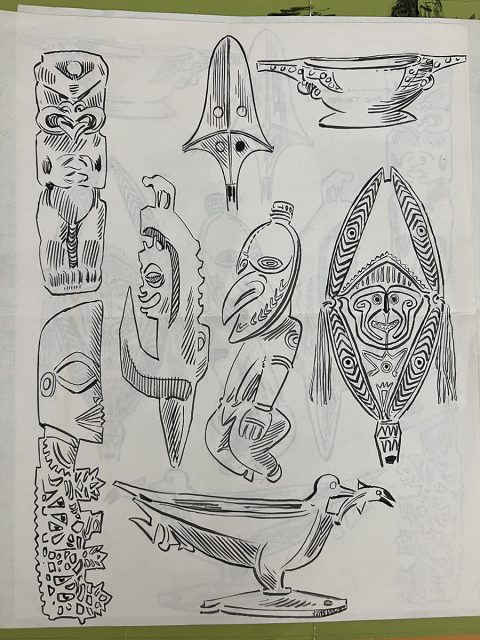 Antonio Sotomayor Papers, San Francisco History Center, San Francisco Public Library
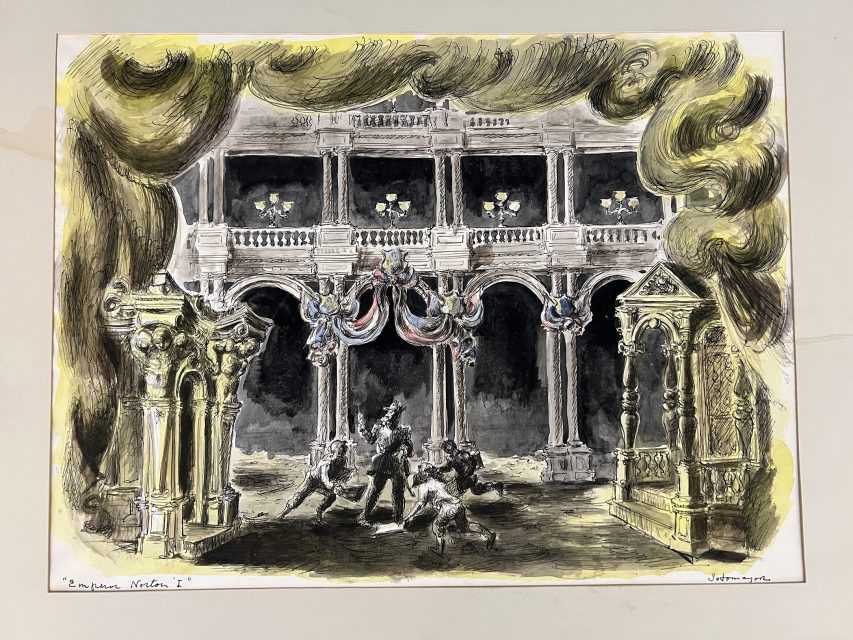 Antonio Sotomayor Papers, San Francisco History Center, San Francisco Public Library
“He’s a pixy, an elf, a man of enormous charm. There’s something almost fey about him. Everyone wants him. After all, there is no one in San Francisco who can really do the things he does,” reads the article, likening Sotomayor to as integral to the city as its cable cars and foghorns.
The remarkably versatile artist dabbled in genres, mediums and materials. He even designed a fountain for the 1939 Golden Gate International Exposition on Treasure Island, using terracotta from the clay producer Gladding McBean. “He essentially lived there for six months,” said Anne Schnoebelen, vice president of the Treasure Island Museum. “It’s three- dimensional tiles, an oval projection of the map of the Pacific […] and the tiles are individually set into a metal basin like a puzzle.” The fountain, incorrectly disassembled, now sits in storage.
“Soto,” as his friends called him, thought an artist should dabble widely — as he clearly did — and have no shame about artwork hanging in hotels and bars, where it would be seen by a greater audience. There was nothing he wouldn’t decorate, including the ceilings and cabinets in his Nob Hill home. Most surprising of all might be the slippers held in his archives, one foot decorated with a male figure, the other with a female one.
Given his description as “San Francisco’s Society Artist” in a 1966 San Francisco Sunday Examiner and Chronicle article, it’s perhaps no surprise one of Sotomayor’s pieces would end up in a lofty Pacific Heights perch designed by renowned architect Oliver Everett.
Sotomayor wasn’t just an artist but a socialite, who was invited to all the balls and cotillions, and — along with his wife Grace — sent everyone in his address book a custom-illustrated Christmas card. That’s likely how he came to know Dr. Mabel Wolfe, the owner of 2535 Vallejo at the time the mural was painted. They would have run in the same social circles, like the Family Club, an offshoot of the famed Bohemian Club.
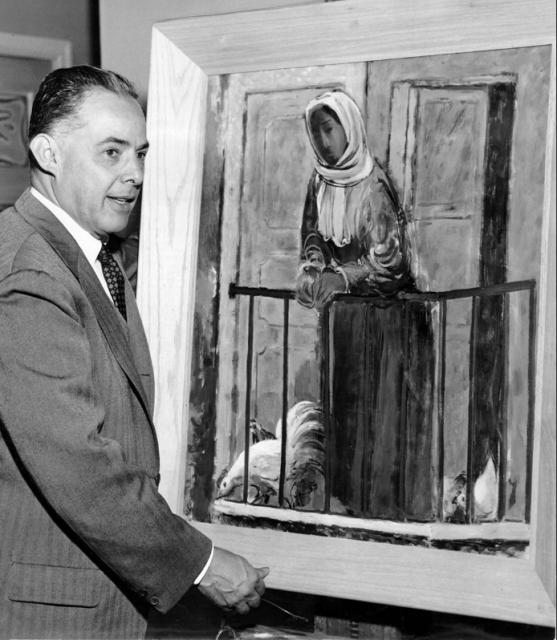 Antonio Sotomayor with one of his paintings. San Francisco History Center, San Francisco Public Library
The fireplace mural depicts a Native-looking figure signing a document — which is actually the signature of both Soto and his assistant, Mona Hofman, along with some faux-looking glyphs. Hofman also assisted Diego Rivera, who painted her into his iconic 1940 mural, “Pan American Unity.”
Sotomayor likely painted the mural around 1937, according to Maynez, when he and Hofman would have already been working together on a mural project in her Hillsborough home. “It’s a pre-Columbian idyllic situation,” Maynez said of the subject. “I wonder whether somebody was into western history and happened to live in the house.” Maynez guesses it’s acrylic, not a fresco, though professional testing could make an official determination.
The story of the mural’s discovery has another uncanny layer. Eight art experts and historians, including Maynez, had gathered in February to meet in the living room of a Cow Hollow home to discuss Sotomayor.
“I hadn’t been home for half an hour, and I get this call from a realtor,” Maynez said. “‘I got this house with a Sotomayor painting in it, would you like to see it?’”
Funnily enough, the realtor got Maynez’s name after making a call to Mexican art specialists, who had referred her to the expert who lived in her own city. “I get a lot of this rebound stuff,” Maynez said. “Somebody wants to do something here, and they call up Mexico, and Mexico will refer them to me.”
All the puzzle pieces came together. It remains to be seen whether the surprise discovery will have any impact on selling the house — and whether Sotomayor’s work will ever become well-known again.
“He’s the most famous San Francisco artist you’ve never heard of,” Schnoebelen said.
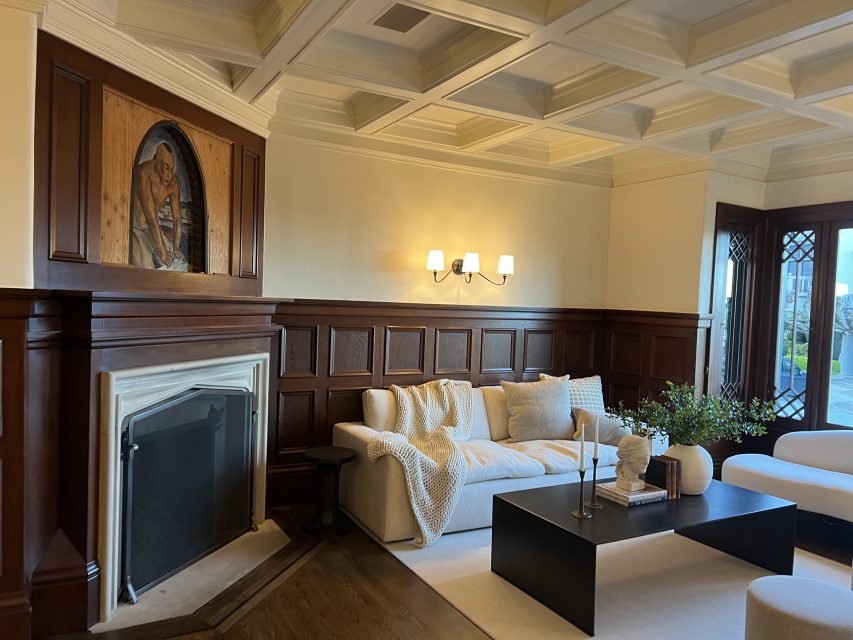 Room where Antonio Sotomayor mural was found. Photo by Julie Zigoris
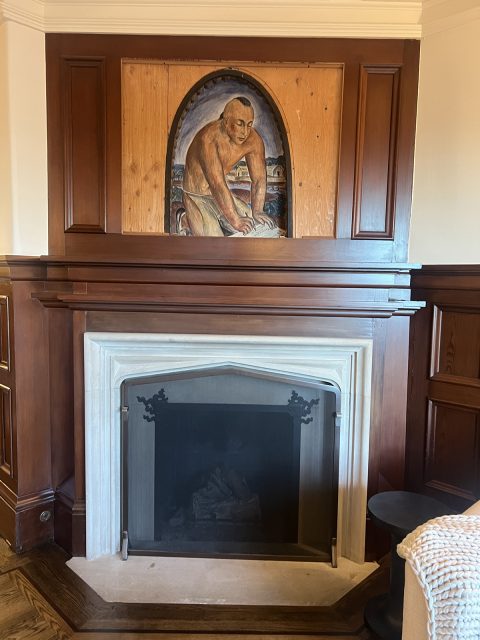 Antonio Sotomayor mural. Photo by Julie Zigoris