
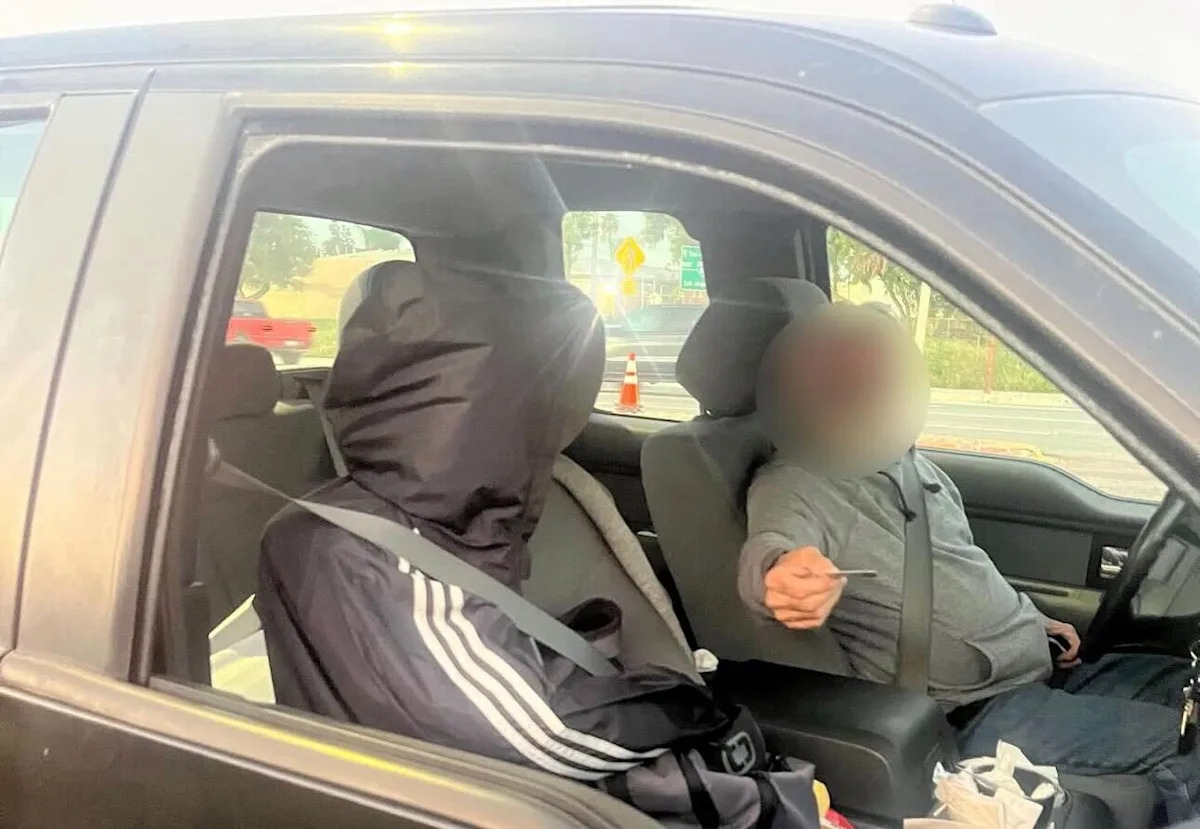
A California driver tried to outsmart traffic—and it didn’t take long for it to fall apart.
According to a social media post from the California Highway Patrol’s Baldwin Park station, an officer patrolling Interstate 10 near West Covina spotted a vehicle traveling in the carpool lane during peak hours that appeared to have a passenger.
At first glance, everything looked compliant. However, something about that “passenger” didn’t sit right.
A Closer Look Reveals the Truth
After taking a closer look, the officer determined the second occupant wasn’t a person at all. It was a jacket, carefully arranged in the front seat with a seatbelt fastened across it to resemble a human passenger.
CHP described the setup directly in its post, writing that the “passenger” was “a jacket carefully wrapped around the front seat with the seatbelt fastened across it to resemble a person.”
“Nice try — but jackets don’t count toward carpool lane requirements,” the agency added.
Officials also used the moment to reiterate that high-occupancy vehicle (HOV) lanes are reserved for vehicles that meet occupancy requirements, noting that “fictitious friends and mannequin copilots won’t cut it.”
Do Carpool Lanes Actually Work?
Carpool lanes, also known as HOV lanes, were designed to reduce traffic by getting more people into fewer cars. In theory, fewer vehicles should mean less congestion.
In practice, the results have been mixed.
Carpooling has declined over time, even as more HOV lanes were added. About 19.7% of commuters carpooled in 1980. By 2019, that number had dropped to just 8.9%.
There’s also what some call the “Goldilocks problem.” In some areas, HOV lanes sit nearly empty while traffic crawls next to them. In others, they’re just as congested as regular lanes during peak hours.
Enforcement adds another layer. Violations are common, and in some regions, studies have found large numbers of drivers in HOV lanes don’t actually meet the requirements.
At the same time, not everyone agrees on what that means. Supporters argue the lanes can still move more people per vehicle and improve travel times in certain corridors. Critics point to declining carpool rates and inconsistent usage as signs the system isn’t working as intended.
That tension is exactly what shows up in moments like this—where a simple traffic stop turns into a much bigger conversation about whether the system itself is working the way it was designed to.
The Line Between Creativity and Compliance
The situation itself is relatively straightforward. Carpool lane rules are clearly defined, and this did not meet them.
At the same time, the reaction highlights a broader reality. Long commutes and heavy traffic have a way of pushing people toward creative solutions, even when those solutions cross the line.
In this case, the idea may have been clever at a glance. But as CHP pointed out, it wasn’t enough to pass inspection.