
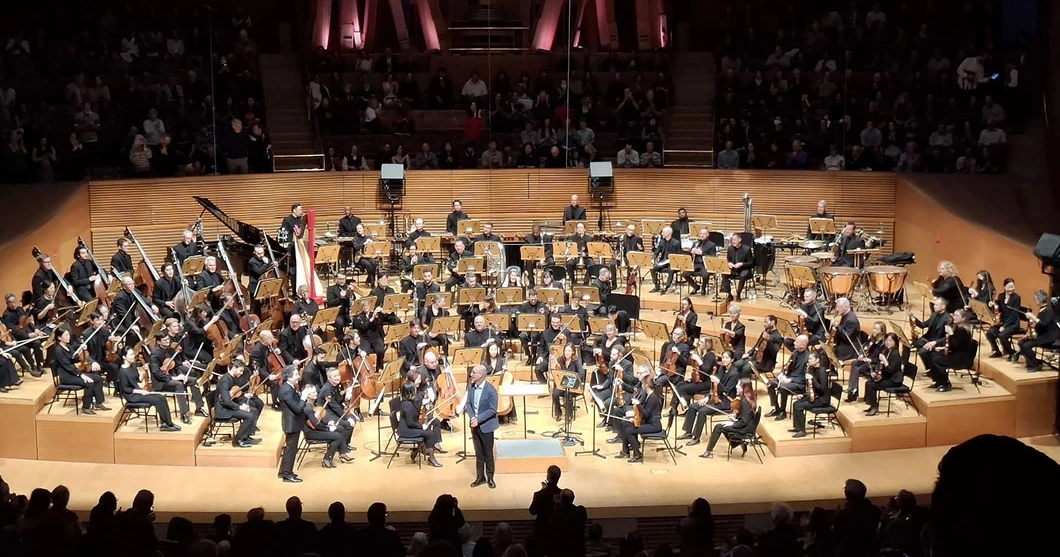
When Ricardo Lorenz returned to Walt Disney Concert Hall this February for the premiere of Humboldt’s Nature, it was less of a beginning and more like a homecoming. Lorenz found through a new commission from the Los Angeles Philharmonic a rare opportunity to weave together musical, cultural and personal elements through the story of famed German scientist Alexander von Humboldt.
Humboldt traveled through Venezuela from 1799-1800, keeping detailed notes and drawings of what he saw. He is revered in Germany and considered worldwide as the founder of modern geography and the father of ecology. But to Lorenz, for many years Humboldt was simply the name emblazoned on the side of the school he attended as a child. When reading Humboldt’s travel diaries in preparation for this new LA Phil commission, however, he recognized the landscapes the explorer documented and for the first time made the connection.
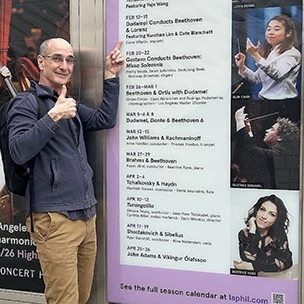 Professor of Composition and composer of Humboldt’s Nature Ricardo Lorenz points to his name on the poster outside Disney Hall, the home of the LA Philharmonic.
Lorenz’s collaboration with the LA Phil began four years ago with his Todo Terreno, a work commissioned through the orchestra’s Pan-American Music Initiative. Conductor Gustavo Dudamel enjoyed it so much that he programmed it multiple times and took it on tour through Europe with the Simón Bolivar Symphony Orchestra. That early success built a foundation of trust that made this new, larger commission possible. But Humboldt’s Nature stands in its own world: more ambitious, more expansive and profoundly reflective.
Lorenz, born and raised in Venezuela with paternal grandparents from Berlin, said that certain aspects of the Humboldt’s Nature premiere at Walt Disney Concert Hall in Los Angeles on Feb. 12 felt like déjà vu. But there was a new and emotional impact on his return to Disney Hall.
“I can’t help but to feel a part of that community of musicians and staff of the LA Phil, because they were so welcoming, so warm to me because they already knew me,” he said.
As rehearsals unfolded, that sense of community strengthened. It involved not only the musicians but also the constellation of people who help bring new music to life.
“There was trust on both ends,” Lorenz said. “There is collaboration not only with the conductor and the musicians, but with the staff of the LA Philharmonic.”
Enhancing experience for MSU students
One of those staff members, LA Phil librarian Stephen Biagini, is now extending that collaboration to MSU.
Later this semester, he will visit Lorenz’s orchestration class virtually to provide composition students with a behind-the-scenes look at how major orchestras prepare, manage and premiere new works. Lorenz is opening the session to the entire composition studio.
“He’s going to be zooming in for my orchestration class, but I’m going to open it up to all students in the composition studio because I’m sure they’re going to want to hear from a librarian of one of the top orchestras in the world,” Lorenz said.
 In addition to the Humboldt’s Nature premiere, the concert featured Beethoven’s Egmont adapted by writer Jeremy O. Harris, left, who enjoyed time after the show with Lauri Vorce and Ricardo Lorenz, Cate Blanchett who narrated Egmont, soprano Elena Villalón, and conductor Gustavo Dudamel.
Such activity represents one of many ways College of Music faculty utilize their professional relationships to enhance the experience of MSU music students. It will be the first of many opportunities following the star-studded events in California.
Humboldt’s Nature was paired in the LA Phil program with Beethoven’s Egmont overture, featuring expertly acted narration by Oscar-winning actor Cate Blanchett, and Schumann’s only piano concerto performed by 21-year-old Korean pianist Yunchan Lim.
Adding to the extravagance of the evening was an MSU reception for LA-area alumni, a West Coast kickoff of the new university-wide campaign, “Uncommon Will. Far Better World.”
Bridging a gap
Prior to the exciting premiere and surrounding events, Lorenz spent time in Berlin at the Berlin Brandenburg Academy of Sciences where he studied Humboldt’s original diaries and immersed himself in the explorer’s observations, sketches and descriptions of sound. He found community there, too, among the researchers who were thrilled to see the work of Humboldt explored musically.
“The linchpin is, of course, Humboldt,” Lorenz said. “It is his work that brought all of this together, making it feel so real, so genuine.”
The result is a 28-minute symphonic fantasy that follows Humboldt’s transformation as he journeys through the tropics: the convergence of cultures in New Andalusia, the haunting calls of the guácharo bird, the ecological lessons of Lake Tacarigua, the atmospheric expanses of the Orinoco River, and the moral reckoning of slavery in Cuba. Rather than depict these episodes literally, Lorenz traces how Humboldt’s worldview evolved — how a scientist became a humanist.
For Lorenz, the project also opened a path back to his own heritage. Though raised in Venezuela, he grew up aware of, but somewhat disconnected from, his German family history. Humboldt helped bridge that gap.
“My paternal grandparents were German,” Lorenz explained. “They came from Berlin, the city where Humboldt was born, so I was able to reconnect my German heritage through Humboldt. And that, to me, was extremely powerful. ”
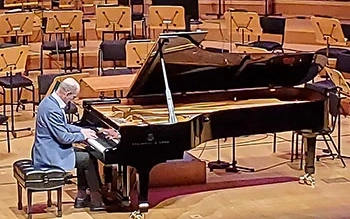 Ricardo Lorenz demonstrating at the piano during one of the pre-concert talks he delivered before each premiere performance at Disney Hall.
The power he felt on a personal level added to the excitement, but it also added to the pressure he felt leading up to the premiere. A few days before leaving for California, Lorenz noted his appreciation for the organizations that allowed him to create this work. MSU provided a Humanities and Arts Research Program grant to support his travel to and research in Berlin. The science academy in Berlin welcomed him and assisted in his research. And the LA Phil initiated the project and performed it brilliantly at the premiere.
“It is nerve wracking and very exciting at the same time,” Lorenz said. “This is a project that is very close to my heart and identity, and I feel an immense responsibility to represent well not only my musical concept but also the incredible institutions that have supported this creative effort.”
Following the premiere, audiences and musicians expressed that they felt Lorenz’s personal investment immediately. One reviewer responded with unusually detailed, movement by movement reflections. Orchestra members and concertgoers spoke with Lorenz after performances, describing how the piece carried them through its landscapes and emotions. And Dudamel himself expressed enthusiasm for bringing the work to future stages.
“They realized the power that the mind of a writer can have on a composer, and then through the composer, the impact that it can have on them through a medium like music, like sound,” Lorenz said.
Back in East Lansing, Lorenz is already sharing what he learned about research, collaboration, identity and the widening arc of artistic practice.
“My message to my students is that they need to see what they do holistically,” Lorenz said. “They need to start making connections the way we do when we mature and realize that everything is interconnected.”
Humboldt’s Nature is, in many ways, a culmination of childhood memories, of scholarly discovery, and of artistic trust. For Lorenz, it is also the beginning of a larger journey, one that continues in the classroom, in new collaborations, and in the quiet work of shaping what comes next.
This story originally appeared on the College of Music’s website.