
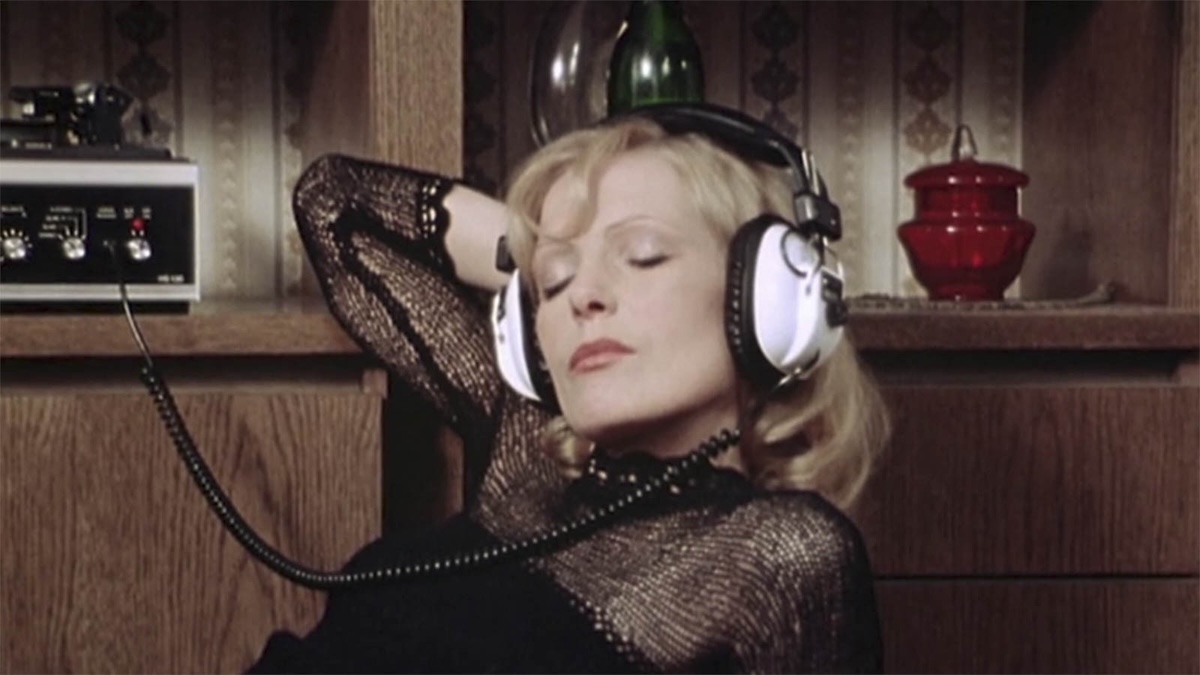
To a dedicated admirer of European movies, going to “Fassbinder and the New German Cinema,” a 20-title retrospective series now under way at the Berkeley Art Museum Pacific Film Archive (BAMPFA), is like tucking into a deluxe smorgasbord. Everything is tempting. Where to begin?
For the sake of argument, let’s zoom in on the work of the late director Rainer Werner Fassbinder, on the strength of his prodigious filmography as well as for the never-flagging sense of skeptical contemporaneity in his best pictures. For his relevance to German-language cinema as well as for the excitement Fassbinder stirred up in art houses worldwide, there’s probably no filmmaker to compare him against—although Werner Herzog is a very tough also-ran.
Several of Fassbinder’s “greatest hits” are part of the series, but the “overlooked” titles contain rewards of their own.
Take Fear of Fear (Angst vor der Angst), a 1975 TV melodrama built around Margot (Margit Carstensen), a bewildered housewife cruising for a nervous breakdown, or worse. Plotted by Fassbinder with writer Asta Scheib, the tale of Margot’s humdrum family life takes a bizarre turn when she loses interest in her dead-wood hubby (Ulrich Faulhaber) and new baby, and turns to Valium and booze. Fassbinder’s stock company of actors is present in full regalia (Irm Herrmann! Ingrid Caven! Brigitte Mira!) to disapprove of Margot, as is the director’s devotion to Hollywood soap-opera auteur—and compatriot—Douglas Sirk. In the hands of a Sirk or a Claude Chabrol, a character as violently delusional as Margot would probably wind up dead. Fassbinder is too cruel to allow that. Fear of Fear plays BAMPFA on March 28.
Chinese Roulette (1976) comes from the same social-problem file as Fear of Fear, here equipped with first-class production values by cinematographer Michael Ballhaus and composer Peer Raben. Upscale Munich resident Ariane Christ (Margit Carstensen), mother of a disabled teenage daughter named Angela (Andrea Schober), is leaving town for a getaway weekend with her other man (Ulli Lommel). Meanwhile, Ariane’s businessman husband Gerhard (Alexander Allerson) is also escaping home, for a hot weekend with his French girlfriend (New Wave star Anna Karina). However, Ariane’s left-out daughter has arranged a surprise for her cheating parents and their playmates: They’re unwittingly all being herded to the family’s summer home.
Naturalistic acting was never a Fassbinder specialty. While the adulterous adults are busy tossing emotional hand grenades at each other, young Angela is revealed as a diabolical avenger on crutches, shades of Catherine Deneuve in Luis Buñuel’s Tristana. This neglected adolescent, who loves the poetry of Arthur Rimbaud, emerges as the grand inquisitor. Fassbinder’s idea of unhappy-family high jinks encourages the combatants to laugh at each other—Americans would throw a fit or pull out guns. Chinese Roulette screens April 5.
Chinese Roulette and Fear of Fear are brilliant meditations on Sirk. Meanwhile In a Year of 13 Moons (1978) functions as a semiautobiographical character study, rare for Fassbinder, who wrote, produced, shot and edited it, in addition to directing. It’s less academic and far more disturbing.
Erwin “Elvira” Weisshaupt (unforgettably portrayed by Volker Spengler) is a frustrated, mixed-up post-op transgender woman, forever unlucky in love. No matter how hard she tries, Elvira’s life is a carnival of suffering, abuse and low self-esteem. Warning to prospective first-time audiences: the initial 30 minutes of the film may prompt walk-outs by the squeamish. The pic is a personal, often brutal portrait of a character desperately in search of love, alternately helped/hindered by more actors from the perennial stock company. The film was evidently prompted by the death of the filmmaker’s real-life lover, actor Erwin Meier. In true Fassbinder fashion, Elvira’s mishaps are often as cartoonish as they are pathetic (May 13).
This series, which also includes titles by Volker Schlöndorff , Margarethe von Trotta, Alexander Kluge, Werner Herzog, Ulrike Ottinger, Hans-Jürgen Syberberg and Wim Wenders, is copresented by Goethe-Institut San Francisco.
* * *Now through May 17 at BAMPFA, 2155 Center St., Berkeley. 510.642.0808. bampfa.org