
Why this matters
Lawmakers faced a lack of coherent data while designing new e-bike rules, leading to debate over the best way to regulate the increasingly popular mode of transportation.
We stay on top of e-bike news for San Diego. Help us keep reporting.
Give $10
A few years ago, people walking into Sharp Coronado Hospital’s emergency room with e-bike injuries was a rare, maybe occasional, occurrence.
Now, Dr. William Bianchi said, it happens weekly.
“These things are basically like small motorcycles in my mind,” said Bianchi, the hospital’s medical director of emergency medicine.
Concussions, bone fractures, sprained ankles — those are common, he said. But he worries about more severe injuries: a collapsed lung that requires a chest tube, or worse, a cerebral hemorrhage that causes irreversible brain damage.
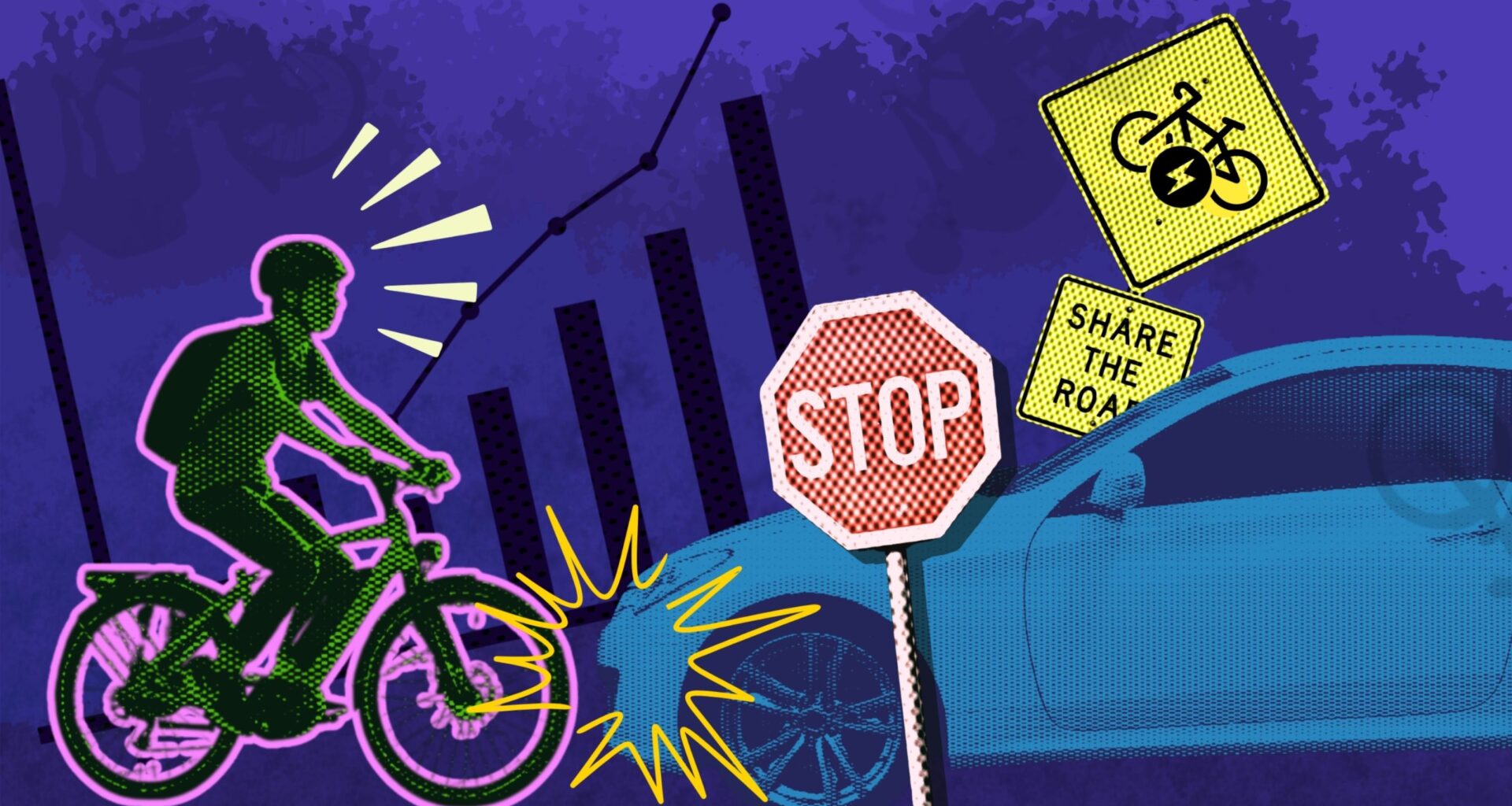
E-bikes have soared in popularity in the past few years. Injuries have skyrocketed, too. Lawmakers at the city and state level have responded with legislation, including a pilot program in San Diego County that sets an age limit for riders. But they’re relying on public safety data that is far from comprehensive.
Doctors who are treating e-bike injuries say something needs to be done.
Bianchi said e-bike injuries could quickly overwhelm the small Coronado hospital and its 15-bed ER.
“We can take care of a trauma patient, but there’s no saying how sick you are, and there’s no saying how long it’s gonna take for me to get you from Coronado to the specialized trauma center if that’s what you need,” he said.
‘The numbers keep on increasing’
Local data shows e-bike injuries at trauma centers, better equipped for treating the most severe injuries, are on the rise.
In 2024, the county’s system of trauma centers reported 294 e-bike injuries — a 54% jump from the 191 reported the year prior. There is no comprehensive data beyond those two years, as the county grouped the injuries with motorcycles until 2022.
“If you were to ask anybody who deals with trauma patients, the first thing that will come up is the increase in these e-bike crashes,” said Zachary Heinemann, trauma program manager at Palomar Medical Center.
There’s been a massive rise in e-bike injuries among local children, especially.
Rady Children’s Hospital reported three e-bike injuries in 2021. Last year, that number had skyrocketed to more than 250.
“The numbers keep on increasing, and it seems like every two years it’s doubling,” said Dr. Romeo Ignacio Jr., a pediatric surgeon at the hospital.
He said the typical age range he sees is 12 to 16. He’s treated patients as young as 4 years old.
Doctors at both trauma centers say they see a range of incidents, from reckless riding to drivers’ poor reactionary time.
“Most injuries we encounter are not accidental. Somebody has made a choice,” said Dr. John Steele at Palomar. “It’s the choice to ride it in an unsafe manner.”
San Diego researchers this month shared preliminary findings at an annual conference in New Orleans showing what doctors say they already know: Due to greater velocities, e-bike riders were nearly 2.5 times more likely to sustain an extremity injury than pedal bicycle users, the San Diego Union-Tribune reported.
Tracking collisions
Each of the county’s 18 cities regulates e-bikes differently, whether that’s banning them from sidewalks, putting an age limit on ridership or confiscating bikes from those riding recklessly.
So far, six — Carlsbad, Poway, San Marcos, Chula Vista, Coronado and Santee — have used a state law specific to the county that allows them to prohibit people under 12 from riding e-bikes.
Leaders who adopted the law said that it was a good step, but several legislators and community members also said that it would not solve the main problem: teenagers riding recklessly. In Carlsbad, for example, roughly over half of the injuries from 2019-25 were among kids between 12 and 17.
But even as local elected officials increasingly consider more e-bike regulations, some police departments lack a special classification for e-bikes, or don’t have a system in place that allows them to easily sort the numbers.
The county Sheriff’s Office, which serves as the main law enforcement for most North County cities, said it does not track independent statistics specific to e-bikes. The department said it could only provide inewsource with general collision statistics.
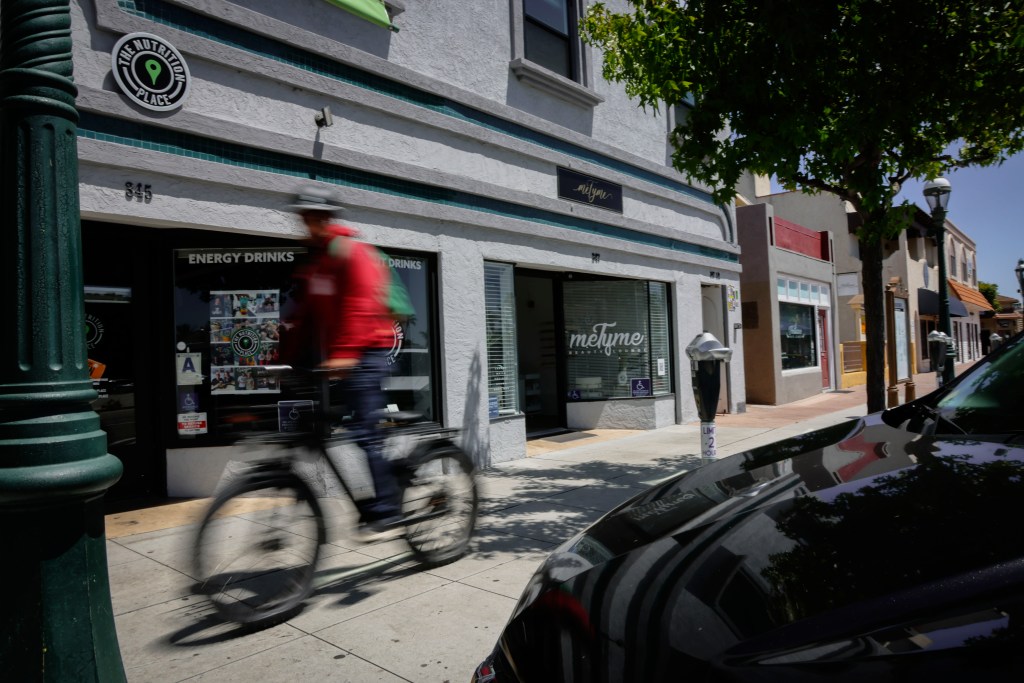 A man rides an e-bike along Third Avenue in Chula Vista on Aug. 5, 2025. (Sandy Huffaker for inewsource)
In Chula Vista, records obtained by inewsource show that the city’s Fire Department responded to 16 collisions involving e-bikes during the 2025 fiscal year. A motor vehicle is involved in nine of them, though the data doesn’t provide more details and the department says the information is largely collected from narrative accounts.
In the records, the fire department noted that the e-bike data is “not purposely collected,” nor does it plan to collect in the future. Chula Vista passed its e-bike regulations in August.
San Marcos reported 80 e-bike collisions between January 2023 and August 2025, according to records that inewsource obtained.
Oceanside’s data showed a dramatic increase: some 800 e-bike-related calls for service in 2025, compared to just 69 four years ago. But the city also lacks a way of singling out e-bike specific incidents: Its system does not make a distinction between e-bikes and pedal bicycles, Oceanside Police Capt. Scott Garrett said.
“Hopefully, when we get a new records management system, it will track the distinction,” he said.
Carlsbad reported nearly 220 crashes between 2022 and 2025, 63% of which it found were the fault of the e-bike rider. Of those 136 “at-fault e-bike collisions,” the largest group was riders between 12 and 17 years old. There were nine crashes for riders under 12, three of which involved a transport to the hospital.
But a ban may not be the answer, some say.
“E-bikes are new, they are here to stay and putting a strict ban on them is a way to limit the amount of usage, but at the same time, people aren’t going to follow the rules,” said Heinemann, Palomar’s trauma program manager.
And some advocates say e-bike users are being unfairly generalized. They favor an education-first approach.
Ian Hembree, the advocacy and community manager at the San Diego Bicycle Coalition, questioned whether there’s sufficient data to support a ban on riders under 12.
He said many of the behaviors people complain about are already against the law and that when cities enact a ban, they’re just “lumping in the unlawful riders that you want to regulate with the lawful riders and kids that just want to ride their e-bike to school like a half-mile away.”
Hembree also said that a key problem is that there are many e-bikes on the market that are faster and more powerful than the state allows. California Sen. Catherine Blakespear, D-Encinitas, introduced a bill that would prohibit manufacturers and sellers from labeling an electric vehicle as an e-bike if it doesn’t meet the requirements.
“In a perfect world, we would have education for all the kids and meaningful distinctions in the goods we purchased so that consumers are protected from companies,” Hembree said.
More restrictions?
Carlsbad first voted in favor of e-bike regulations in December with wide support. Councilmembers want to explore even more restrictions, including possibly pushing for state legislation that would allow them to raise the age requirement to 16, like a pilot program that was launched in the Bay Area’s Marin County.
At the time, Carlsbad Senior Assistant Attorney Jennifer True said that a different state law was also commissioning a comprehensive study on e-bikes.
“Until that statewide analysis is complete,” she said in December, “cities like Carlsbad must continue to rely on local data and real world experiences to help shape interim safety decisions.”
That study came out at the end of 2025, and found that the number of crashes involving e-bikes grew to 961 in 2024, up from 1 in 2017.
Oceanside took a markedly different approach, adopting new rules in January that allow police to temporarily confiscate e-bikes for what officials described as safety reasons, including for people with two or more bike-related criminal violations within a year. The bikes would be held as evidence until the case is closed, and the owner can get it back afterwards without paying any fees.
Encinitas is entertaining similar rules, though the city pushed discussion to a future City Council meeting.
The Imperial Beach City Council directed staff in January to begin drafting regulations, starting with banning Class 3 e-bikes from all sidewalks and areas where speed limits are around 40 mph. Councilmembers opposed adopting a ban on riders under 12 years old, with at least one official raising concerns about reporting data to the state.
The bill requires the cities to report the data so that the state can use it to guide policy going forward.
Chula Vista Councilmember Michael Inzunza, who led the city’s latest ordinance changes on the e-bikes, wants to take rules even further for Class 3 e-bikes.
“If it was up to me, it would be 16 years old and a driver’s license,” Inzunza said.
He said he wants state legislators to draft a law that would require a driver’s license to ride a Class 3 e-bike. Those bikes have the highest speeds and already require riders to be at least 16 years old.
Ignacio, the Rady Children’s doctor, said he has helped lead workshops in Chula Vista about e-bike safety. He has also contributed to research on injury rates, and is working with state senators on more e-bike laws that would apply across California.
Ignacio said a federal bill in the works could collect national data on e-bike riders to help inform safety laws. But for now, he and other experts urge e-bike riders to wear helmets and ride safer.
“Waiting for that data,” he said, “that’s gonna probably take five, 10 years from now. That’s a lot of kids who are gonna get injured.”
Type of Content
News: Based on facts, either observed and verified directly by the reporter, or reported and verified from knowledgeable sources.