
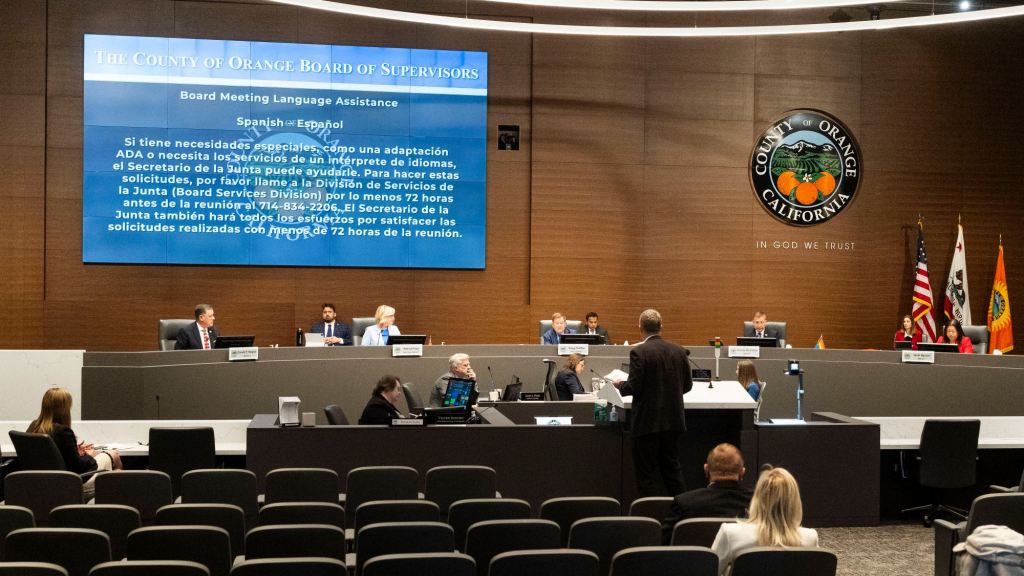
The OC Board of Supervisors discussed the need for more transparency measures and to inspire changes to a culture of government that enabled disgraced former Supervisor Andrew Do to direct contracts and payments to allies with little oversight.
The county’s five supervisors discussed for the first time publicly on Tuesday, March 24, the results of a county-commissioned audit that said Do and his chief of staff, Chris Wangsaporn, bullied county staffers who asked questions or raised concerns, establishing “a culture where decisions related to District 1 contracts were not to be questioned.”
Do pleaded guilty in 2024 to accepting $550,000 in bribes to steer $10 million in pandemic relief funds to charities he was affiliated with, including one that employed his daughter, for contracts to provide meal programs that authorities said were not fulfilled. But the audit by Houston-based accounting firm Weaver said, “contracts appeared to have been steered toward businesses that employed an immediate family member of Former Supervisor Do, businesses that contributed to his political campaigns shortly after being awarded a contract, businesses that provided a media platform for Former Supervisor Do, as well as businesses involved in various aspects of the Tet and Moon festivals put on each year for District 1 ‘constituents.’”
Do, who is serving a five-year sentence in federal prison, and his chief of staff used their influence to subvert the county’s vetting and procurement processes, said the audit’s authors, and would go over the heads of staff members who complained. Wangsaporn could not be immediately reached Tuesday for comment.
Second District Supervisor Vicente Sarmiento said Tuesday there is now an opportunity for the county to fix the culture of influence and intimidation that appeared to prevent employees from successfully reporting wrongdoing by elected officials — a problem he said is not unique to Orange County.
“I don’t think we’ll be able to eliminate bad behavior or bad conduct,” Sarmiento said, “but we certainly can go a long way into making sure there’s not complete deference to board offices.”
Sarmiento suggested the board look into expanding the power of the ethics officer and the county’s ethics commission, which at the moment is “really, really toothless,” he said. The board might also consider posting online its public contracts so they’re more readily accessible to residents, he said.
Fifth District Supervisor Katrina Foley suggested that the county create a more organized and easily navigable transparency portal on its website, where the public can search for each board office’s financial documents.
“We do not have a good website that’s current, that allows for everything to be centered in one location,” she said.
Foley said the county had already implemented most of the auditors’ recommendations, including requiring nonprofits that contract with the county to prove they have active nonprofit status.
Foley said she supports exploring the remaining new recommendations, including an evaluation of the county’s current fraud reporting hotline, but wants a way to ensure that these new changes are effective.
“What’s to say that all these new protocols that we have now will work?” Foley asked. “What else do we need to do to make sure that when a county staff member or community member or a contractor of the county makes an official complaint, that it actually gets investigated by an objective third party?”
The board contracted Weaver in November to review 1,500 county contracts in the wake of Do’s guilty plea. The first phase of the four-part probe recently released investigated 145 “top priority” contracts amounting to $486 million in taxpayer money.
Heading into the probe’s second phase, First District Supervisor Janet Nguyen asked the auditors to further investigate a printing contract Do’s office entered into for 54,000 invitations to the District 1-sponsored Tet and Moon Festivals.
“How much was billed out for which mailer? What’s the cost per piece? What’s the cost per postage?” Nguyen asked. Specifically, she wanted to know whether Do received a reduced price for the mailers at the county’s expense.
Nguyen also urged the auditors to share information with CalOptima, which conducted its own audit into Do’s actions during his tenure on that board; CalOptima oversees public health insurance for the county’s poorest residents.
“I want to make sure that we don’t take these reports just to read it and file it,” Nguyen said. “We want to take the next step.”
The audit is reviewing county contracts, including all within the County Executive Office, Health Care Agency, OC Community Resources and the Social Services Agency, between January 2019 and August 2024.
Phase Two will look at 681 high-priority contracts worth $1.7 billion. In total, about $4.2 billion in spending is expected to be reviewed by the completion of the fourth phase.