
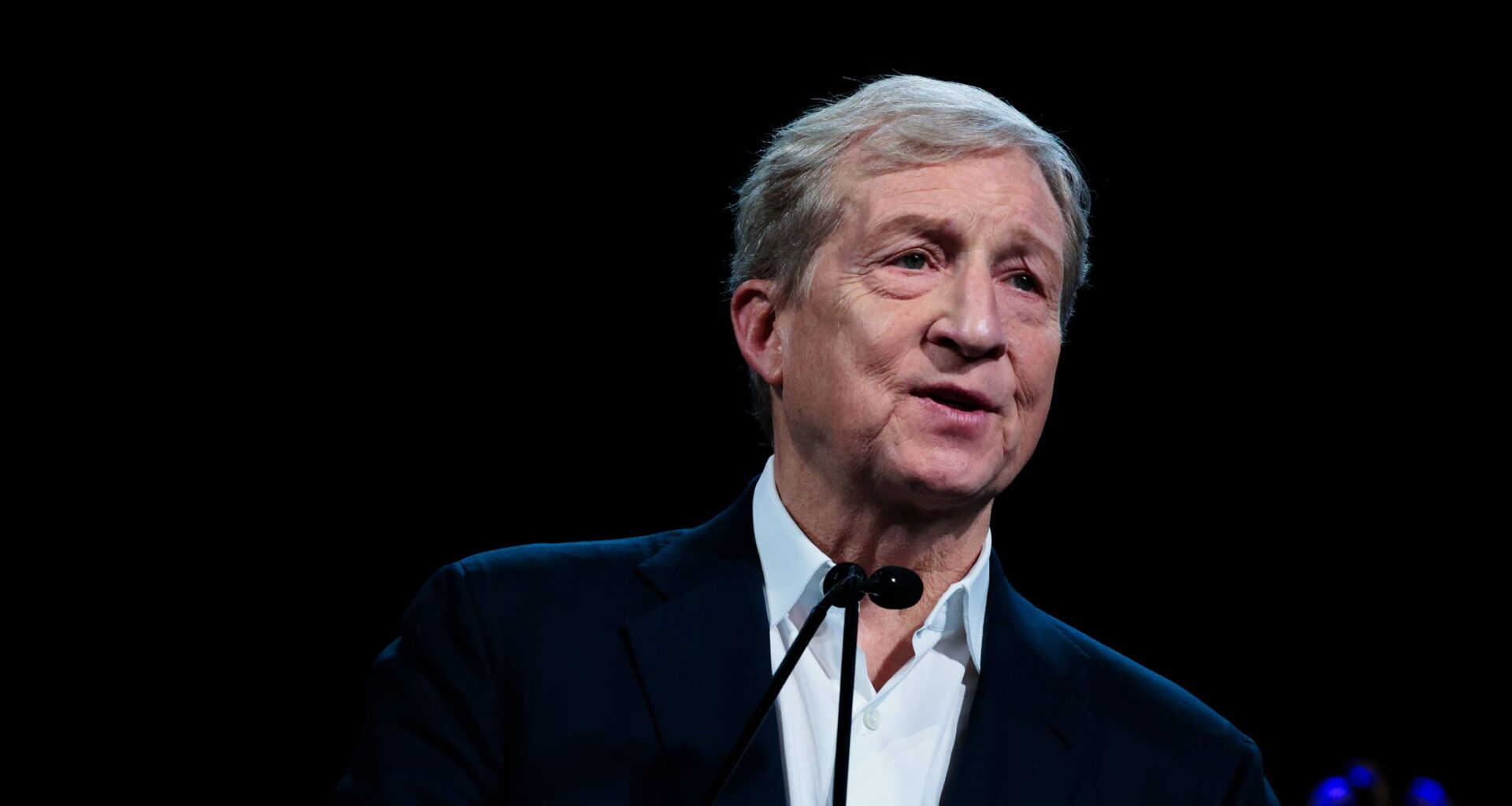
Author and former Fox News host Steve Hilton announced his run as a Republican candidate for California governor in Huntington Beach (Orange County) nearly a year ago.
Paul Bersebach/Associated Press
Californians will receive their June 2 primary ballots in early May and yet there remains a “historically high” level of unawareness of the election to choose a new governor, a collective statewide shrug that is increasing the likelihood that a Republican will be the next governor of deep blue California.
The big questions surrounding the race continue to be: “Who’s that?” and “Who cares?”
Article continues below this ad
While record numbers of people are expected to take to the streets for Saturday’s anti-Trump No Kings demonstrations across the nation, California’s likely voters have yet to show the same sort of interest in the race for governor. Termed-out Gov. Gavin Newsom has not endorsed a candidate.
Rep. Eric Swalwell, D-Castro Valley, a candidate for California governor, is seen here during a House Judiciary Committee hearing at the Capitol in January.
Mark Schiefelbein/Associated Press
The percentage of voters who have “no opinion” of a candidate ranges from a high of 67% for former state controller Betty Yee to a low of 29% for former Rep. Katie Porter, according to a Berkeley IGS poll released last week. That disinterest — along with the large number of Democratic candidates dividing their party’s vote — is fueling the chances of two Republicans facing off in the general election, which was 20% on Monday, according to an online tool developed by political data expert Paul Mitchell that runs thousands of simulations of the race. The top two candidates in the primary, regardless of party affiliation, advance to the general election.
San Francisco Chronicle Logo
Make us a Preferred Source to get more of our news when you search.
Add Preferred Source
“That’s a historically high lack of awareness. They’re just not tuning in,” said Mark DiCamillo, director of the Berkeley IGS Poll.
Article continues below this ad
On Tuesday, USC canceled a debate between six of the candidates: former Fox News commentator Steve Hilton, Riverside County Sheriff Chad Bianco, Rep. Eric Swalwell, Porter, billionaire climate advocate Tom Steyer and San Jose Mayor Matt Mahan. Hilton led the Berkeley poll with 17%, followed by Bianco with 16%, and Swalwell and Porter with 13% each. The survey found that 16% of the voters were undecided.
California gubernatorial candidate Katie Porter speaks at the California Democratic Party convention in San Francisco in February.
Jeff Chiu/Associated Press
Four of the lower-polling Democrats — Yee (1% in the Berkeley IGS poll released last week), state Superintendent Tony Thurmond (1%), former Los Angeles Mayor Antonio Villaraigosa (4%) and former Secretary of Health and Human Services Xavier Becerra (5%) — complained last week in a joint press conference about being excluded from the debate, noting that the only four candidates of color in the race were not invited.
“We recognize that concerns about the selection criteria for tomorrow’s gubernatorial debate have created a significant distraction from the issues that matter to voters,” the university said in a statement announcing the cancelation. “Unfortunately, USC and (co-sponsor) KABC have not been able to reach an agreement on expanding the number of candidates at tomorrow’s debate. As a result, USC has made the difficult decision to cancel tomorrow’s debate and will look for other opportunities to educate voters on the candidates and issues.”
But other forces within the party, fearful of Democrats getting frozen out of the general election, would like to see their field shrink to increase the probability of a Democrat making it to the general election.
Article continues below this ad
Last month, California Democratic Party Chair Rusty Hicks Hicks wrote an open letter to the Democrats in the race, telling them “it is imperative that every candidate honestly assess the viability of their candidacy and campaign.” Days later, Hicks announced the state party would spend hundreds of thousands of dollars on publicly releasing six polls of the race, a nudge to publicly shame the lower-ranking candidates to bow out of the race.
On Tuesday, the party was set to release the first of six polls it has commissioned designed to show the public, media and donors the state of the race.
California gubernatorial candidate Tom Steyer delivers remarks during the California Democratic Party convention at Moscone Center in San Francisco in February.
Yalonda M. James/S.F. Chronicle
Among my questions: Why is Steyer not being asked to leave the race? The former San Francisco hedge fund manager has spent nearly $90 million of his own money, but has only clocked 10% in the IGS poll. Given that return on investment, aren’t voters telling Steyer they’re just not that into him?
“It’s certainly striking that even after all of that money, he has not gotten more support,” said Erick Schickler, a professor of political science at UC Berkeley. “I think a reasonable case could be made that if a Becerra or Villaraigosa had all of that money to spend, they might be able to do better than 10%.”
Article continues below this ad
But, pointed out DiCamillo, “Tom Steyer is one of the guys who’s moved the most between October and March. He moved from 1% before his ad campaigns began to 10%. He is the candidate who’s got the greatest amount of momentum, if you look at the change.” Hilton’s support over that period moved a similar distance, from 8% to 17%.
San Jose Mayor and California gubernatorial candidate Matt Mahan speaks while being interviewed at the California Democratic Party convention.
Jeff Chiu/Associated Press
Plus, Steyer is racking up a wide variety of endorsements, most strikingly from some of the most progressive corners of the California Democratic Party universe who appear unbothered by endorsing the race’s lone billionaire. He’s been endorsed by the California Nurses Association; the California Donor Table, which focuses on electing progressive candidates, particularly people of color; the California Labor Federation (jointly shared with three other Democrats); criminal justice advocacy organization Smart Justice and California Environmental Voters (co-endorsement with Porter).
California Donor Table CEO Ludovic Blain said Steyer has “gone all the way from investing in prisons and other things to being endorsed by progressive criminal justice groups because he’s good on criminal justice. He has really changed his trajectory of investing and spending in ways that these donors (to other candidates) have not yet.”
With all of those validators — and a bottomless wallet — Steyer is unlikely to leave the race. He has a 23% chance of making it into the top two, according to Mitchell’s modeling.
Article continues below this ad
California gubernatorial candidate Xavier Becerra delivers remarks during the California Democratic Party convention at Moscone Center.
Yalonda M. James/S.F. Chronicle
But other Democrats in the race have finite resources. And they share an overwhelming problem for themselves and others who don’t want to see a Republican leading California: None of the Democrats are setting voters’ hearts aflutter. All of the Democratic candidates — except Becerra — have a higher unfavorable rating than a favorable one. Becerra has an equal percentage (26%) of each. His problem is that 48% of voters have no opinion of him, according to the survey.
“There’s just no star in the race for the Democrats,” Schickler said. “No obvious person that everybody’s going to focus on. I think they’re all viewed by Democrats as kind of similar, basically mainstream, kind of normal Democrats. There aren’t, like, glaring differences” between them.
Democratic candidate Antonio Villaraigosa speaks at a gubernatorial candidate event in Sacramento in May 2025.
Andri Tambunan/For the S.F. Chronicle
One reason for the splintered support is that voters are widely divided in what they want from the next governor, according to the survey. Topping the list of what voters want from the next governor is to “aggressively fight Trump administration policies,” which 42% of voters selected as an important attribute. Cited next (28%) is the attribute of being “progressive in politics.” But voters were split on more than two dozen other attributes in the survey, ranging from environmental to labor concerns.
“No one as yet has won over a large segment of Democratic voters with a clear message about what they want this election to be about,” DiCamillo said.