

In summary
Over 250 college students spent a day lobbying at the California Capitol recently, holding over 100 meetings with state leaders and their staff. The students are backing several bills aimed at increasing basic needs support, including one to streamline CalFresh applications and another to reform the process for building student housing. They also are leading the push to add more student voting power to the UC Board of Regents.
Welcome to CalMatters, the only nonprofit newsroom devoted solely to covering issues that affect all Californians. Sign up for WhatMatters to receive the latest news and commentary on the most important issues in the Golden State.
UC students have been waiting years for this moment — another chance at a bill to add a second student seat with voting power to the UC Board of Regents. Earlier this month, the bill was reintroduced as over 250 college students spent a day lobbying at the California Capitol, holding over 100 meetings with state leaders and their staff on various issues across all UC campuses.
“It’s time to put students first,” said Assemblymember Jessica Caloza, a Los Angeles Democrat who authored the bill. “On this 26-member body, the UC Board of Regents, the student voice and the student experience cannot be an afterthought.”
The bill, ACA 18 or the Student Regent Empowerment Amendment, was introduced on the Assembly floor during the UC Student Association’s annual lobbying day on March 9, which brought together UC students across all nine undergraduate campuses to engage with elected officials on issues affecting students across the system. Students pushed for key bills to boost basic needs access, including streamlining CalFresh applications and reforming the California Environmental Quality Act to make it easier to build student housing.
For years, UC students have been advocating for the addition of a second voting student regent to the UC Board of Regents, the system’s governing body that sets policy and votes on issues like tuition. Currently only one student regent can cast a vote.
Now, students have found a champion in Caloza — someone who herself once lobbied on the Capitol’s steps, just like them, as part of the student association 16 years ago as an undergrad at UC San Diego.
“It feels at first scary to step into the spotlight as a student who was, at the time, broke, burdened, tired, hungry — to think that I had a voice at the table, that my voice mattered,” Caloza said. “It was UCSA who empowered me, who educated me to say that not only are students powerful, but together, students are unstoppable.”
After Caloza introduced the amendment on the Assembly floor, Assemblymember Josh Lowenthal, a Democrat from Long Beach, asked students to remain standing in the gallery if they planned to run for the Legislature one day. Over half of the students remained standing.
“Let’s go,” Lowenthal said. “The leaders of tomorrow, we are counting on you.”
Caloza’s bill proposes an amendment to the California Constitution that would add voting power for a second student regent, with one student representing undergraduates and the other representing graduate students. California voters would still have to OK the amendment if the Legislature passes it.
Just the right amount of news
Just the right amount of news
Get California’s most essential headlines without feeling overwhelmed.
Get California’s most essential headlines without feeling overwhelmed.

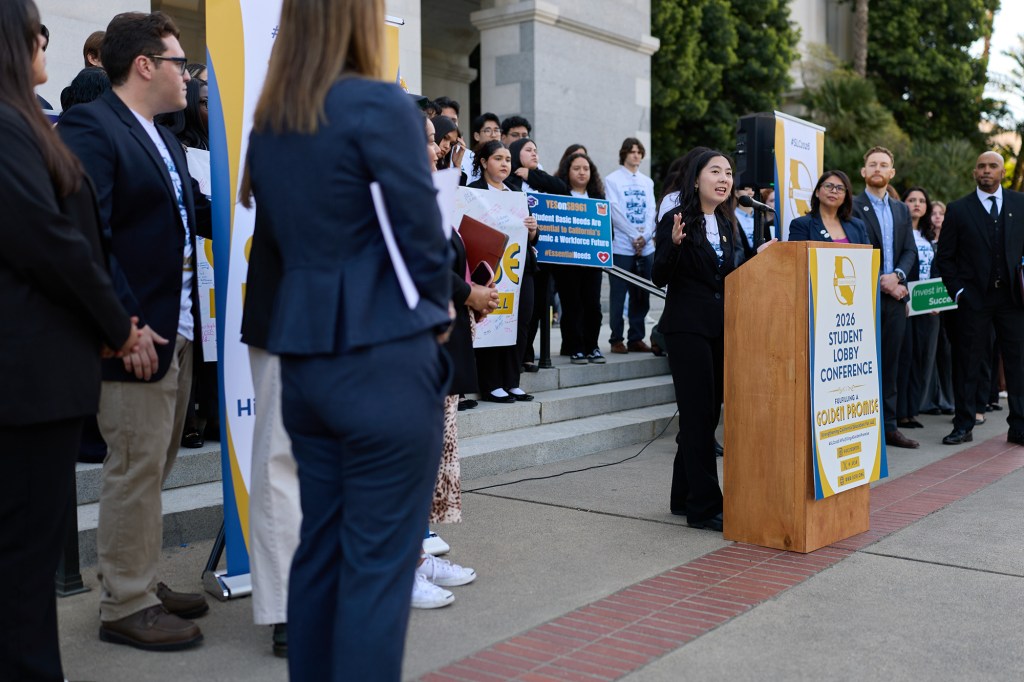 UC Student Association Government Relations Committee Chair Candice Phan speaks during the UC Student Association Lobby Day press conference on the west steps of the state Capitol in Sacramento on March 9, 2026. Photo by Fred Greaves for CalMatters
Samantha Zavala, a third-year public policy major at UC Riverside and vice chair of the UCweVote campaign, has been leading the effort this academic year to make the change.
“Once we connected with (Caloza’s) office, it was like an immediate click,” Zavala said. “It’s just like a full-circle moment.”
Multiple students advocated for the amendment during their lobby sessions, including UC Santa Cruz student Evelin Chavez. She noted that the Cal State and California Community College systems already have two voting student seats on their governing boards.
“I always ponder the question, ‘Why can’t we have, like, an undergrad?’” Chavez said. “Graduate student issues are very different from undergraduate student issues.”
While both undergraduate and graduate students can apply to the position, there has been a greater number of graduate students who have served on the board. Since the student regent position was first added in 1975, 29 have been graduate students. The last time an undergraduate student served on the board was during the 2021-22 academic year.
The work doesn’t stop now that the association has found a legislator to author the amendment, Zavala said. Student leaders will mobilize students across each campus to support the amendment and educate them about regents’ roles.
“It affects everyone, including students who are incoming and want to go to a UC,” said Zavala. “Their voices deserve to be represented.”
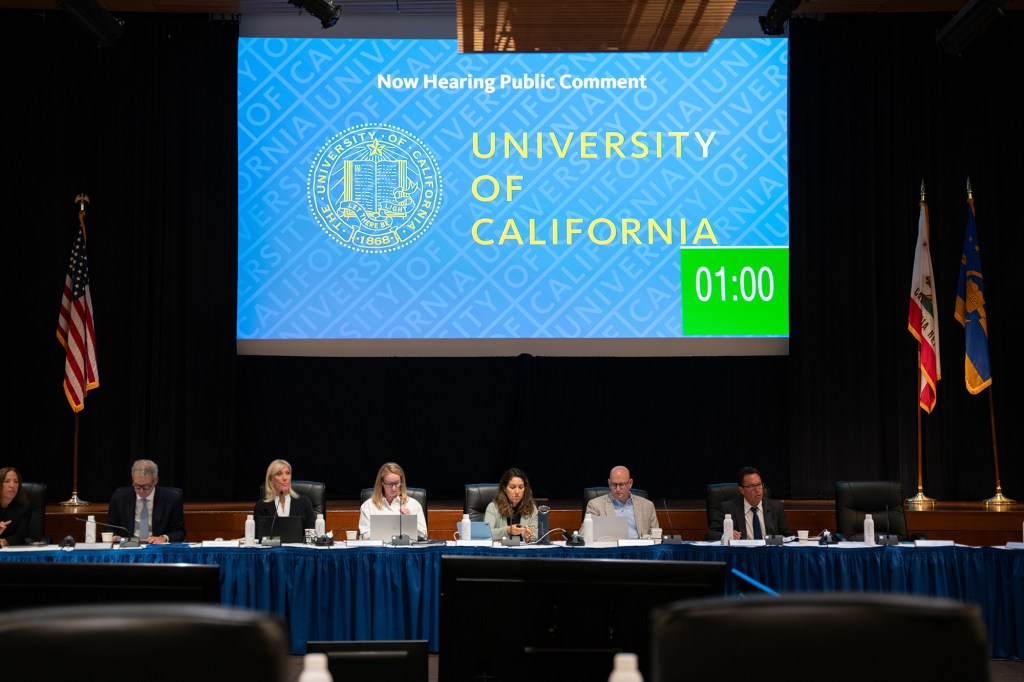 The Regents of the University of California and its committees meet on the second day of a two-day session at the UC San Francisco Mission Bay Conference Center in San Francisco on Sept. 17, 2025. Photo by Florence Middleton for CalMatters
Student leaders said that their past lobbying days helped get key bills passed, including SB 98, also known as the Sending Alerts to Families in Education (SAFE) Act. The bill requires K-12 schools and higher education institutions to notify students, parents, faculty and staff if immigration enforcement authorities are present on campus. Students lobbied for its passage last year and it was approved in September.
“If students are worried about ICE coming on the campus, or ICE coming into their hometowns, where their family lives, that hurts them mentally and academically,” said Candice Phan, a third-year student at UC Davis and the student association’s government relations chair.
Students push for more housing and food access
During the lobbying day, Chavez, the UC Santa Cruz student, mentioned how some of her peers live in their cars, with some even parking overnight in San Jose and commuting to Santa Cruz for school.
“Housing is a basic need and a human right,” said Chavez, who serves on the student association’s board. “That affects your education at the end of the day.”
With 1 in 20 UC students facing homelessness, the group pressed for leaders to pass multiple bills related to student housing.
One of those bills is AB 1732, which would expand the CEQA exemption to include student, staff and faculty housing projects at UC, Cal State, and community college campuses. Democratic Assemblymembers David Alvarez of Chula Vista and Buffy Wicks of Oakland authored the bill.
Local opponents weaponize CEQA to keep students away from certain communities and hinder desperately needed housing, said Kate Rodgers, executive director of the Student Homes Coalition, at the student association’s lobby day press conference. “It is the students that pay the price,” she added.
For first-time student lobbyist Emily Giron, a third-year sociology major at UC Santa Barbara, lobbying seemed like a way to advocate for her peers facing housing insecurity. She felt that legislative staffers were empathetic to the stories she shared.
“I’ve seen (my friend) struggle through what it’s like to be unhoused for a long period of time,” Giron said. “… At the same time, I know that his story is only one.”
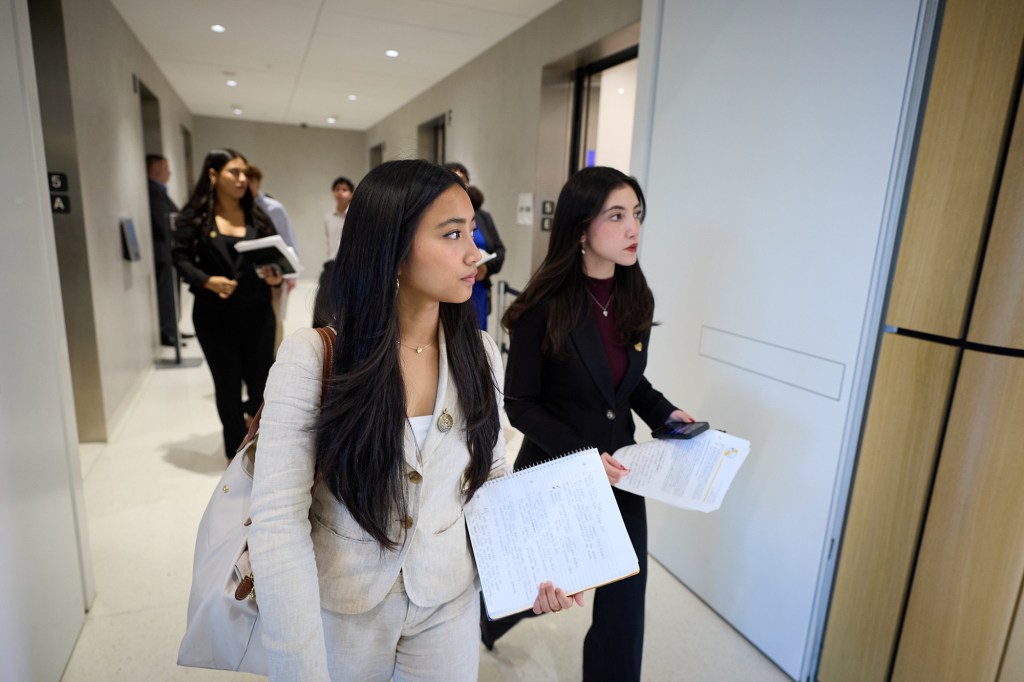
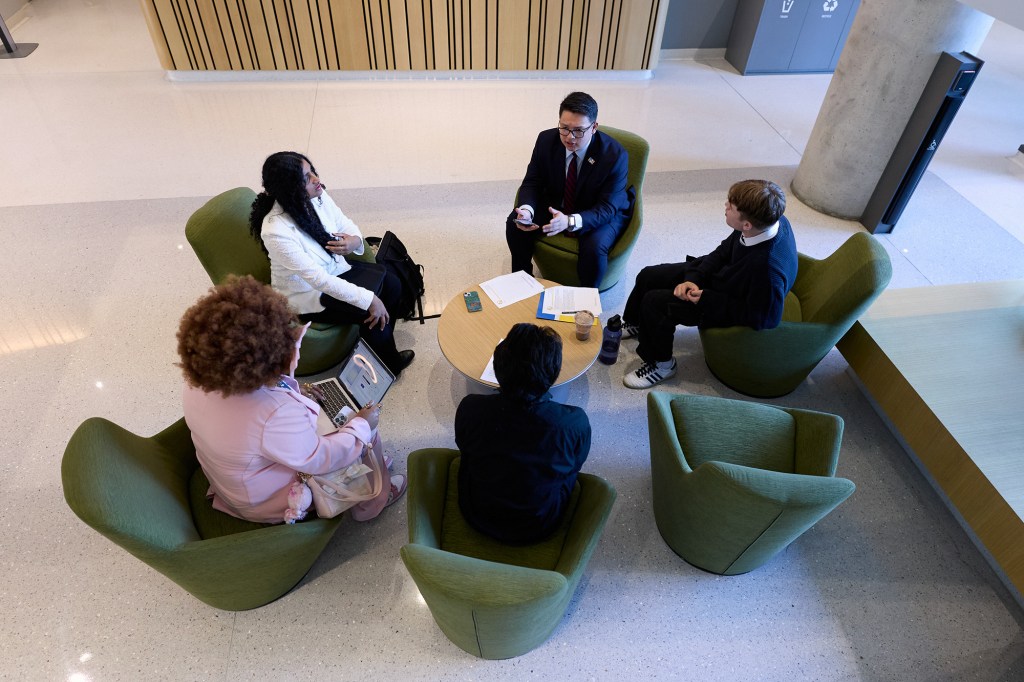
First: From left, UC San Diego students Erin Ramos and Tatiana Valdovinos look for the location of their next lawmaker visit. Last: At center, legislative aide Fernando Serratos, who works for Assemblymember Michelle Rodriguez, speaks with UC Riverside students at the Capitol Annex Swing Space in Sacramento on March 9, 2026. The students were part of the UC Student Association Lobby Day at the Capitol. Photos by Fred Greaves for CalMatters
To address student food insecurity, students lobbied for SB 961, authored by state Sen. Angelique Ashby, a Democrat from Sacramento, which aims to increase student access to CalFresh, the state’s federally funded food assistance program.
Between 400,000 and 750,000 college students are eligible for CalFresh, but only about one-fifth receive federal food assistance. The bill aims to make the CalFresh application process more accessible by increasing information sharing between campuses and state agencies and increasing targeted outreach to students. The bill will also ensure that any degree or certificate program at a college or university is eligible for approval as a Local Program that Increases Employability, which counts for the work requirement for CalFresh eligibility.
“(SB 961) really resonated with me a lot because I personally didn’t think I was eligible for CalFresh,” said Andrew Yanez, a fourth-year computer engineering student at UC Santa Barbara, who later learned he could apply. “… People aren’t getting the resources that they deserve.”
Student calls for help ‘overflowing’
To identify priority issues, association leaders reached out last semester to students and staff at each campus, and basic needs staff spoke about being overworked. Student housing case management was overflowing, recalled Phan, the UC Davis student and association leader.
“There was a very clear trend,” Phan said, “… that showed that basic needs centers across the UC are not funded properly and that they’re not being prioritized.”
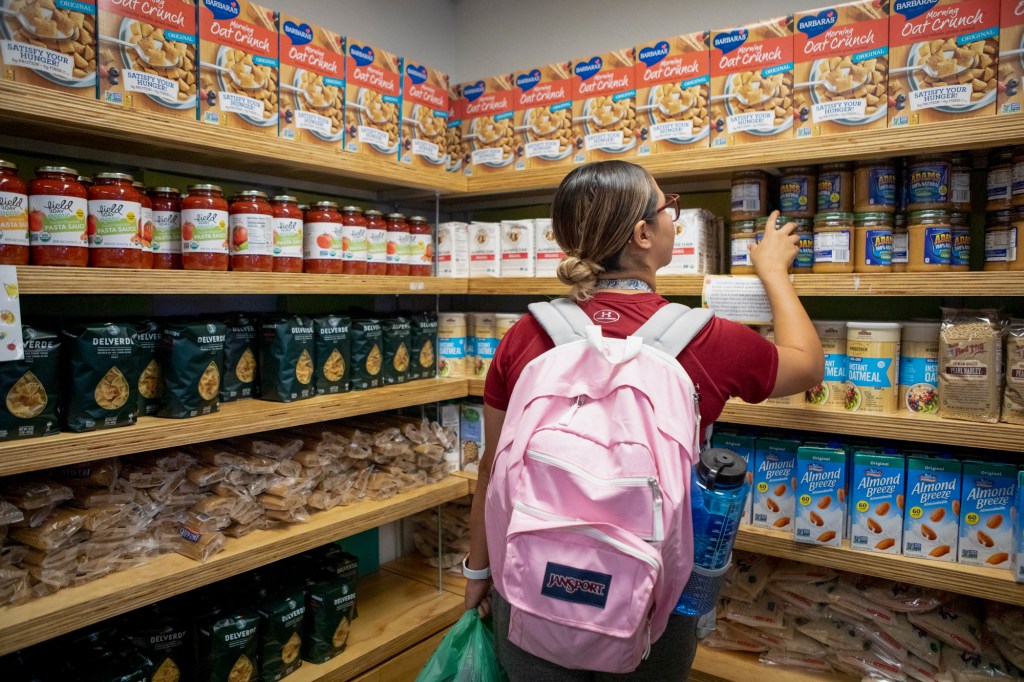 Junior Dominique Martinez shops for pantry staples at the UC Berkeley campus food pantry on Oct. 25, 2019. Photo by Anne Wernikoff for CalMatters
Mayra Bahena, a third-year education and social transformation major at UCLA, advocated for the CalFresh for Students Act so the program more easily reaches first-generation students.
“As a student who’s going to be living off campus next year, it’s really important that I have access to CalFresh and EBT,” Bahena said. “I’ve heard from my fellow peers that it’s a lengthy application process and sometimes difficult to understand as first-generation students. We don’t know how to navigate these systems.”
For students like Zavala, lobbying has been transformative. She used to major in psychology, but found her passion for lobbying with the association and changed her major to public policy. She encourages students in all fields to make their voices heard on the issues that matter to them.
“That privilege of coming to the Capitol and lobbying for myself really changed and really impacted the trajectory of my career,” Zavala said. “Personally, it’s so nice to feel represented and to be able to talk to your representative who’s actively advocating for you.”
Khadeejah Khan is a contributor with the College Journalism Network, a collaboration between CalMatters and student journalists from across California. CalMatters higher education coverage is supported by a grant from the College Futures Foundation.
.wp-block-group__inner-container > :not(h2){margin: 16px 40px !important;}.cm-cta.long-ask .wp-block-group .wp-block-group__inner-container{display: flex;gap: 12px;align-items: center;}.cm-cta.long-ask figure{max-width: 40px;flex-shrink: 0;}.cm-cta.long-ask .wp-block-group p{font-size: 18px;font-weight: 700;line-height: 120%;letter-spacing: -0.36px;width: 100%;}.cm-cta.long-ask .wp-block-group .wp-block-buttons{flex-shrink: 0;}.cm-cta.long-ask .wp-block-button__link{padding-left: 40px;padding-right: 40px;}@container long-ask (min-width: 601px){.cm-cta.long-ask *{font-size: 16px;}}@container long-ask (max-width: 600px){.cm-cta.long-ask h2,.cm-cta.long-ask .wp-block-group p{text-align: center;}.cm-cta.long-ask h2{background: linear-gradient(90deg,#FFE094 0%,#FFB500 100%);padding: 12px 20px;font-size: 20px;letter-spacing: -0.4px;}.cm-cta.long-ask .wp-block-group .wp-block-group__inner-container{flex-direction: column;}.cm-cta.long-ask > .wp-block-group__inner-container > :not(h2){margin: 16px 20px !important;}}]]>
Nonpartisan, independent California news for all
We’re CalMatters, your nonprofit and nonpartisan news guide.
Our journalists are here to empower you and our mission continues to be essential.
We are independent and nonpartisan. Our trustworthy journalism is free from partisan politics, free from corporate influence and actually free for all Californians.
We are focused on California issues. From the environment to homelessness, economy and more, we publish the unfettered truth to keep you informed.
We hold people in power accountable. We probe and reveal the actions and inactions of powerful people and institutions, and the consequences that follow.
But we can’t keep doing this without support from readers like you.

Please give what you can today. Every gift helps.