
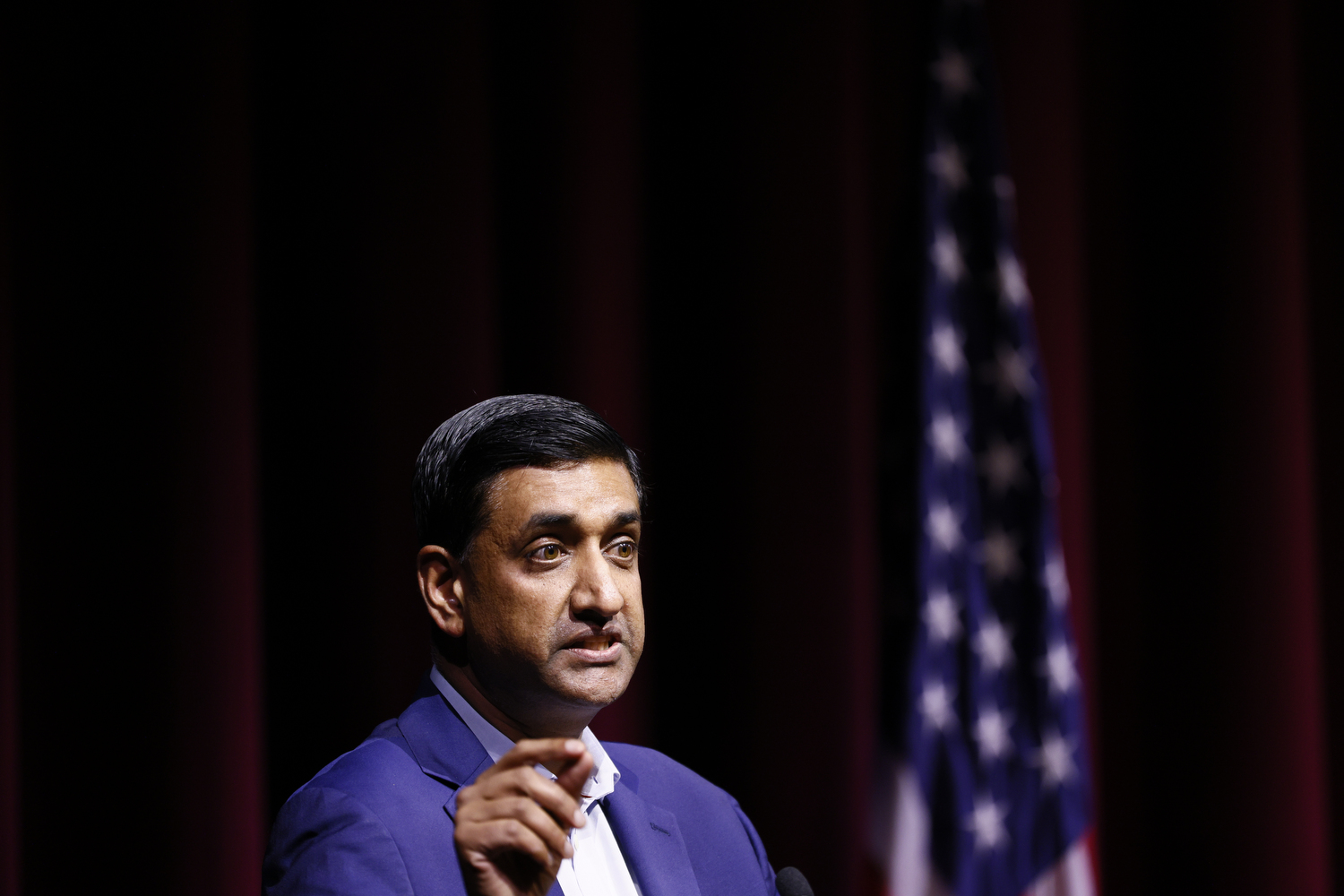
Rep. Ro Khanna speaks at Stanford University alongside Sen. Bernie Sanders at an event titled “Who Controls the Future of AI: The Oligarchs or the People” on Feb. 20, 2026.
Santiago Mejia/S.F. Chronicle
WASHINGTON — As fall drew to a close, Rep. Ro Khanna was riding high.
The Santa Clara Democrat had just scored the biggest legislative victory of his career, forcing the release of investigative files related to the late sex offender Jeffrey Epstein over the objections of President Donald Trump, and turbocharging his national profile in the process.
Then came six words. Shortly after Christmas, amid reports of California billionaires fleeing the state to avoid a proposed wealth tax, Khanna posted a sarcastic, Franklin Roosevelt-referencing retort on social media: “I will miss them very much.”
Article continues below this ad
The sentiment jolted Silicon Valley executives and crystallized the tension inherent to Khanna’s political rise: the richest congressional district in the country is represented by a close Bernie Sanders ally who has made wealth inequality a central cause. A group of tech leaders quickly mobilized to recruit a challenger and, earlier this month, little-known entrepreneur Ethan Agarwal entered the race on a platform that Khanna has lost touch with the values of his own community.
If his critics dig into their deep pockets to mount a serious campaign, it would be the most consequential threat to Khanna’s political future since he arrived in Congress nearly a decade ago.
San Francisco Chronicle Logo
Make us a Preferred Source to get more of our news when you search.
Add Preferred Source
Yet, buoyed by a growing fan base across the country, Khanna hardly seems worried, telling the Chronicle bluntly in an interview, “I’ve never been at a more popular place in the district.” He recently doubled down on the wealth tax by introducing a national version with Sanders, and he’s more eager to talk about how Democrats can win back Trump voters, of which there are few in his South Bay district.
As he lays the groundwork for a presidential bid, seeking to assume Sanders’ progressive populist mantle in the 2028 Democratic primary, perhaps Khanna couldn’t ask for a more perfect opportunity to burnish his credentials than a fight with billionaires.
Article continues below this ad
“The most important quality in modern American politics is courage,” he said. “This is a proof point that I’m willing to stand up for my convictions, even against the most powerful people in my own district.”
Is Khanna winning his reelection campaign, even if he loses?
Ambition on display
That Khanna has his eye on the White House is barely veiled subtext to everything he does these days. Between endless media hits, frequently on conservative shows and podcasts, and visits to early-voting states such as South Carolina and New Hampshire, he is working hard to thrust himself onto the list of serious presidential contenders.
As a fifth-term member of the House of Representatives, a vanishingly rare launching pad to the presidency, Khanna would be an unconventional choice — though that’s seemingly built into his pitch that Democrats need to clear out the old guard that led the party to defeat by Trump twice.
Article continues below this ad
Khanna reached a new political apex last year, after working with Republican Rep. Thomas Massie of Kentucky on a discharge petition to compel disclosure of the highly sought Epstein files, which Trump campaigned on releasing and then abandoned. What began as a seemingly quixotic quest turned into an underdog triumph that not only grabbed the spotlight in Washington but briefly consumed the entire country’s attention.
With an old school embrace of bipartisanship, Khanna now touts it as the roadmap for Democrats back to the White House.
From left, Rep. Ro Khanna, D-Calif., Rep. Thomas Massie, R-Ky., and then-Rep. Marjorie Taylor Greene, R-Ga., discuss the Epstein Files Transparency Act at the U.S. Capitol in Washington, D.C., on Nov. 18, 2025.
DANIEL HEUER/TNS
Unlike firebrands such as California Gov. Gavin Newsom or Illinois Gov. JB Pritzker — whose strategy of merciless confrontation with Trump has galvanized frustrated liberals and boosted their shot at the presidency — Khanna emphasizes building ties across the ideological aisle. He suggests that if Democrats stop shaming Trump voters and listen to their concerns, his party can make an argument based on reason and ideas to a broader swath of the country.
It’s a quaint notion in an era of extreme political division. Expect Democrats to spend much of the 2028 primary campaign grappling with whether it presents a realistic path to regain power.
Article continues below this ad
But Khanna argues that, though his politics are far left of the center, the victory on the Epstein files gave him credibility with a segment of Trump’s MAGA base that otherwise disagrees with him on most issues and thus an opening to make his case for “a new moral vision.”
“We have scrambled the political coalition,” he said. “This is the first time since Donald Trump came down the escalator that the Democrats are successfully engaged with any Trump voters.”
Winning over MAGA
Khanna aims to build on that momentum by championing the anti-interventionist platform that Trump has steadily abandoned since returning to office. He and Massie partnered again on a war powers resolution to pull U.S. forces out of Iran, which narrowly failed earlier this month.
He also hammers accountability for a corrupt elite that he has dubbed “the Epstein class” and economic development for communities that will be hollowed out as artificial intelligence replaces jobs. Khanna believes this is a unifying agenda that can bring enough Trump voters back into the fold to return Democrats to power, though to what end he’s less certain.
Article continues below this ad
“I think the country wants more issues like that,” he said. “Can I get the Ro Khanna progressive agenda on that? Probably not. But are there two or three other big things that we could do? Yes. Can I tell you right now what they are? No, because I couldn’t have told you that the Epstein Act would be it.”
For the moment, Khanna remains stuck as a nonfactor in early polling on the Democratic primary, often receiving 0% in surveys that bother to include him at all. But his message has begun to break through in some circles.
The executive director of The American Conservative magazine, which was founded in 2002 to oppose the Iraq War, has publicly stated in recent months that he would prefer Khanna as president over Secretary of State Marco Rubio or other Republicans committed to a foreign policy driven by Israel’s priorities more than the United States.
In an interview, Curt Mills said Khanna’s forceful condemnations of the Iran war have been refreshing compared with the limp pushback by the Democratic establishment. While he does not agree with Khanna’s economic policies, including the wealth tax, Mills sees him as the type of populist Democrat who could appeal to more independent-minded voters that flipped from backing former President Barack Obama or Sanders to Trump.
“He’s the only one I could imagine supporting,” Mills said. “The fact that he’s even caring about reaching MAGA voters is heartening and good for the country.”
Losing the Silicon Valley elite
To get there, of course, Khanna first needs to win a sixth term.
Despite being repeatedly and overwhelmingly reelected to his liberal seat — stretching from Fremont around the bay to Cupertino, it is the home of tech giants including Apple — Khanna has a somewhat uneasy relationship with Silicon Valley. Between his first run in 2014 and two years later, when he took out the longtime incumbent, Khanna began a political transformation from voice for the tech industry to economic populist who supported a vast expansion of social programs and railed against the elite.
Khanna still calls Silicon Valley “an extraordinary place to represent,” a region that is shaping the future like Athens or Florence once did. But he speaks now of the need for a “new tech social contract” where the industry steps up to address economic inequality, because “we will not have a country if we continue down the road” of having “islands of prosperity and seas of despair.”
Rep. Ro Khanna holds a town hall meeting at MLK Community Center in Bakersfield on March 23, 2025 as part of an attempt to speak out against DOGE and President Donald Trump and drum up support to flip red districts in 2026.
Scott Strazzante/S.F. Chronicle
That includes supporting the California wealth tax proposal, which unions are collecting signatures to place on the November ballot. It would tax billionaires 5% of their wealth to bolster public health programs following funding cuts by the Trump administration.
The measure has infuriated some tech leaders, particularly a provision that would treat voting shares on corporate boards as wealth. They argue it would undermine Silicon Valley by reducing the availability of investment capital and making it a less attractive environment for startups. Some industry figureheads, including the founders of Google, have reportedly already cut ties with the state to escape qualifying for the tax.
Among the most vocal critics is Garry Tan, CEO of the venture capital firm Y Combinator, who rails to his large online following that Khanna is destroying prosperity with asset seizure and turning his back on his district to improve his presidential prospects. Tan spearheaded the push to recruit a challenger.
“This is about policy alignment and the increasingly performative nature of our politics,” he said in an email. “It’s a recognition that California’s economic foundation is fragile. We’ve already seen companies and talent leave. So when proposals come forward that could accelerate that trend, people who build companies are going to speak up.”
The tweet heard ’round the Valley
Though Khanna concedes he might have handled his controversial social media post better, he said he was reacting to an attitude he found genuinely offensive and which is at the root of a seething anger in the electorate: the sense that the wealthy play by different rules.
“We’re all part of a democratic society. If they pass a law that I don’t like, I figure out how to live with it. I don’t just say, ‘OK, I’m gonna get up and leave,’” he said. “Could I have done a better job after that in articulating a sense of openness to how we design taxing billionaires and a conversation instead of just going back and forth on Twitter? I’m sure I could have done that — and I have now.”
Protesters march during a People Over Billionaires protest in the Pacific Heights neighborhood of San Francisco on Nov. 15, 2025.
Stephen Lam/S.F. Chronicle
Khanna said he spoke with some Silicon Valley leaders and conveyed their concerns to the union leaders behind the wealth tax proposal to open a dialogue about avoiding capital flight.
He has no regrets, however. Khanna takes credit for pushing forward a necessary debate, pointing to alternative tax proposals that tech billionaires such as Vinod Khosla have suggested since then.
“Where were all of them before I spoke out? I didn’t see all these proposals of tackling wealth inequality and tackling billionaire wealth,” Khanna said. “We have spawned a conversation.”
‘I don’t want him to sell his soul’
Ultimately, Khanna and his allies don’t expect the kerfuffle to make much noise outside of social media — certainly not enough to swing the race against him. His district, he notes, voted for Sanders in the 2020 Democratic primary. Perhaps a local leader like San Jose Mayor Matt Mahan, who passed to run instead for governor, could have put up a “real fight,” Khanna said, but he doesn’t think money alone is going to move the needle.
“Tech is not a monolithic thing,” said Ben Linder, a retired entrepreneur from Palo Alto who has become close to Khanna through local progressive activism. “Not everyone makes over a million dollars a year in this ecosystem.”
Linder said one disagreement about economic policy will not override the appreciation that most of Silicon Valley has for Khanna’s tech advocacy in Congress, including helping secure billions of dollars in new research and development funding under President Joe Biden. He warned that elite critics of the wealth tax proposal are the ones who may be going too far.
“It’s pretty ironic that those who have risen to the top of the meritocracy all of a sudden want to turn their back on the rest of the country,” Linder said. “Silicon Valley only makes people billionaires if the rest of the world buys it. So at some point, there’s a codependence.”
If Agarwal begins gaining steam, organized labor could step in to defend Khanna. The California Labor Federation, which has its own vast financial resources plus armies of volunteers to canvas, recently endorsed him. President Lorena Gonzalez said the primary challenge is “a prime example of how out-of-touch Silicon Valley billionaires are.”
For Khanna’s fiercest supporters, it’s also a signal that he’s on the right track.
Harpreet Grewal, a constituent from Fremont, had never contributed to a politician before Khanna’s 2014 congressional campaign. The former tech worker and owner of a chain of child care centers considers himself a more moderate Democrat than Khanna, but was drawn to the progressive for championing common people over billionaires and powerful lobbyists.
“If he’s getting shot back at, great for him,” Grewal said. “I’d rather have him lose, I’d rather have another candidate win, but I don’t want him to sell his soul.”