
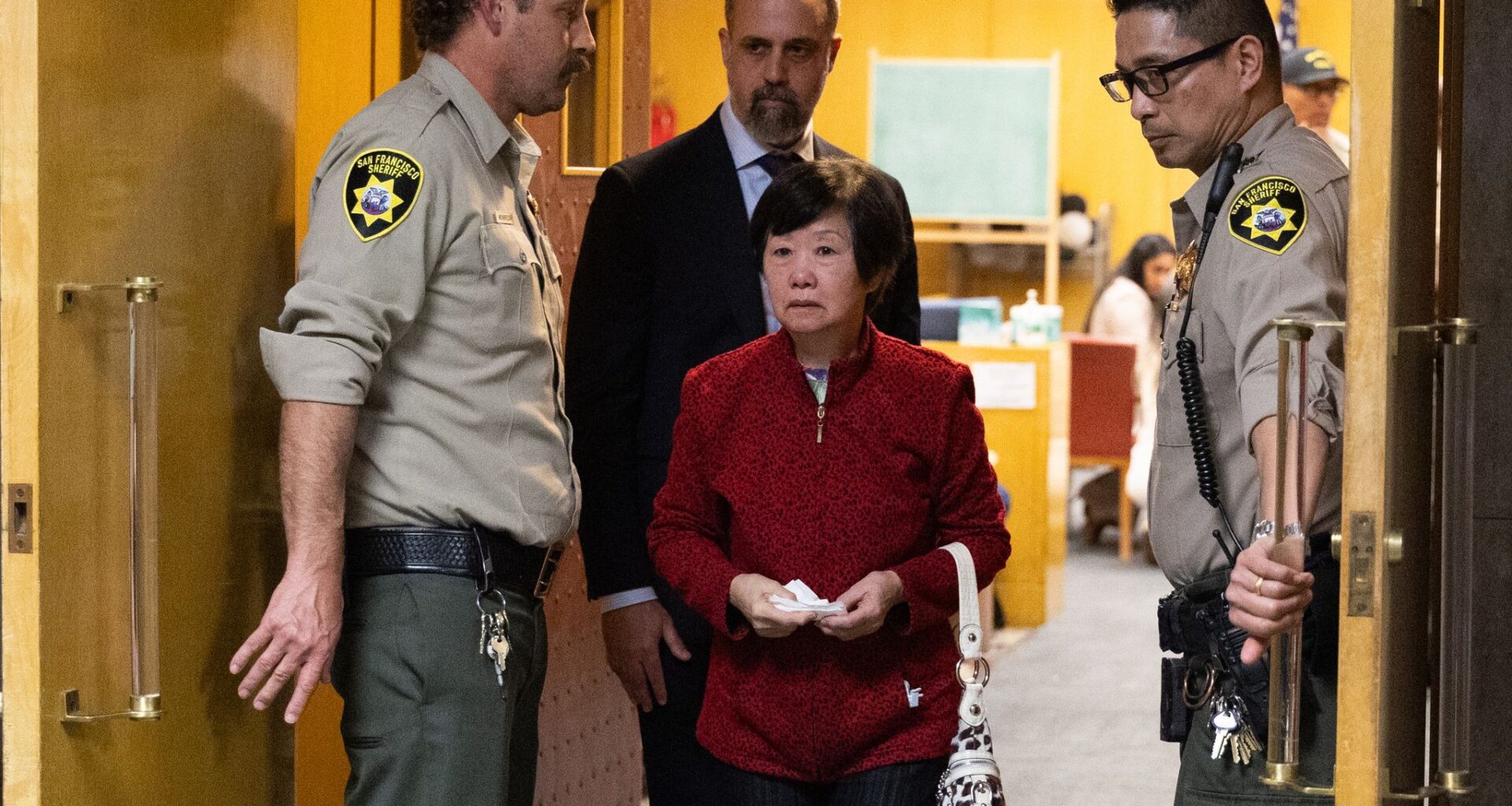
Mary Fong Lau was sentenced to probation and temporarily lost her driving privileges for a crash that killed a family of four in San Francisco.
Benjamin Fanjoy/For the S.F. Chronicle
The driver who struck and killed a family of four in San Francisco’s West Portal neighborhood could be back behind the wheel in three years.
Mary Fong Lau, 80, was sentenced to three years of probation, plus 200 hours of community service, for an incident that convulsed the city in 2024. Speeding down a residential block in the quiet west side neighborhood, Lau lost control of her Mercedes SUV and barreled into a couple and their young children, who were waiting to catch a bus to the San Francisco Zoo. Lau pleaded no contest last month to four counts of gross felony vehicular manslaughter, and temporarily lost her driving privileges.
She could seek to renew her license at age 83, once the sentence is up. Whether she would have to take a behind-the-wheel test is unclear.
Article continues below this ad
Her case has come to illustrate how difficult it is to permanently deprive a person of their power to drive. In California, only one type of criminal conviction — for assault using a motor vehicle as a deadly instrument — authorizes a court to strip away someone’s license forever. That basically means the person has to be found guilty of intentionally hitting a victim with their car.
“For permanent revocation, you need to use the car as a weapon,” said San Mateo County District Attorney Stephen Wagstaffe. He noted that in most other contexts, the Department of Motor Vehicles has discretion to give someone a second chance. Or a third. Or a fourth.
San Francisco Chronicle Logo
Make us a Preferred Source to get more of our news when you search.
Add Preferred Source
Serious driving convictions (for vehicular manslaughter, felony DUI with priors, hit-and-run leading to injury or death, or felony evading that causes an injury crash) routinely trigger temporary loss of a license, with restoration contingent on completion of a program or proof of financial responsibility. Though the DMV may rescind a motorist’s licenses over a medical diagnosis, particularly for a condition that could result in sudden loss of consciousness, the process of denying a license for reckless behavior appears more complicated.
Driving is a privilege, but the legal system treats it as a fundamental liberty — even, critics say, for people who demonstrate they can’t handle the rules of the road.
Article continues below this ad
“Being able to operate this incredibly powerful, massive, high-speed device is something that we should take a lot more seriously,” said Tara Goddard, an assistant professor of civil engineering at Cal Poly San Luis Obispo. She views the protected status we grant driver’s licenses as a symptom of our societal dependence on automobiles.
“We think that people who don’t have access to a vehicle can’t participate in life,” Goddard said.
Mary Fong Lau could ask to have her drivers license reinstated after three years.
Benjamin Fanjoy/For the S.F. Chronicle
Miriam Pinski, a researcher at the Shared Use Mobility Center in Los Angeles, said withdrawal of a driver’s license isn’t a very effective penalty. Judges are reluctant to do it for fear of being too onerous, since many people can’t get to work without a car, she said. If a judge metes out the punishment, court staff sometimes fail to communicate with the DMV. And people with suspended or revoked licenses continue driving anyway, she said.
In Pinski’s view, smart technology, like speed governors for habitual speed violators, is a much more effective way to compel safe driving.
Article continues below this ad
Some defendants in vehicular homicide prosecutions voluntarily relinquish their licenses, as Arnold Kinman Low did two years ago. Low, then 82, had pled guilty to vehicular manslaughter and driving under the influence for a crash in the Presidio that killed USA cycling champion Ethan Boyes. Part of his federal court plea deal involved giving up the license and agreeing not to drive for the rest of his life.
While Low’s attorney, Doug Rappaport, said his client had voluntarily offered to give up driving, Boyes’ mother said she and other family members had asked for that to be a condition of the plea agreement.
“We really wanted for him to no longer be able to drive, and we made that clear from the beginning,” Penny Boyes said in an interview Tuesday. “It was not something that he (Low) offered out of left field; it was one of our priorities.”
Yet if the denial of a driver’s license is based on such arbitrary factors as a victim’s advocacy, or a defendant’s remorse, or public opinion, or the whims of state bureaucrats, the results are inconsistent. Data from the DMV shows the number of license revocations has remained steady over the past 10 years though the number of suspensions has plummeted, from 1,183,819 in 2015 to 533,299 in 2025. Agency staff could not immediately explain the downward trend. (Suspensions are a lighter penalty than revocations, since the affected motorist can automatically get their license back after a set period without having to re-apply.)
Occasionally people’s capability to drive becomes the subject of fierce debate.
Article continues below this ad
Take the example of Timothy Hamano, a Piedmont wealth manager who in 2024 pled no contest to felony vehicular manslaughter for hitting and killing a man on an Oakland sidewalk three years earlier. The incident sparked outrage: Hamano had plowed his Lexus into a parked SUV, striking pedestrian Gregory Turnage with enough force to throw Turnage over the hood of the Lexus and back onto the pavement.
As Turnage lay bleeding, witnesses said, Hamano opened his door and walked around the crumpled front bumper. His eyes strayed down to the gravely injured man. Then he fled the scene on foot, opting to turn himself in the next day. Although police obtained restaurant receipts that suggested Hamano had been drinking alcohol before the crash, prosecutors lacked sufficient evidence to charge him with driving while intoxicated.
Hamano spent three years on house arrest, a period during which he “voluntarily” declined to drive to “mollify” the victim’s family, according to his attorney, Colin Cooper. After entering his plea he should have faced a mandatory three year driving prohibition, except that — due to a clerical error — court officials did not notify the DMV of his conviction. Thus Hamano re-applied for the license he’d let expire and got back in his car without having to take a written or behind-the-wheel test.
Only after reporters at CalMatters began asking questions did the DMV officially revoke Hamano’s license last May, over objections from Cooper. According to a DMV spokesperson, Hamano — now 69 — will be “eligible for licensure” next year, a prospect that frightens Brey.
She plans to petition the DMV and present Hamano as a threat to public safety, though she is not sure the agency will be persuaded.
Article continues below this ad
“Ultimately, it’s up to the discretion of the DMV to make that call,” Brey said, not hiding her frustration with the system. “If you take somebody’s life because you’re reckless or intoxicated, you’re obviously the ultimate danger on the roads,” she continued. “Why is that not the line?”
Data reporter Sriharsha Devulapalli contributed to this story.