
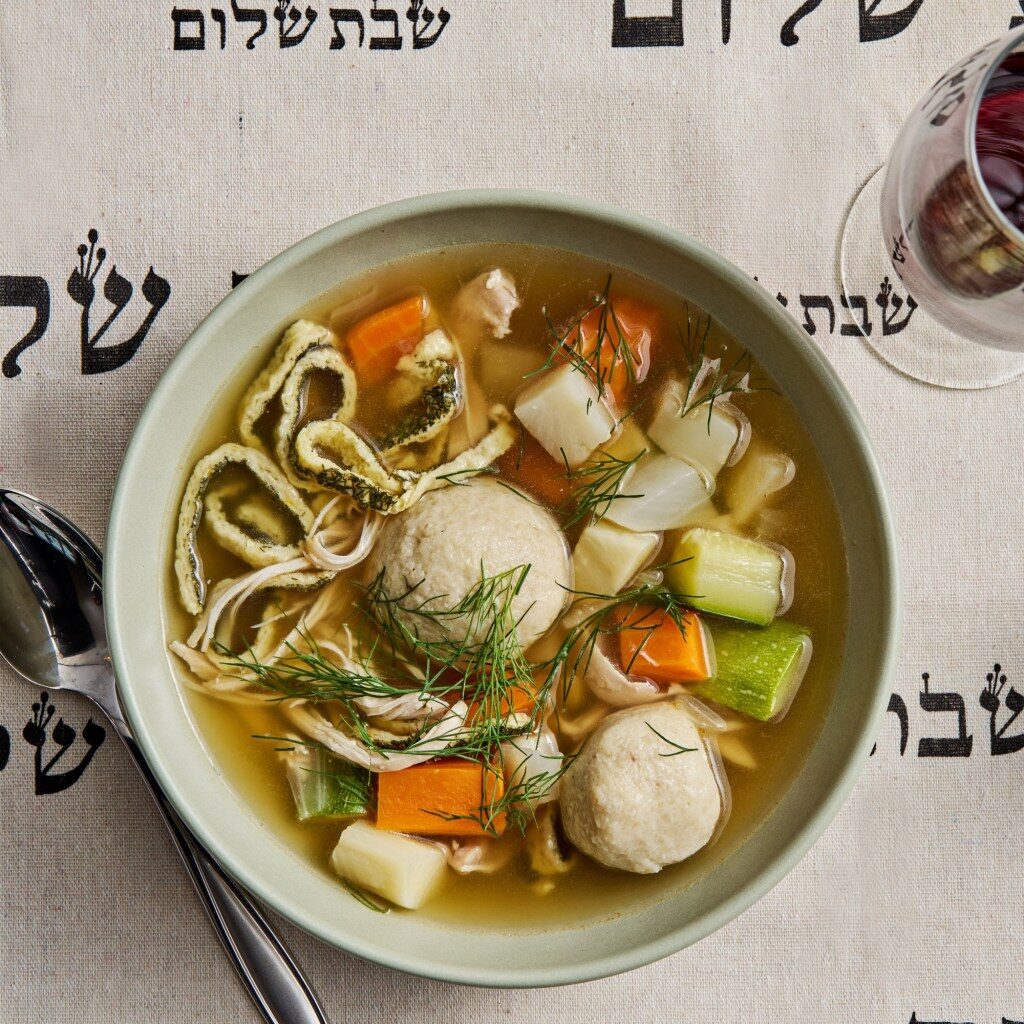
For The Union-Tribune
When I was growing up, one of the most reliable meals you could count on was the Passover Seder. In our family, my maternal grandparents almost always hosted it for our large family. The dishes never changed from year to year, and they were always something to look forward to — juicy brisket, crispy potato kugel, chewy chocolate macaroons and a moist, citrusy orange sponge cake made with matzo meal.
The challenge came the rest of the week. After all, Jews who try to observe the dietary rules that eliminate bread and other leavened grains, or “chametz,” for a week face the absence of everything from bagels and tortillas to cereal and cookies. All these missing carbs really can cut into your usual meal planning.
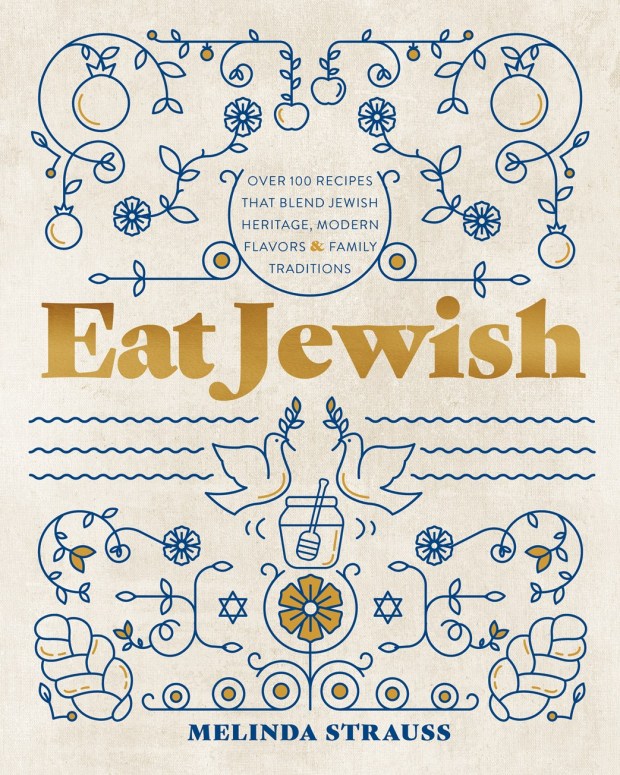 “Eat Jewish: Over 100 Recipes That Blend Jewish Heritage, Modern Flavors, and Family Traditions,” by Melinda Strauss (2025, Rock Point, an imprint of The Quarto Group, N.Y.)
So I was delighted when I came across a recent cookbook by Melinda Strauss called “Eat Jewish: Over 100 Recipes That Blend Jewish Heritage, Modern Flavors, and Family Traditions” ($30, 2025, Rock Point). Strauss, known as “Jewish TikTok Mom,” identifies herself as a Jewish content creator, educator and cookbook author. She started out her career in recruiting, but once she had her second child and her family moved to Long Island, N.Y., she stayed home with her daughter. While her daughter slept, Strauss started playing with food and posting her recipes and photos in a Facebook album.
“It went very quickly from that to my friends saying, ‘You should start a blog,’” she recalled. “This was 15 years ago, and I was like, ‘What’s a blog?’ and thought OK, let’s jump in and start one.”
She called it Kitchen Tested. It wasn’t always specifically Jewish food, just whatever she was in the mood to make. The “educator and content creator” part evolved after 10 years, when she said, as she started shifting into an account of other parts of her life, she began sharing her personal growth and evolution. And when she joined TikTok to supervise her young daughter, the world opened up.
“I joined, and I just started sharing random things because I didn’t have any followers,” Strauss recalled. “And over time, you know, because I would mention being Jewish, I would mention turning off my phone [for Shabbat], and people started asking me questions, so I started answering them. And that’s really where the growth from being a smaller food blogger, but still, like well-known in the Jewish world, to this growth to the hundreds of thousands of followers. Suddenly, where I’m like, ‘Oh my gosh, people really want to learn about Judaism.’ So my focus became Jewish education, and some of that is through food. Because, as you know from my book, it’s teaching the world about Judaism through food. And that’s Jews and non-Jews.”
 Melinda Strauss, cookbook author of “Eat Jewish,” is known on social media as “Jewish TikTok Mom” and educates about Judaism through food. (Sheneur Menaker)
With close to 2 million followers, Strauss — who considers herself modern Orthodox and keeps kosher — decided it was time for a cookbook. And she’s a clever original. “Eat Jewish” is filled with recipes that opened my eyes to new, very accessible possibilities like Yeminite Green Schug, a spicy condiment featuring cilantro, parsley, chiles and garlic, and Boyikos, simple cheese biscuits that highlight mozzarella and Parmesan cheeses.
“Eat Jewish” also includes Strauss’ twists on the familiar, especially for Passover. She includes great recipes for Potato Kugel, Chicken Soup With Matzo Balls, and Macaroons. But there’s a great sounding Hamburger Farfel Stuffing, a Spaghetti Squash Casserole and Pistachio Meringues.
I was drawn to share three other recipes, though: Passover Egg Noodles, Passover Bagels and Tahini Chocolate Chip Cookie Sticks. All are super easy to make and perfect to have on hand for Passover week (although I’d happily take the tahini cookies to a seder if asked to bring a dessert).
Because traditional flour noodles are forbidden during Passover, Strauss turned to a family favorite, Passover Egg Noodles, which are kind of like a thin, crepelike omelet sliced into noodles. This doesn’t contain flour, however. It’s just eggs, chicken or vegetable stock, potato starch and chopped, fresh herbs. But instead of using the traditional technique for making them, Strauss simplified the process.
“They’ve been around forever, but they’re a pain in the neck because you have to make all the crepes, and then you have to roll them and slice them,” she said. “And I was like, I don’t want to make crepes. I hate making crepes. So I tried it instead in a sheet pan and I bake the whole thing. It’s one big, long egg sheet. You roll it up and you slice it.”
Strauss primarily adds the noodles to chicken soup, but a friend’s cookbook includes a recipe using them to make a whole kugel. Strauss and her family also just like snacking with them.
I admit it: I was gobsmacked when I came across her Passover Bagels. It wasn’t merely the notion that you could enjoy bagels during Passover, but when I looked at the ingredients, they were the same (with one big exception) as the matzo meal popovers my family has made for generations — just shaped into a bagel. Brilliant. So what’s the ingredient difference? Strauss uses oil. Our nonkosher family uses butter, which Strauss acknowledged was perfectly fine for a dairy meal.
The technique is simple but, as Strauss said in the context of all her recipes, you have to read and follow the recipe or it won’t work. You start by boiling water and oil. Then add matzo meal, sugar and salt, turn off the heat, and stir well with a wooden spoon. Then — this is the key direction — wait a good five minutes for the mixture to cool before you add the eggs — again, key — one at a time. You don’t want to scramble the eggs when adding to a hot mixture, and adding one at a time makes the dough fluffier.
Here’s where Strauss’s creativity comes through. Instead of placing balls of the dough on a sheet pan to bake into rolls, she takes those balls and pokes a hole in the center with her thumb and shapes the dough into a bagel. Then she bakes them.
And now you can have bagels, lox and cream cheese during Passover.
“And it’s such an easy travel food, too,” Strauss said.
Finally, dessert. I’ve made my share of macaroons and chocolate-covered matzo. Love them! But when I saw Strauss’s Tahini Chocolate Chip Cookie Sticks, I was drawn to the flavor profile, which also includes maple sugar and vanilla extract.
And the whole concept was a salvation project for a goof. Strauss calls them her “accidental cookies.”
She explained: “I had a recipe on my blog for tahini brownies, and literally, like, maybe an hour before Shabbos, I’m like, I’m going to try making these into blondies, and the batter was so loose. I’m like, this is not going to work. But I threw it on a sheet pan anyways, just for fun to see what would happen. And these cookies came out, and I literally grabbed my camera, took some pictures.”
So, brownies turned into cookies. And the photos and recipe went viral.
A word about tahini: Strictly speaking, Ashkenazi Jews are prohibited from eating sesame seeds (I’m a food writer, not a theologian, so you can look up the debate yourself). Tahini, made with ground sesame seeds, of course, is also a no go during Passover. But Sephardic Jews can eat sesame seeds and tahini, so you can decide how strict you want to be. I’m going for it. Plus, beyond Passover, it’s a great cookie for people who are gluten-free and vegan.
Now, don’t be put off by the thin batter, Strauss said. You can’t make individual cookies, but you can pour a long strip down a parchment-covered baking sheet and bake it, then slice.
“Keep going. It’s this magical batter that makes no sense, but makes just delicious cookies, and they’re fun,” Strauss said. “You could add sprinkles to them, you could add nuts to them. You could do so much with them, but it’s just this very unique batter that shouldn’t make sense, but it does.”
Passover Egg Noodles
Makes 8 to 10 servings
INGREDIENTS
Cooking spray or neutral oil, for greasing
6 large eggs
1/2 cup (120 ml) chicken or vegetable stock
3 tablespoons potato starch
2 tablespoons chopped fresh dill or 1 tablespoon dried dill (optional)
1/2 teaspoon kosher salt
DIRECTIONS
1: Preheat the oven to 350 degrees. Lightly grease a rimmed baking sheet with cooking spray or oil, line it with parchment paper, and grease it again.
2: In a large bowl, add the eggs, stock, potato starch, dill and salt; whisk until smooth and runny.
3: Pour the mixture onto the baking sheet, using a rubber spatula to scrape the bowl clean. The mixture will spread out evenly to the edges of the baking sheet. Transfer to the oven and bake until the egg mixture is set and no longer runny, about 15 minutes.
4: Transfer the baking sheet to a heatproof surface and let cool enough to be handled, about 10 minutes.
5: From a long side, roll up the egg sheet jelly-roll fashion, using the parchment paper to help lift and roll. Transfer the roll to a cutting board. Slice the roll into thin noodles, around 1/8 to 1/4 inch thick. Unroll the noodles and, if serving right away, add them to bowls of chicken soup to serve. If not, let them cool completely on the cutting board, about 30 minutes, before packing up for storage.
Note: The egg noodles can be stored in the refrigerator in an airtight container for 2 to 3 days and the freezer for up to 3 months. Thaw the noodles for 2 to 3 hours in the refrigerator and add them to bowls of hot chicken soup to heat through.
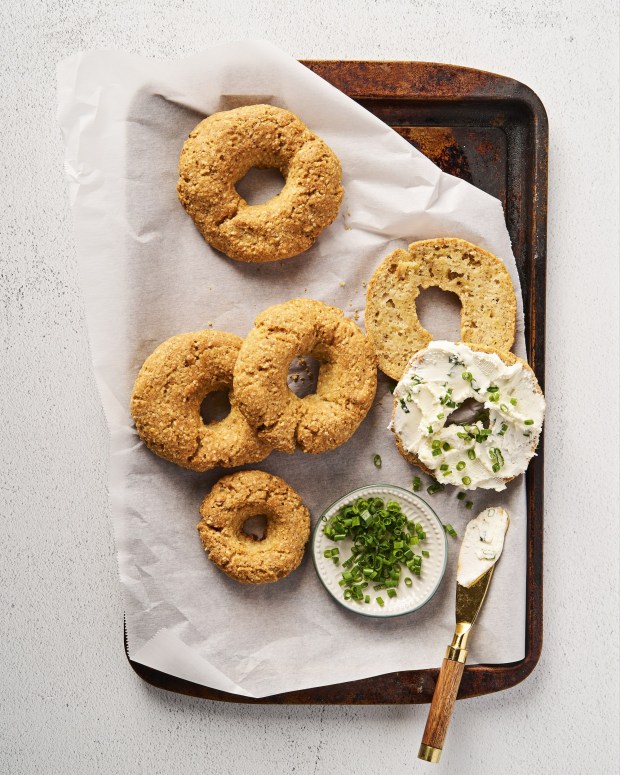 Passover Bagels from “Eat Jewish” make inventive use of matzo meal. (Sheneur Menaker)
Passover Bagels
Makes 8 bagels
INGREDIENTS
1/2 cup (120 ml) neutral oil
2 cups (240 g) matzo meal
1 tablespoon granulated sugar
1 teaspoon kosher salt
4 large eggs
DIRECTIONS
1: Preheat the oven to 350 degrees and line a baking sheet with parchment paper.
2: In a 3-quart saucepan, heat the oil and 1 cup of water to boiling over high heat. Add the matzo meal, sugar and salt and turn off the heat. Using a wooden spoon, stir until a crumbly dough is formed. Let cool for 5 minutes.
3: Add the eggs, stirring them in one at a time, and stir vigorously until the dough is thick. Let cool slightly, about 15 minutes.
4: Using the wooden spoon or your hands, transfer the dough to a cutting board. Wet your hands with water and divide the dough into 8 equal portions. Working one at a time, roll a portion of dough into a ball and, with your thumbs, poke a hole in the center. Shape the dough into a bagel and place on the baking sheet. Repeat with the remaining dough, leaving 1 inch between each bagel.
5: Bake for 40 to 45 minutes, until the tops are golden brown. Let cool slightly on the pan, about 10 minutes, then transfer the bagels directly to a wire cooling rack to cool completely, about 30 minutes.
6: Slice the bagels and serve.
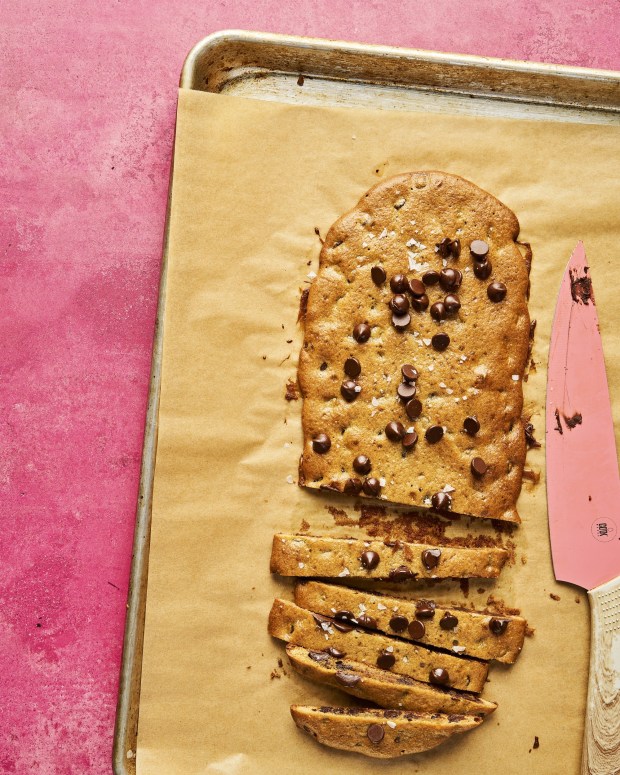 The Tahini Chocolate Chip Cookie Sticks, beyond Passover, are ideal for people who are gluten-free and vegan. (Sheneur Menaker)
Tahini Chocolate Chip Cookie Sticks
Makes 24 cookie sticks
INGREDIENTS
1 cup (240 ml) raw/pure tahini
6 tablespoons pure maple syrup
2 large eggs
1 teaspoon vanilla extract
1/2 teaspoon baking soda
1 cup (180 g) semisweet chocolate chips, plus more for topping
Coarse sea salt, for topping (optional)
DIRECTIONS
1: Preheat the oven to 350 degrees and line two baking sheets with parchment paper.
2: In a medium bowl, add the tahini, maple syrup, eggs, vanilla and baking soda. Using a rubber spatula, stir until a thick, smooth batter is formed. Fold in the chocolate chips.
3: Transfer half of the batter to a prepared baking sheet, using a rubber spatula to scrape it from the bowl and shape it into a 5-by-12-inch rectangle. Repeat with the second baking sheet and remaining batter.
4: Bake until golden brown, about 15 minutes. Let cool slightly, about 5 minutes. Sprinkle them with chocolate chips and sea salt (if using) and set aside until the chocolate has slightly melted, about 5 minutes.
5: Transfer the parchment paper with the baked tahini rectangles to a cutting board. Cut the rectangles into 3/4-inch-thick sticks. Transfer the sticks to cooling racks and let cool completely, about 30 minutes.
Note: The cookie sticks can be stored at room temperature in an airtight container for 3 to 4 days and in the freezer for up to 3 months.
Recipes excerpted and adapted from “Eat Jewish” by Melinda Strauss (2025, Rock Point). Text and images reproduced by permission of the publisher, Rock Point, an imprint of The Quarto Group, New York, N.Y.