
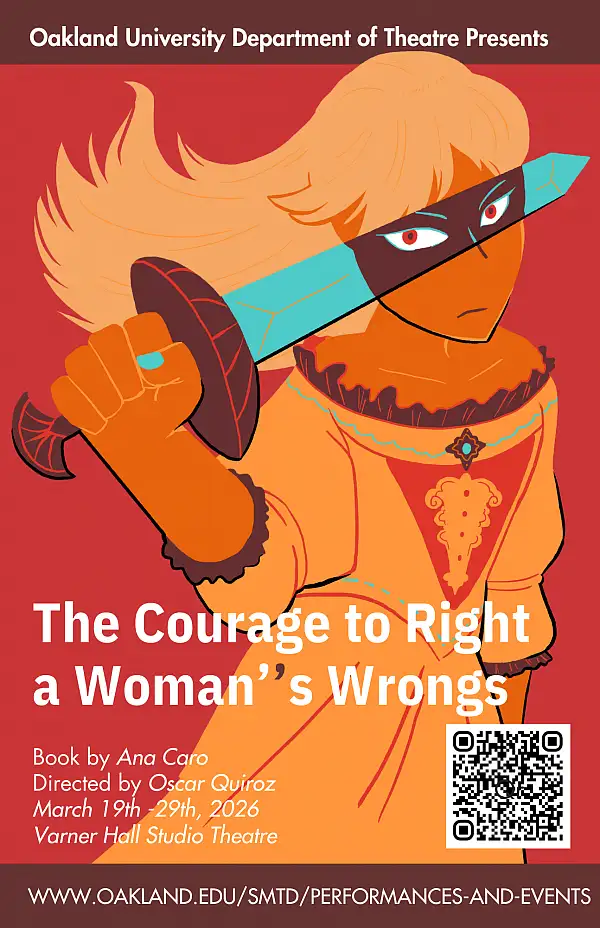
Oakland University’s Department of Theatre presented the play “The Courage to Right a Woman’s Wrongs,” Ana Caro’s sharp and spirited Golden Age comedy, on March 19, 2026, at 8 p.m. in the Varner Hall Studio Theatre.
Directed by Oscar Quiroz, the production delivered a lively blend of humor, adventure and social commentary that remains as engaging today as it was when it was first written.
This production showcased the relevance of Caro’s work, exploring themes of courage, gender, identity and more while keeping the audience entertained.
The story follows Leonor, played by Denetria Gibson, as she boldly transforms herself into the male disguise “Leonardo” to pursue her unfaithful lover, Juan, all the way to Brussels, Belgium. In this guise, Leonor navigates a world of duels, deception, and desire, using her wit, courage and combat skills to restore her honor and confront those who have wronged her.
Gibson’s performance anchored the play, capturing both Leonor’s emotional challenges and triumphs while managing the physical demands of her dual role. Her portrayal made the character’s struggles and successes relatable to the audience.
Supporting Gibson, Gavin Carcamo as Don Fernando delivered a performance that was both funny and charismatic, while Bradley Jacobs brought animated expressions and perfectly placed comedic timing to Prince Ludovico.
Isabeli Buendia portrayed Countess Estela with a perfect blend of intelligence and charm. Jay Harrison, as Ribete, Leonardo’s sidekick, provided consistent comic relief and Nate Stelzer as Tomillo contributed additional humor that kept the audience laughing from start to finish.
The set design was beautiful and reminiscent of larger-scale productions such as Hamilton, featuring a multi-level wooden structure decorated with green vines. It allowed for dynamic movement and action, creating a space that accommodated sword fights, quick entrances and fast-paced interactions.
Costumes blended the style of stories like “The Three Musketeers” with the elegant, more period-inspired aesthetics of Bridgerton, capturing both the romantic intrigue and the action-driven elements of the story. They also clearly marked Leonor’s transformation into her male disguise, Leonardo, making her dual identities easy for the audience to follow.
Spanish dialogue was woven throughout the performance, adding authenticity while keeping interactions clear and further drawing the audience into Leonor’s and the others’ journeys.
One of the production’s most captivating elements was the frequent breaking of the fourth wall. At key moments, the actors spoke directly to the audience, giving viewers insight into Leonor’s choices and actions. These moments, combined with quick-witted dialogue and strong comedic timing, kept viewers laughing while also highlighting the societal pressures and limitations faced by women in the play’s historical context.
Beyond just humor and adventure, the play addressed contemporary issues such as gender identity, social expectation, and LGBTQ+ representation. Leonor’s bold defiance of convention, her pursuit of justice, and her refusal to be confined by societal norms made the play extremely relevant.
Through its engaging performances, the play showed that classic works can remain relevant and entertaining for modern audiences, celebrating a story of courage, transformation and determination, one that proves a woman’s spirit cannot be confined by social boundaries.