
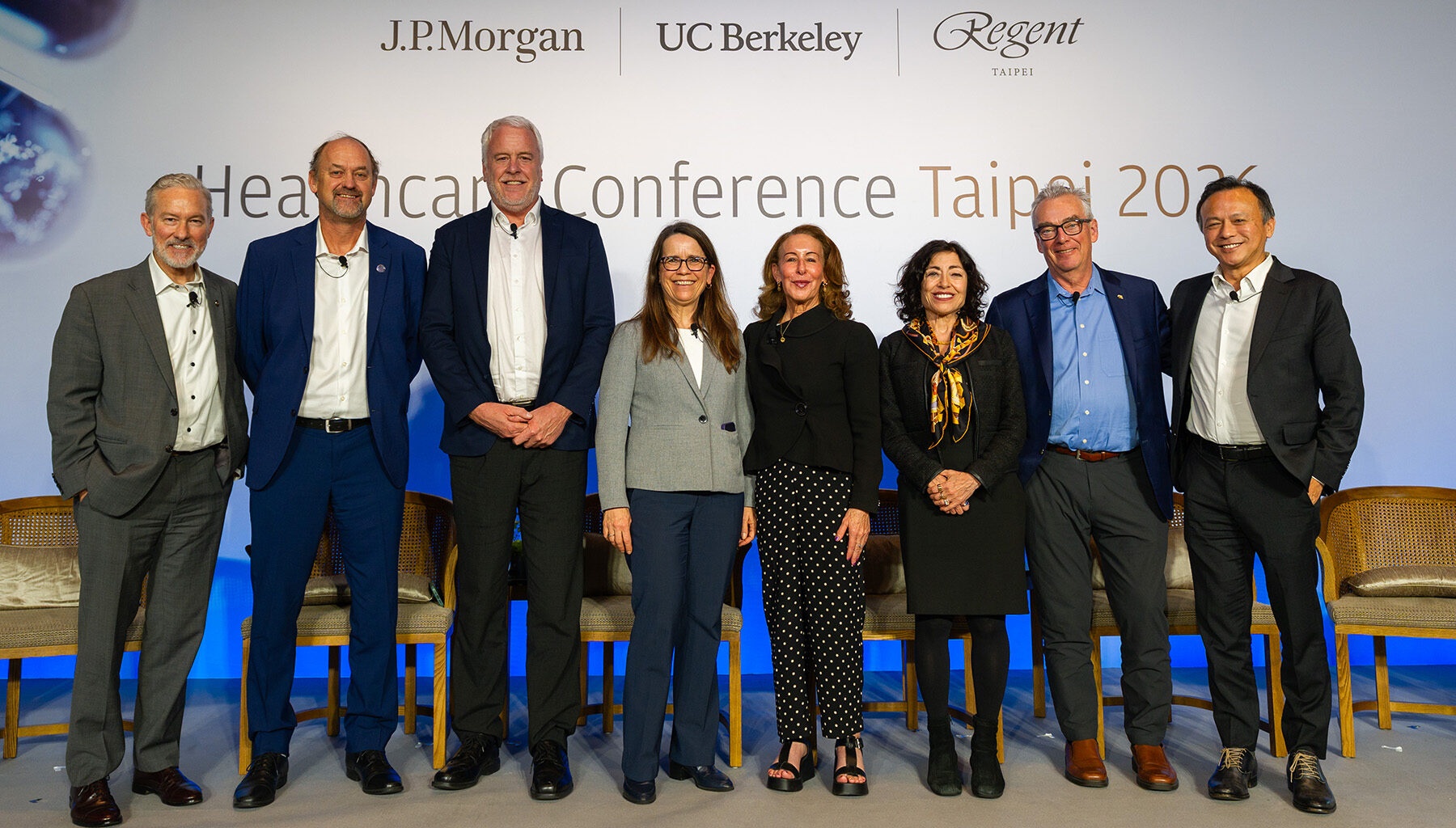
For more than four decades, the J.P. Morgan Healthcare Conference in San Francisco has been the epicenter of biotech and healthcare investment and innovation. This February, that stage extended across the Pacific.
The third annual Healthcare Conference Taipei—presented by UC Berkeley, J.P. Morgan, and the Regent Taipei—continued to grow as a vital cross-continental bridge. What began as a visionary idea from UC Berkeley School of Public Health Dean Michael C. Lu has evolved into a powerful convening, bringing together more than 350 invite-only entrepreneurs, venture capitalists, and high-powered academic and industry leaders from across the United States and Asia.
The goal of the conference is to build partnerships in biotech and healthcare across the Pacific. “We want to bring the best of the world to Asia,” said conference co-host Steven Pan, UC Berkeley trustee and Chairman of the Regent Hotels Group, “And showcase the best of Asia to the rest of the world.”
The presence of UC Berkeley leadership was unprecedented, signaling the university’s commitment to translating “fundamental ideas” into “long-term societal benefit.” Led by Chancellor Richard K. Lyons, the Berkeley delegation included eight distinguished deans and a Nobel Laureate: Omar Yaghi, UC Berkeley professor of chemistry.
“The world’s great research universities are among society’s most valuable assets,” Chancellor Lyons noted in his welcoming remarks. “Economic and societal prosperity has one source: New ideas put into practice.”
Dean Michael C. Lu framed the gathering as more than a conference on investment and innovation. It was, he told the audience, an opportunity to steward the future of healthcare. Stewardship, he argued, begins by “changing the conversation about the future of healthcare—from walls to bridges, from later to earlier, from profit to purpose.”
On global collaboration, Lu stressed that healthcare must transcend borders and politics. “Instead of building walls, we must build bridges,” he said. “Progress accelerates – and scales – when we work together.”
Lu also urged the industry to move upstream in the health continuum. “As long as we continue to overinvest in late-stage disease treatment and underinvest in the real drivers of health, we’re not going to move the needle on population health,” he said. Leveraging rapid advances in science and technology, Lu said, “the future of healthcare must move beyond treating disease to measuring, sustaining, repairing, and restoring health—long before illness takes hold.”
Finally, Lu reminded the audience that healthcare innovation must remain grounded in its human purpose. “Healthcare is not just an industry or a market,” he said. “At its core, it is about saving lives, reducing suffering, and improving health.”
The two-day event featured panels on healthcare investing, drug development partnerships, entrepreneurship, and artificial intelligence in healthcare, along with pitch presentations from 60 companies from the United States and markets across Asia, including China, Hong Kong, Japan, Korea, Malaysia, Singapore, and Taiwan.
The closing panel showed how UC Berkeley’s research is helping steward the future of healthcare.
Richard Harland, dean of Biological Sciences, highlighted the transformative promise of gene editing. “One of the most exciting things that’s going to be happening—and has already happened—is the development of personalized genetic treatments through CRISPR,” he said, emphasizing the need to make such therapies “faster, better, and cheaper” and ultimately accessible to patients around the world.