
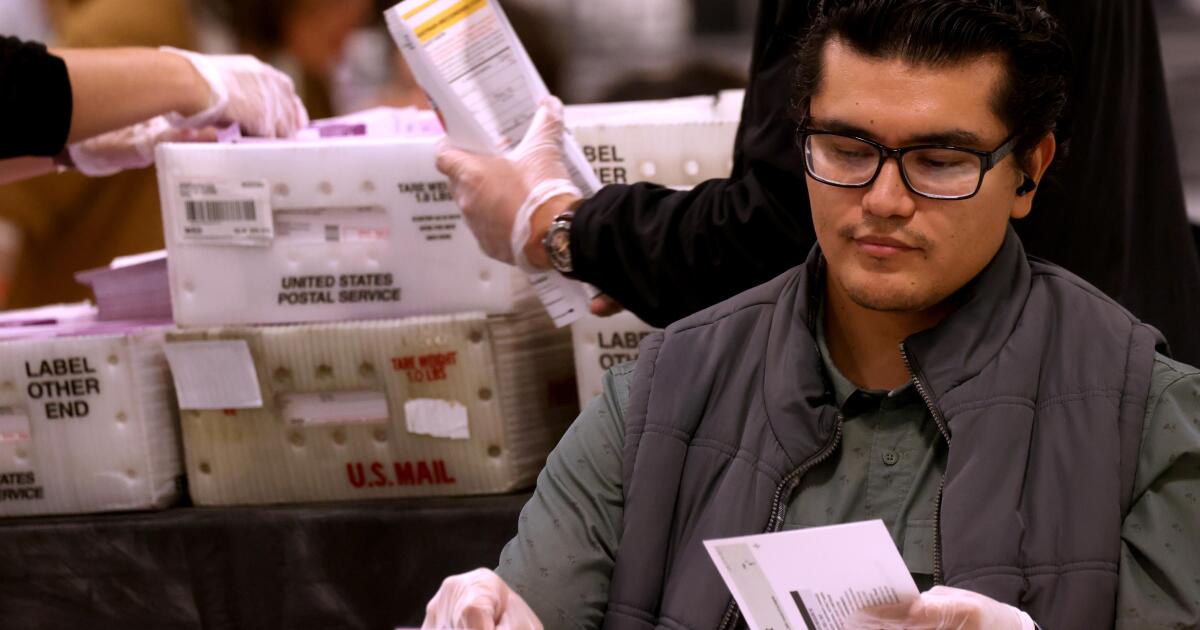
To the editor: California can absolutely make voting both easier and faster — but with a less convoluted approach than columnist Mark Z. Barabak suggests (“California can have both easy voting and quicker election results. Here’s how,” March 22).
First, set a clear, firm standard: All mail-in ballots must be received by election day. No gray areas, no extended uncertainty. Voters who wait until the last minute can still participate — by dropping off their ballots in person at designated polling sites on election day. That preserves access while restoring timely results.
Second, strengthen confidence and speed by encouraging in-person voting with voter ID. Verifying identity at the point of voting eliminates the slow, error-prone process of signature matching after the fact. The result: ballots validated instantly, counts finalized sooner and greater public trust in the outcome.
Efficiency and integrity aren’t competing goals. With straightforward rules like these, California can — and should — deliver both.
Brian Suckow, Palo Alto
..
To the editor: An easy fix presents itself to alleviate the majority of our voting returns woes: Remove the restrictions on early release of voting results accompanied with sufficient notification that these are not official results. Yes, we must check every last signature, but we should not be forced to wait up to a month to know outcomes. Save the long waits for the tight races; the majority of outcomes are quickly apparent.
John C. Nelson, Los Angeles
..
To the editor: James Rainey’s article about the mess in the gubernatorial race recommends ranked-choice voting as a way out (“Rank choice voting could have saved Democrats from their governor’s race mess,” March 20). The system described is actually instant-runoff voting, the worst of several ranked-choice alternatives. It throws votes away, raising grave constitutional concerns.
By the nature of its algorithm, it fails to find the majority winner and often leads to paradoxical results. Moreover, by requiring centralized tallying, it greatly slows the vote-counting process. Partial (e.g. precinct) counts do nothing but mislead voters and candidates as to the likely outcome.
In contrast, Condorcet voting, aka instant round-robin, pairs candidates head to head and finds the candidate who defeats all others. It’s also much simpler and can be done by hand if necessary or preferred.
Karen A. Wyle, Bloomington, Ind.