
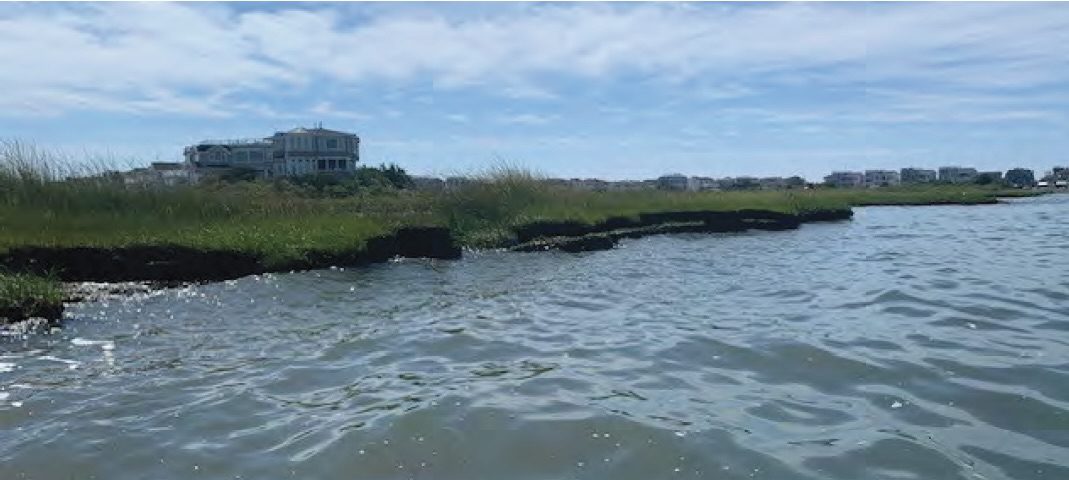
RESTORATION: Clam Cove Reserve in Holgate – once a peninsula and now an island – is the site of a oyster reef installation Long Beach Township has undertaken in collaboration with partners such as the Monmouth University Urban Coast Institute and the Stockton University Coastal Research Center. The municipality is prioritizing the bay islands, which officials call ‘critical infrastructure for coastal resilience.’ (Supplied Photos)
Each year the New Jersey State League of Municipalities hosts an award program to highlight exemplary local government programs that provide novel and practical approaches to solving municipal problems and concerns. Near the end of 2025, during the annual league conference, Long Beach Township was presented with an “innovation in governance” award for its use of oyster reefs to stabilize and restore bay islands.
An article featuring the township’s project appears in the March issue of NJ Municipalities Magazine, the official publication of the NJSLM, to highlight this lauded project, submitted for award consideration by township Mayor Joseph Mancini and Resilience Project Manager Angela Andersen.
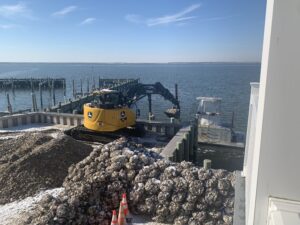
SITUATED ON THE SOUTH END: Clam Cove, off Osborn Avenue in Holgate, is adjacent to the Long Beach Township Marine Education Field Station, a hub for the sustainability work that the municipality pioneers in the community.
According to Mancini and Andersen, as per the article, “This project is part of the innovative way that Long Beach Township prioritizes the bay islands as critical infrastructure for coastal resilience. The township is invested in safeguarding these islands to protect habitat, mitigate flooding and minimize the impacts of increased storm waves and boat wake energy on our shorelines and our on-land properties and infrastructure.”
LBT and partners began to collect post-consumer oyster and clam shells from area restaurants for bay restoration projects in 2017 – and is the only municipality in New Jersey to do so. Up until 2022, the shell was used at the Tuckerton research oyster reefs in Little Egg Harbor Bay, in collaboration with Stockton University. Since then, the shell is being used for bay island stabilization and restoration projects offshore of the township.
The township’s Clam Cove Restoration Project got officially underway in Holgate in early winter when several municipal departments collaborated with the Monmouth University Urban Coast Institute dive team to start placing oyster castles along the coast of Clam Cove, an island in Little Egg Harbor Bay. As township officials noted at the time, “This framework will then be filled with our recycled oyster shells to stabilize the eroding shoreline.”
Clam Cove has not always been an island. The land was once a marsh peninsula, but, as the municipality explained, “over the years, erosion slowly created a shortcut through the peninsula and into the cove, what many know today as ‘the cut.’ This change happened partly because the local ecology couldn’t keep up with our ever-changing environment.
“Species like the Atlantic ribbed mussel and common marsh grass (spartina alterniflora) play a big role in holding the island together by using their sticky threads and roots to bind sediment,” they added. “Unfortunately, these important species have been struggling to survive as temperatures rise and water levels increase.”
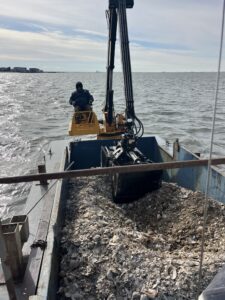
BAY TO TABLE TO BAY: LBT and its partners began to collect post-consumer oyster and clam shells from area restaurants in 2017. Currently the shell is being used for the bay island stabilization and restoration projects offshore of the township.
As Mancini pointed out, “The township has been focused on restoration work at Clam Cove since we acquired the parcel,” utilizing the municipality’s open space trust in cost share with the Ocean County Natural Land Trust. Clam Cove, off Osborn Avenue, is adjacent to the recently established Long Beach Township Marine Education Field Station, a hub for the resilience and sustainability work that the township pioneers in the community.
Over the past few years the municipality has worked to secure funding for data collection, design and permits for the installation of a hybrid oyster reef breakwater, an ongoing project that is utilizing shell collected in 2023 and 2024. The hybrid reef breakwater is an innovative design combining an oyster castle framework with loose and bagged oyster and clam shell within the structure. Various bagging materials are being tested to reduce plastic inputs to the ecosystem but still maintain the integrity of the outcomes.
The reef is designed to stabilize the most vulnerable piece of the marsh project site and be the model to restore the full marsh shoreline of Clam Cove Reserve and additional bay island sites.
As the league article explains, “The vibrant health of Little Egg Harbor Bay and surrounding oyster farms alongside neighboring restoration projects have provided an abundance of wild-set oysters in the system, and the more hard surface we can provide to capture this native species growth the better off the system and the communities will be.”
In short, said Andersen, “Oyster reefs and bay islands are perfect together.”
The partnerships for this project, including the Monmouth University Urban Coast Institute and the Stockton University Coastal Research Center, stem from the township’s leadership in the New Jersey Bay Islands Initiative and the New Jersey Coastal Resilience Collaborative.
“It is through these partnerships that they promote the transferability of these innovative strategies to other coastal townships,” the league article states. “The funding and basis for these projects include workforce development within the township staff and resource capacity. The township believes that a strong and knowledgeable workforce is the foundation for implementing successful resilience projects. From the department of public works and municipal engineering, to establishing a resilience project manager on staff, this progressive look at innovative solutions to municipal governance is a standout model for all New Jersey communities.”
Andersen said earlier this week that work on the Clam Cove oyster reef breakwater will resume in late spring to finish the distribution of the recycled shell, and she offered thanks to the project funders at New Jersey Resources and the New Jersey Corporate Wetlands Restoration Partnership.
“There will be much to learn from this installation,” she remarked. “We hope that it diminishes the rapid erosion, while the project team makes strides in final data collection and design under the federal grant from National Fish and Wildlife Foundation, for the full shoreline project at Clam Cove.
“We are developing summer programs and opportunities for all ages at the field station to engage in this innovative work,” she added. “It is a combination of coastal and community resilience.”
As the league article points out, the local, regional and statewide relationships the township has been developing since Superstorm Sandy “have created the tapestry of innovation and building blocks for making ideas become implementable and meaningful projects. These legacy projects are investments in community and coastal habitats whose benefits will be realized for the foreseeable future.”
— Juliet Kaszas-Hoch