
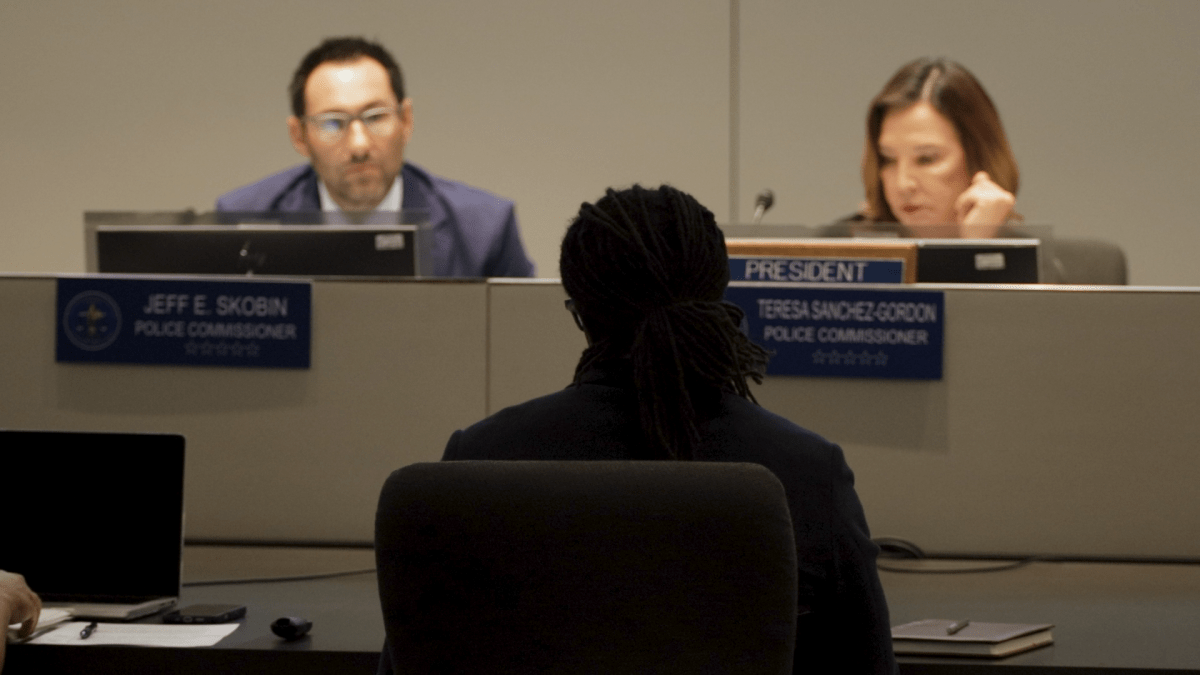
The Los Angeles Police Department’s oversight board considered Tuesday whether to permanently restrict certain types of pretext traffic stops, where officers use traffic violations as lawful reasons to stop motorists in order to look for evidence of more serious crimes.
The Los Angeles Board of Police Commissioners heard presentations from the Push LA coalition, which is urging the City to ban most pretextual stops, and from members of the LAPD command staff, who defended the stops as Constitutional and important in efforts to prevent violence and find illegally possessed guns.
“If the City were to move forward with a stronger approach, it would help reduce racial disparities and disproportionate stops of black and brown folks,” said Chauncee Smith of Catalyst California, part of the Push LA effort to further limit the stops and end certain types of traffic enforcement by police entirely.
The discussion followed recent City Council efforts to review police policies with the goal of reducing friction between officers and residents, after years of complaints that these particular traffic stops have led to distrust of the police and to frustration, as the LAPD’s own data shows Black and Hispanic drivers are stopped more often than others, and statistically, relatively few pretext stops have resulted in the discoveries of other crimes.
“Pretext stops are lawful detentions,” LAPD Capt. Shannon White told the commissioners, and showed a map that illustrated the majority of these stops in 2025 were conducted in neighborhoods experiencing the highest rates of street violence, and of serious traffic collisions that caused injuries and deaths.
“As we attempt to drive down crime it is still disproportionately in Central and South Bureau where you’re seeing the most harm to victims,” she said, referring to murders, assaults, kidnappings, human trafficking, and robberies.
The LAPD changed its policy in 2022 to limit pretext stops to investigations of more serious crimes, and directed officers to use their body-worn-video cameras to record their rationale for a stop as they were being made.
Data showed the number of stops dropped that year before increasing in each of the following years.
According to the Department, the top violations used in pretextual stops in 2025 included moving violations for drivers who failed to stop at crosswalks or intersections, speeding, and equipment violations for cars without license plates or without working lights.
Push LA said equipment violations could be enforced with fines mailed to the registered owners of the cars, and has separately advocated for removing law enforcement from traffic enforcement by exploring the idea of using unarmed City Department of Transportation employees instead.
“On the surface it can seem that these [traffic violations] are unimportant, that these are things that we can just let go or send somebody a letter,” Capt. White told the Commissioners.
“But we’re ultimately challenging our officers to be proactive in preventing crime,” she said.
Commissioner Jeff Skobin asked if Push LA had examined whether there was a correlation between the number of pretext stops and the crime rate, and whether one appeared to affect the other.
Smith said that analysis wasn’t part of their research.
The LAPD said these stops are part of the reason officers have discovered more illegally possessed guns in recent years.
The Department’s data showed there was a 21% increase in the number of guns seized in January and February of this year compared with the same time last year, but it did not note how many of those discoveries were the result of pretext traffic stops or the resulting searches.