
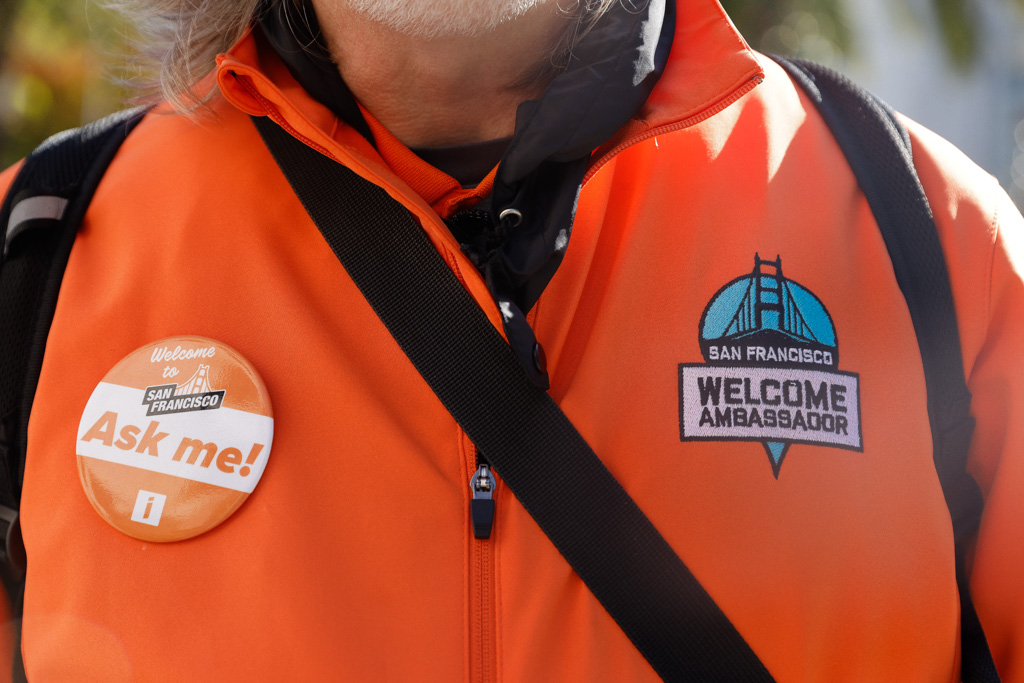
The San Francisco Downtown Development Corporation has said it will commit money to ensure the continuation of downtown’s ambassador program.
Lea Suzuki/The Chronicle
In vests and windbreakers bright as traffic cones — or, just as often, in dark navy layers — San Francisco’s safety ambassadors fan out across downtown, from Union Square to the Montgomery BART station, the Embarcadero and the edges of Moscone Center, radios crackling as they scan the shifting crowds of commuters, conventioneers and tourists.
In the years since the pandemic emptied downtown, these privately-funded emissaries have become a fixture in the area — and helped drive a drop in 911 calls. But the funding that keeps them on the streets is set to expire next month.
Now, the San Francisco Downtown Development Corporation said it will step in, confirming to the Chronicle that it will fund the Union Square Alliance and Yerba Buena Partnership HEART ambassadors for another year, preventing a lapse in service across downtown’s hospitality zone.
Article continues below this ad
The DDC’s fresh investment to the tune of a $5 million grant means that a total of 21 ambassadors will be stationed on the corridor stretching from Union Square to the Yerba Buena area. These operate independently from the teams deployed by Urban Alchemy, a nonprofit that focuses on outreach to unhoused residents and crisis prevention, rather than on visitor services.
Funding from the DDC — a nonprofit formed last year that works with civic, business, labor, and philanthropic leaders to revitalize downtown San Francisco — will also be used for to expand the city’s Market Street Safe Corridor Program at the Powell Street Bart Station, placing three full-time ambassadors at the busy downtown transit stop during business hours, for 40 hours per week. That program, launched last year by the Downtown SF Partnership and initially funded by Amazon, Google and Visa, already covers the Montgomery and Embarcadero Bart Stations. It was supplemented in the fall with investment from the DDC that ensured its survival through the end of last year.
San Francisco Chronicle Logo
Make us a Preferred Source to get more of our news when you search.
Add Preferred Source
The group’s CEO, Shola Olatoye, said that placing these “human wayfinders” who monitor crowds, assist commuters and tourists, provide directions, perform welfare checks and help de-escalate conflicts at key BART Stations has had a “tremendous impact on both the perception and reality” around public safety issues in downtown. And that is, essentially, the core of DDC’s mission.
“Establishing safety and cleanliness as a foundational condition is critical to ensuring that the work that’s underway can continue,” she said.
Article continues below this ad
Mayor Daniel Lurie has consistently framed his vision for a downtown long scarred by pandemic-era empty storefronts and offices as one of transformation: Turning the commercial core into a vibrant, 24/7 neighborhood. According to city officials, the area’s lingering reputation for cleanliness and public safety challenges continues to complicate efforts to attract workers, residents and visitors back to the heart of the city.
“Downtown is the economic engine of our city. The revenue generated here funds critical services across the city, including Muni and our parks. That revenue pays our first responders and sustains critical services that help families thrive,” Lurie said in a statement, adding that the Powell Street Station is one of downtown’s busiest transit hubs, and therefore key to supporting the city’s recovery.
In Union Square, San Francisco’s premier shopping district, nine ambassadors are already out around the clock, seven days a week. Over in the Yerba Buena neighborhood, where the city’s largest convention center and a number of hotels and cultural institutions are located, another nine are on duty every day from early morning into the evening, patrolling both fixed posts and roaming the streets throughout the district.
“We’re grateful to the Downtown Development Corporation for stepping in to sustain this program and ensure Union Square continues to be a place where everyone feels safe, supported, and welcome,” said Marisa Rodriguez, CEO of the Union Square Alliance, which manages the HEART Ambassador program with the Yerba Buena Partnership.
Those groups said that, last year, the program resulted in 250 emergency calls, 1,300 service requests to city agencies and 50 confirmed lives saved through Narcan administration, among other outcomes.
Article continues below this ad
“It’s exciting to see a prolonged surge in optimism among businesses, residents and visitors about the vitality that exists in Yerba Buena today and what’s to come,” said Scott Rowitz, executive director of the Yerba Buena Partnership.
Olatyoe, of the DDC, pointed to data showing that the “Safe Corridor” pilot at the Montgomery and Embarcadero stations — which, along with the Powell Street Extension, will now be funded through the end of the year — drove a 53% drop in safety-related 911 calls, which she said underscores DDC’s role.
“We can come in and fill critical gaps — and we can move quickly with high-impact capital,” she said.
Backed by corporate heavyweights and deep‑pocketed donors such as Laurene Powell Jobs’ Emerson Collective, the Dolby Family and Ripple founder Chris Larsen, the DDC has quickly positioned itself as a linchpin in the push to remake the city’s urban core, and is aligned closely with Lurie’s agenda. The nonprofit has already secured more than $60 million in private contributions and commitments to fund safety, cleanliness and activation projects downtown, including support from Google, Amazon, OpenAI, Ripple and other major tech players.
With its focus on safety, cleanliness and public space activation — especially as high-profile events like the Super Bowl and World Cup shine a spotlight on the city — there are concerns that this corporate-led approach prioritizes visible, short-term interventions over sustained investment in the communities that have long anchored San Francisco’s cultural identity.
Article continues below this ad
Museums in and around the Yerba Buena neighborhood illustrate this tension, having faced program cuts, staff reductions and even closures, highlighting the vulnerability of arts institutions outside the public-safety driven revitalization agenda.
Despite the successes of the initiatives that have received DDC funding, Olatoye acknowledged that major hurdles to downtown’s revitalization remain.
“Let’s not sugarcoat it — we have some big challenges ahead of us,” Olatoye said, but added: “We cannot do anything to refill empty storefronts, get people to come back to work or get people to patronize cultural institutions — if people do not feel safe.”