
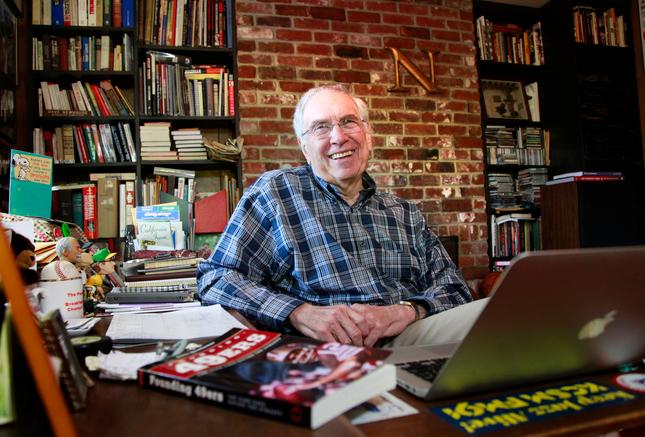
Dave Newhouse, whose columns delighted Oakland Tribune sports fans for more than 47 years, died March 12 from a heart attack, and the Bay Area lost a great sportswriter; his family lost a beloved husband and father; and I lost a dear friend.
When you read a Dave Newhouse column, you didn’t come away thinking, “Wow! What great writing,” you thought, “Wow! What an interesting story.”
RELATED: East Bay loses Newhouse and Steward, longtime forces of sports writing
Some writers like to show off with writing that almost shrieks, “Look how clever I am!” Not Dave. He not only had a knack for finding a great story but the good sense to step back and let the story write itself. His art was the art that conceals itself. I was a fan of his even before I met him 40 years ago when I joined the Tribune. Like everyone else, I not only admired him, I loved him.
He was invariably generous, thoughtful and kind and had an integrity most of us can only aspire to. At one point he had a radio show on KNBR that he really loved, but when the Giants owners and station management ordered him to stop talking about the Oakland A’s he refused; and they fired him, as he knew they would.
He also had guts. When he was in Miami covering the Super Bowl between the 49ers and Bengals in 1989, an African-American motorcyclist named Clement Lloyd was shot and killed by some cops. A riot quickly broke out and got more dangerous by the hour.
The other reporters were too scared to go into the heart of the riot and interview people, but Dave dived in and got their stories firsthand. It earned him the Professional Football Writers Column of the Year award.
“I’ll never forget his principled decision after so very many seasons to relinquish his Baseball Writers of America membership card — and with it his annual vote for the Baseball Hall of Fame in Cooperstown — because he felt that so many players in the ’90s and later had violated the sanctity of the game with their me-first attitudes and use of PEDs (performance-enhancing drugs),” Pete Wevurski, a former managing editor of the East Bay Times, wrote on Facebook.
“Also to be remembered was a flip comment he made about Bill Buckner in a column — nothing vile, of course, but something that followed the trope of Buckner being the (scape) goat of the Boston Red Sox collapse in the ’86 World Series. Bill’s sister wrote Dave a heartfelt defense of her brother, and Dave felt compelled to write a follow-up column about her comments. He delved deeply into all the good and great things Buckner had done throughout his career for all of his teams and teammates.”
Dave’s decency also served him well when it came to interviewing players. For instance, Marshawn Lynch is noted for his reluctance to talk to reporters because he’s so used to getting cheap-shotted; but he always trusted Dave, who began covering him when he played for UC Berkeley.
“I think it’s because Dave always treated him with respect,” Herb Benenson, Cal’s former associate athletic director for communications, told me.
After Dave retired from the paper, he re-embarked on his second career: writing books about sports. He already had published a few before retirement, but most of them came afterwards, each one more fun to read than the last.
There were 20 in all, and I can’t decide which one is my favorite. Sometimes I think it’s “Disqualified,” a fascinating inside look at the 1972 Olympics as seen through the eyes of Eddie Hart, the great Cal sprinter who was the victim of one of the worst foul-ups in the history of the games.
Or maybe it’s his most recent book, “Goodbye Oakland,” which combines some great stories from glory days past with a well-deserved trashing of team owners who betray a city and a people who supported them so loyally for so many years, abandoning them for the fleshpots of Las Vegas.
I’ll let his son Casey have the last word: “His grit reflected the values he lived by as an Oakland native: protecting human dignity, showing compassion and empathy for the good in people and standing fearlessly against anyone he judged to be a thief, liar, quitter or cheat. Those were his rules — for himself, for his family and for life.”
Martin Snapp can be reached at catman442@comcast.net.