
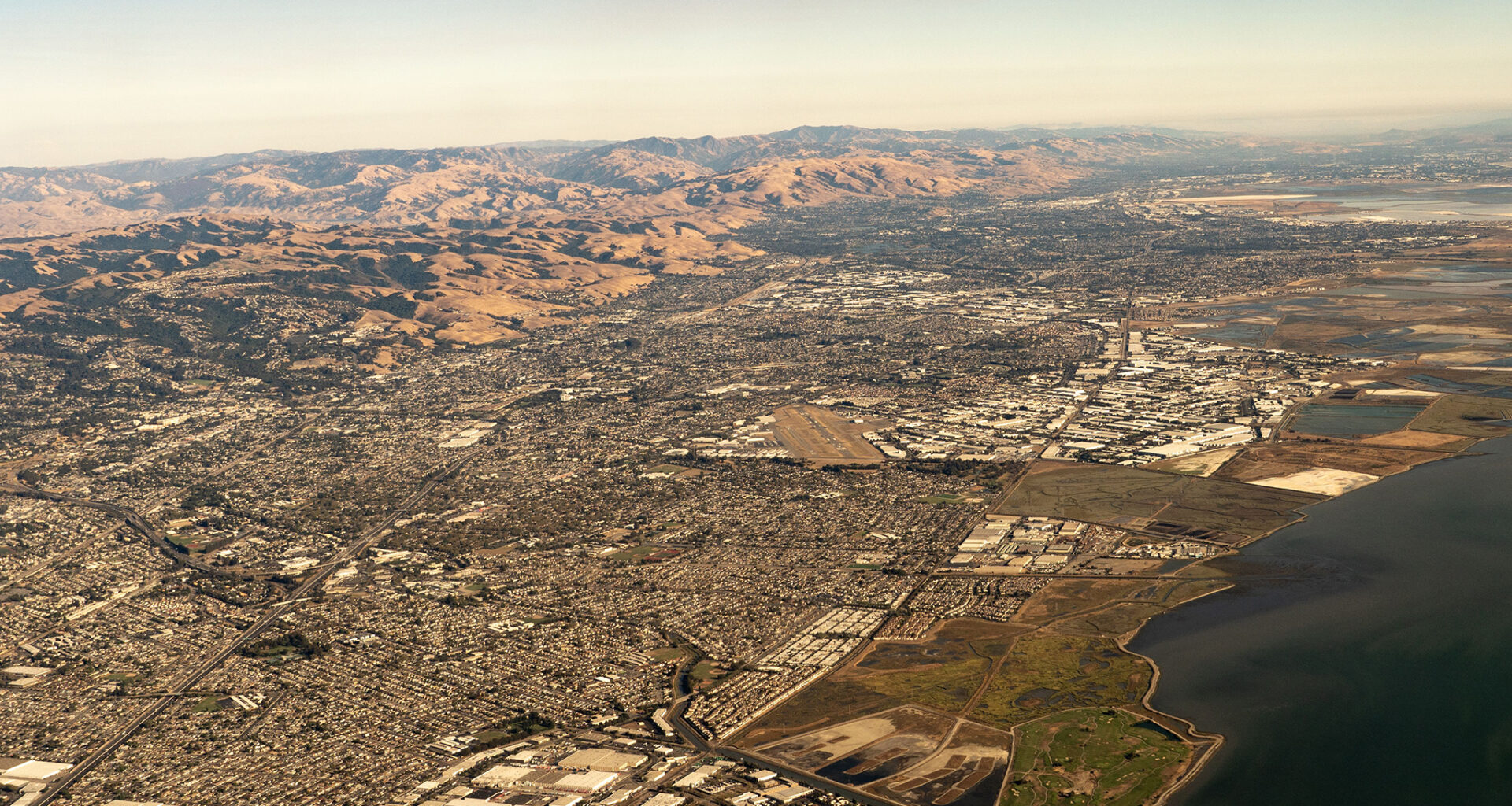
There are two kinds of people who don’t hang pictures on their walls: minimalists, and people who live directly above a fault line.

Alex Cully is the latter. From 2016 to 2017, Cully rented an apartment in the Hayward Hills, near Garin Regional Park, that was directly on the Hayward Fault. Because two continental plates were having a shoving fight beneath the floorboards, Cully had started to forgo the normal interior decor.
“I never put up photos on the walls, and kept everything fragile either in a box or somewhere that falling wouldn’t break them,” Cully said in an email.
Article continues below this ad
But that wasn’t the worst of it.
Everyone in the San Francisco Bay Area knows we live in a geologically active region. Lest you forget, small reminders poke out everywhere: tsunami warning signs, earthquake insurance fees, triangular crossbeams that gird earthquake-retrofitted buildings, and our noticeable lack of brick construction.
Make SFGATE a preferred source so your search results prioritize writing by actual people, not AI.
Add Preferred Source
But then there are the brave Bay Area residents who live directly on top of the boundary between two tectonic plates — what, in common parlance, we call a fault line. For them, the existential threat presents itself in small, and sometimes big, ways on a weekly basis. Plate tectonics is not a slow process but something that plays out constantly on their property.
Article continues below this ad
An aerial view of UC Berkeley’s California Memorial Stadium in Berkeley, Calif.
Steve Proehl/Getty Images/Corbis Unreleased
Many prominent properties in the Bay are built atop faults: UC Berkeley’s California Memorial Stadium; much of Cal’s adjacent frat row; the Oakland Zoo; and a long swath of Skyline Boulevard on the Peninsula are all bisected by either the Hayward or San Andreas faults. Moreover, hundreds of single family-homes on both sides of the Bay sit atop a fault line.
And if you’ve ever wondered what it’s like for the people who live atop such geologic hazards — boy, do they have stories.
What’s happening geologically
The Bay Area is one of the most seismically active urban areas in the whole world. In terms of natural beauty, that’s a boon: vast mountain ranges, dramatic coastlines and San Francisco’s legendary hills all owe their existence to our geologically active region.
In other words, the Bay’s famous topography is the result of a few major fault lines, including the San Andreas Fault, which runs south by southeast from Daly City down through San Juan Bautista (and ultimately down to SoCal), and the Hayward Fault, which runs parallel from Richmond and through Morgan Hill. There are other fault lines in the area, too — among them are the Calaveras Fault and the Rodgers Creek Fault. But technically, these are all part of the same fault system, experts said.
Article continues below this ad
An illustration shows the major fault lines in the San Francisco Bay Area.
Getty Images
Specifically, the treacherous Hayward Fault is a “secondary strand” of the San Andreas Fault system, Roland Bürgmann told SFGATE in a phone interview. Bürgmann, a professor of geophysics at the Berkeley Seismological Laboratory, studies active tectonics, including the Hayward Fault.
To visualize the relationship between the San Andreas and Hayward faults, Bürgmann likened it to slices of cake. The wedge of cake bound by the Hayward and San Andreas faults is moving a little faster than the plate to its east, and the (mostly oceanic) plate west of the San Andreas Fault is moving faster than either of those.
Meanwhile, some fault systems abut and push into each other, producing mountains.
Article continues below this ad
That’s not what ours does.
Our fault system is what is known as a “slip-strike” fault, Bürgmann said — meaning these tectonic plates “move horizontally” against each other.
“In this case, the Pacific plate moves towards the northwest and relative to North America,” he added. Bürgmann said the Hayward Fault moves about 10 millimeters a year, while the San Andreas moves about 20 millimeters. (That motion is relative to either side of the fault.)
FILE: A bridge crosses over the San Andreas Fault from the Pacific to the North American tectonic plates near Parkfield, Calif.
Frederic J. Brown/AFP via Getty
This explains what was going on in Cully’s apartment complex in Hayward. The western half of the apartment was moving northwest relative to the eastern half. And since buildings are designed to be, well, immobile, that didn’t exactly have positive consequences for Cully’s photos on her wall — or the rest of her building, as she’ll explain soon.
Article continues below this ad
When a fault line suddenly slips
For an example of the effects of the Hayward Fault on human-made structures, take a stroll around UC Berkeley’s California Memorial Stadium. Home to Cal’s football team, the Golden Bears, the stadium also happens to bisect the Hayward Fault.
In 2008, the university initiated a nine-figure renovation to seismically retrofit the stadium. As Carolyn Jones wrote for SFGATE at the time, the plan called for “portions of the stadium to be sliced into blocks that will rest on plastic sheets. When the earth ruptures, the soil will move under the sheets but, engineers hope, will leave the blocks intact.”
While the structure itself is safe(ish) by virtue of these retrofits, you can see the dramatic effects of what the fault is doing to the surrounding environment. Where the exterior stairs touch the stadium, cracks in the concrete reveal that it is pulling away from the structure. Grout in the sidewalk adjoining the stadium and sidewalk is inches apart from where it clearly used to be. Walk about a hundred feet from the stadium’s south entrance and kneel, and you can see a rippling in the cinder block steps that form the walkway — an ominous reminder from the Earth that, yes, it is alive, and there’s stuff happening down there.
Article continues below this ad
Buckling cobblestones in the sidewalk outside UC Berkeley’s California Memorial Stadium in Berkeley, Calif., on March 1, 2026. The Hayward Fault runs directly beneath the stadium.
Keith A. Spencer
But these literal cracks in the facade are better than the alternative, it turns out — not all faults are so gracious.
“There are essentially two major ways in which faults slip,” Bürgmann explained. “One is suddenly — in an earthquake, going fast enough that it also produces seismic shaking.”
“And the other would be this slow sliding” — what is known as creep or slow slip, he said. The land around Cal’s stadium is doing the slow sliding, fortuitously.
Article continues below this ad
Bürgmann also said that the Hayward Fault in particular has “little, slow, so-called creep events. Those are much slower than earthquakes.”
And that creep is visible in the concrete and grout that’s slowly separating around the Berkeley stadium.
Steve Graham, a geology professor in the Department of Earth and Planetary Sciences at Stanford University, explained in a phone interview that creep is preferable to the sudden release of energy that accompanies an earthquake. Creep means that the energy from the fault is coming out slowly rather than all at once. (Though that “doesn’t preclude a larger earthquake happening along a creeping section,” Graham clarified.)
And if you live on a fault line that suddenly slips?
Article continues below this ad
The author’s foot is seen next to the drainage grate, left, on the sidewalk abutting the California Memorial Stadium; grout and the sidewalk, at right, are separating from the California Memorial Stadium in Berkeley, Calif.
Keith A. Spencer
“There’s little that could be worse than living exactly on a break or a fault, because if it slips 15 feet suddenly in an event, your house is going to be ripped asunder,” Graham said.
Graham mentioned the Kaikoura earthquake that struck New Zealand in 2016. One of his Ph.D. advisees was working in the area near a house that was “built exactly where that fault actually breached the surface in this earthquake.”
“And there’s a very dramatic aerial view of the house that actually was fully twisted off of its foundation and the driveway offset by 15 feet in a lateral movement,” Graham added.
Article continues below this ad
That now-iconic photo from that earthquake shows the house on one side of the fault and its foundation on the other — as though a magician performed a tablecloth trick on the house. A seam like a scar runs across the two, the product of the fault below.
Because the Bay Area has the same kind of strike-slip faults, this is what could happen in a big quake if you were living right on a fault line.
Cully found this out firsthand.
The most dangerous apartment in the East Bay?
In the year she lived in the fault-overlapping Hayward apartment, Cully never saw something as dramatic as the building getting ripped off its foundation. But she observed the effects of the fault all the time. And they kept escalating.
Article continues below this ad
“Asphalt constantly cracked,” Cully said. Her water pipes “were breaking regularly in the same areas.” Wooden railings would separate from the walls as cracks formed between wood and concrete. The sidewalk was pushed up in random spots. And cracks appeared in the road and parking lot — cracks that grew regularly, she noted.
FILE: Contra Costa College in San Pablo, Calif,. sits near the Hayward Fault. Bricks at the Campus Circle courtyard on the campus’s north side appear to have shifted into an S-alignment.
John Dvorak/Getty Images
The apartment’s parking lot was repaved while Cully lived there and immediately began deteriorating. “By the time I moved out, there was 1.5 inches of dip from the main road, and the center had begun to sink,” Cully said.
As Graham noted, Cully was observing not only creep but the more dramatic, sudden “slip” effects from small earthquakes, too.
Article continues below this ad
“There was one particular 3.0-plus [quake] that made the whole building creak and shift. It was very scary,” Cully said. “After that, the walls had deep cracks going horizontal, showing that the foundation had tilted and the drywall separated. This wasn’t relative to just our unit. Lower down the hill, the roadway began to split into deep convex fissures.”
“Seeing the walkways constantly disintegrate was concerning,” Cully added. “I worried about our parking situation going downhill — literally.”
In practical terms, what was happening was that the western side of this apartment complex was moving north relative to the eastern half — by a staggering 10 millimeters a year. That might sound small, but modern buildings built to exact specifications aren’t typically designed to have their opposite ends move 4 inches apart every decade.
Eventually, Cully had to adapt to life on a fault. Besides forgoing hanging art, she also stopped using the “bad side” of her patio because it was splitting off from the main building.
Living on the fault in a less urban area is a very different experience compared to Cully’s apartment situation. Carrie Coe has lived for 30 years on a fork of the San Andreas Fault in San Benito County. Coe said that she “rarely worries about the San Andreas.”
Article continues below this ad
“This property survived the quake of ’89,” meaning the Loma Prieta quake, she said over email. That quake, a magnitude 6.9 event, devastated nearby Santa Cruz, wrecked the Embarcadero Freeway and severed a deck segment of the Bay Bridge.
“I figure if it survived that, we’re probably okay,” Coe added. “If we get a quake bigger than that I think everyone will be in trouble.”
She said that she feels earthquakes “frequently” on the property. “We had a doozy on Thanksgiving,” she noted. “They freak out people from the East Coast, but us locals are used to them.”
But excepting the so-called Big One, Coe is worried more about other natural disasters.
Article continues below this ad
“Honestly, El Niño is what scares me,” she said. The fault line creates hilly topography on her property, which “means we get mudslides when we get too much rain.”
FILE: The remains of the Cypress Freeway, which ran through the center of Oakland, Calif., following the Loma Prieta earthquake in 1989.
Jim Sugar/Corbis via Getty Images
Who wants to live on a fault line?
So, how dangerous is it actually living on a fault line, as Carrie Coe, Alex Cully and thousands of locals do? And how does that compare to living near one, as hundreds of thousands of us do?
Article continues below this ad
Geologists I spoke with said that’s hard to assess — but living directly on a fault line would be inadvisable.
“If you’re right on the fault, nothing good is going to come out of that,” Graham said.
“You don’t want to live right on the fault,” Bürgmann concurred.
FILE: The Carrizo Plain in eastern San Luis Obispo County, Calif., contains the most strikingly visual portion of the San Andreas Fault.
Lloyd Cluff/Getty Images
However, risk is “not as simple as distance from the fault,” Bürgmann said. “Low-lying areas along the bay that are built on bay mud or reclaimed land experience much more shaking than locations that are closer to the fault but are on solid bedrock,” he noted.
Article continues below this ad
“It depends so much on construction of your home and specifically what it was built on,” Graham said. “Was it built on soft sand like in the Marina District, where buildings subsided where the old sand dunes foundered? Or is it built on and tied into bedrock?”
Bedrock, of course, is the safest option.
“If you’re built on bedrock and tied into it structurally, you’re going to shake with the earth instead of disharmoniously, and that’s going to greatly reduce the damage to your house — in principle,” Graham added.
Meanwhile, neighborhoods like the Marina, despite being several miles from the San Andreas Fault line, are apt to be the most decimated. That’s because the Marina is built on artificial landfill — a mix of sand and debris from the 1906 earthquake.
Article continues below this ad
FILE: An apartment in San Francisco’s Marina District appears heavily damaged following the 1989 Loma Prieta earthquake.
Jim Sugar/Getty Images
And Bürgmann is putting his faith in science to the test. He said that he lives two blocks from the Hayward Fault. But his house is on solid ground and has the most modern earthquake-proof construction techniques.
“I think I live in a pretty well constructed home, but in a zone that could see quite intense shaking. So we will find out.
“We do have earthquake insurance,” he added.
Article continues below this ad
Regardless of your proximity to either fault, the Hayward Fault is considered one of the most dangerous fault lines in the world. Part of that is the probability of a quake, and another part of that is how urbanized the land around it is.
Bürgmann said that his colleagues at the United States Geological Survey have data “going back 2,000 years or so” on when big earthquakes occurred.
“Those data suggest, on average, the Hayward Fault can have an earthquake every 150, 260 years,” Bürgmann noted. “And that’s just about as long as it’s been since the last one,” referring to the 1868 Hayward earthquake.
According to Bürgmann, scientists estimated that between 2013 and 2043, there is a 30% probability of a 6.7 magnitude or greater earthquake occurring on either the San Andreas or Hayward Fault. And for that one, you probably don’t want to be living directly above it.
Article continues below this ad
If you’re curious whether your home is on a fault, you can look at U.S. Geological Survey maps that show the path of these fault lines in great detail.