
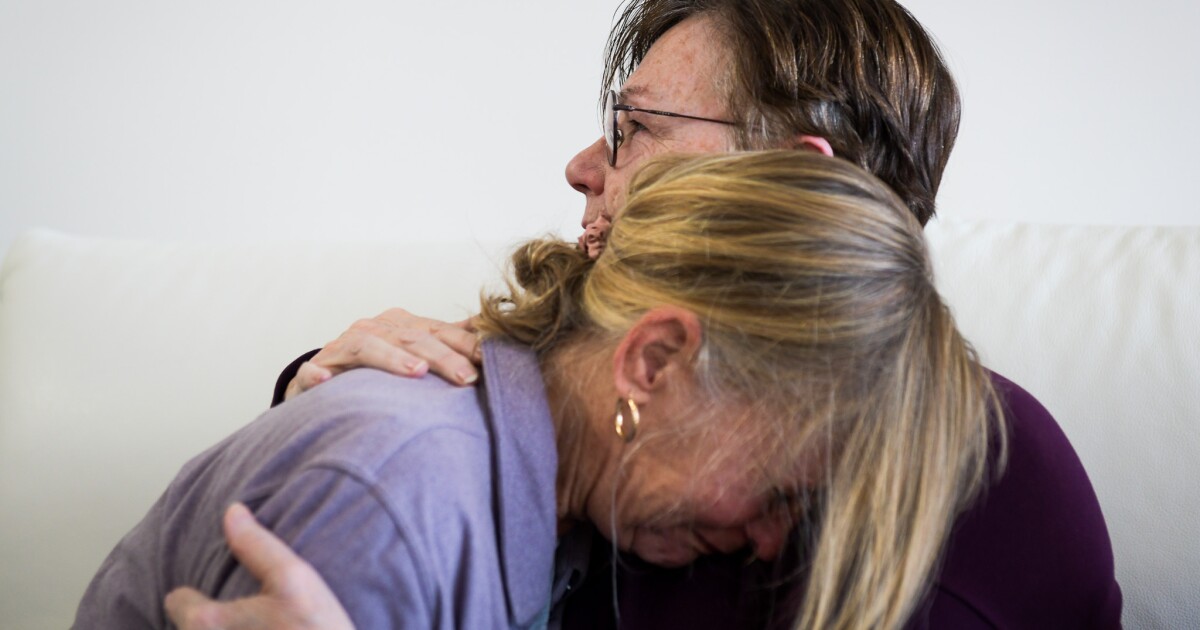
Just hours before her death, Theresa Margaret Mary Kelly was surrounded by loved ones in her San Diego home. They were singing, dancing, and celebrating a choice she believed more people should know they have.
“I have stage four clear cell carcinoma, but prior to that, I was diagnosed with frontotemporal dementia,” Kelly said.
Kelly was 69. For years, she had searched for answers.
“We were dragged to and from this hospital to that hospital,” she said. “One neurologist, two neurologists, three neurologists.”
But even in her final days, Kelly remained funny, sharp, and quick to joke.
“Hi Dr. Moore. You missed the party. The drinks are all gone…,” she said as her physician entered the room.
California is one of 13 states where terminally ill patients with less than six months to live can request medication to end their life.
It’s called the End of Life Option Act, often referred to as medical aid in dying. It was made permanent in the state in October.
1 of 2
Theresa Margaret Mary Kelly holds a photograph of herself on Feb. 12, 2026, as she looks through her keepsakes, reminiscing about her life about a week before she planned to take prescription aid-in-dying drugs. “I worked so hard in my life to be the best person I can,” Kelly said. “I’ve given love. And, right now, I’m spending time receiving love.”
2 of 2
Theresa Margaret Mary Kelly holds a photograph of herself on Feb. 12, 2026, as she looks through her keepsakes, reminiscing about her life about a week before she planned to take prescription aid-in-dying drugs. “I worked so hard in my life to be the best person I can,” Kelly said. “I’ve given love. And, right now, I’m spending time receiving love.”
“So from the time I had the diagnosis of frontotemporal dementia, I started thinking about aid in dying,” Kelly said.
As her condition worsened, she sometimes struggled physically to explain why she was ready.
“For one thing, this,” she said, struggling to get the words out. “OK, this is a big part of why I don’t want to do this for 10, 11 years.”
Years of tests and medical visits left her exhausted, and certain about what she doesn’t want.
“I don’t want to be in any kind of medical office because it’s traumatic,” she said.
Kelly is one of a small but growing number of people choosing medical aid-in-dying in California. In 2016, when the law went into effect 151 people died after taking prescribed aid-in-dying drugs, in 2024 1,032 people did, according to the state Department of Public Health.
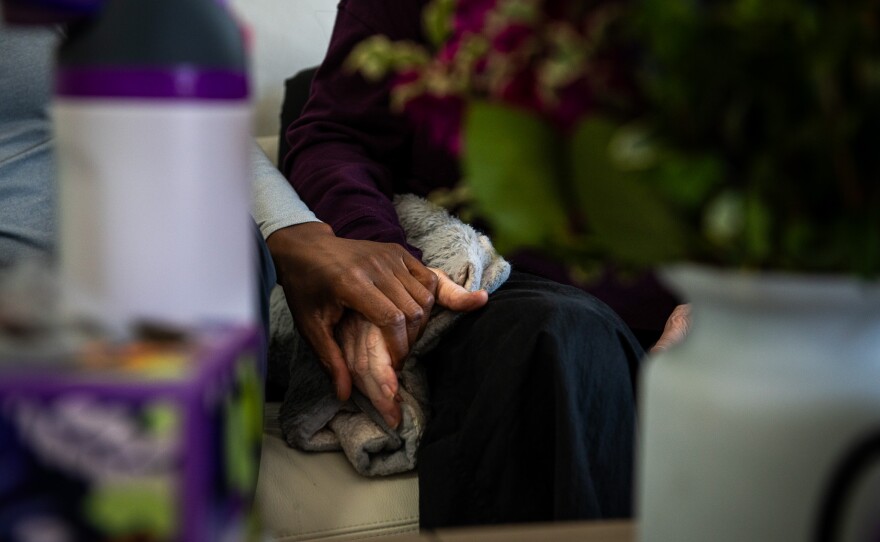
Dr. Douglas Moore holds Theresa Margaret Mary Kelly’s hand during her final hours on the day she died, Feb. 20, 2026. Moore runs Autonomy Health and helped Kelly with the medical aid-in-dying process.
Kelly worked with Dr. Douglas Moore to plan her end of life care. Moore runs Autonomy Health, a practice that helps patients navigate end of life decisions.
“The biggest accessibility issue is that people don’t know that they have this option,” he said.
Without knowing their options, Moore said some patients may spend their last months in pain, undergoing prolonged care and racking up medical bills.
“The question I came up with right away was…how long can I afford to live? Not long,” Kelly said.
In the U.S., care in the final year of life averages $80,000. Patients are often responsible for thousands out of pocket.
Medical aid in dying can be costly, too. It can range from $3,000 and $5,000 between doctors visits and the medication. And it isn’t covered by insurance.
For many, Moore said, the decision is about control.
“They’re really choosing out of a sense of wanting agency over their life…to really choose how they exit this world,” he said.
Lack of awareness and outreach may be why most people who chose aid in dying are white, he said.
In 2024, only about 5% of patients were Asian or Hispanic. An even smaller amount were Black.
“We see that it is brought up less to people of color, that it’s accessed less,” Moore said. “I would love to see more marginalized communities, the awareness that this exists and the profound sense of comfort that it can provide.”
In February, State Sen. Catherine Blakespear, (D-Encinitas) introduced a bill that would strengthen how patients’ end-of-life wishes are documented.
It modernizes key forms, like advance directives and do-not-resuscitate orders (DNR) and Physician Orders for Life Sustaining Treatment (POLST), so they’re clear and recognized across health systems, in emergencies or across state lines.
“The reality is that the medical system is designed to keep people alive, so there are interventions that happen if you don’t make your wishes known,” Blakespear said. So these documents allow people to have more control over their end of life.”
1 of 2
Theresa Margaret Mary Kelly died on Feb. 20, 2026, surrounded by friends and family. “I have this feeling I’ve won the game life because the amount of love that’s been shown to me this last couple of weeks, it’s painful in many ways.” Kelly said. “I’m ready.”
2 of 2
Theresa Margaret Mary Kelly died on Feb. 20, 2026, surrounded by friends and family. “I have this feeling I’ve won the game life because the amount of love that’s been shown to me this last couple of weeks, it’s painful in many ways.” Kelly said. “I’m ready.”
Kelly hoped her story would help others understand their options.
“It doesn’t have to be a terrifying, scary thing,” she said.
She chose Feb. 20 to end her life on her own terms.
“International Day of Social Justice,” she said. “I sort of want to give my heart to that as I leave the planet.”
Moore walked with her to her bedroom, filled with flowers and flickering candles.
Friends shared stories, held her hand and celebrated her life as she drifted off to sleep.
Kelly’s story shows what’s possible when people know their rights and plan ahead, Moore said.
If you or someone you know needs help, contact the 988 Suicide & Crisis Lifeline by calling or texting the number 9-8-8.