
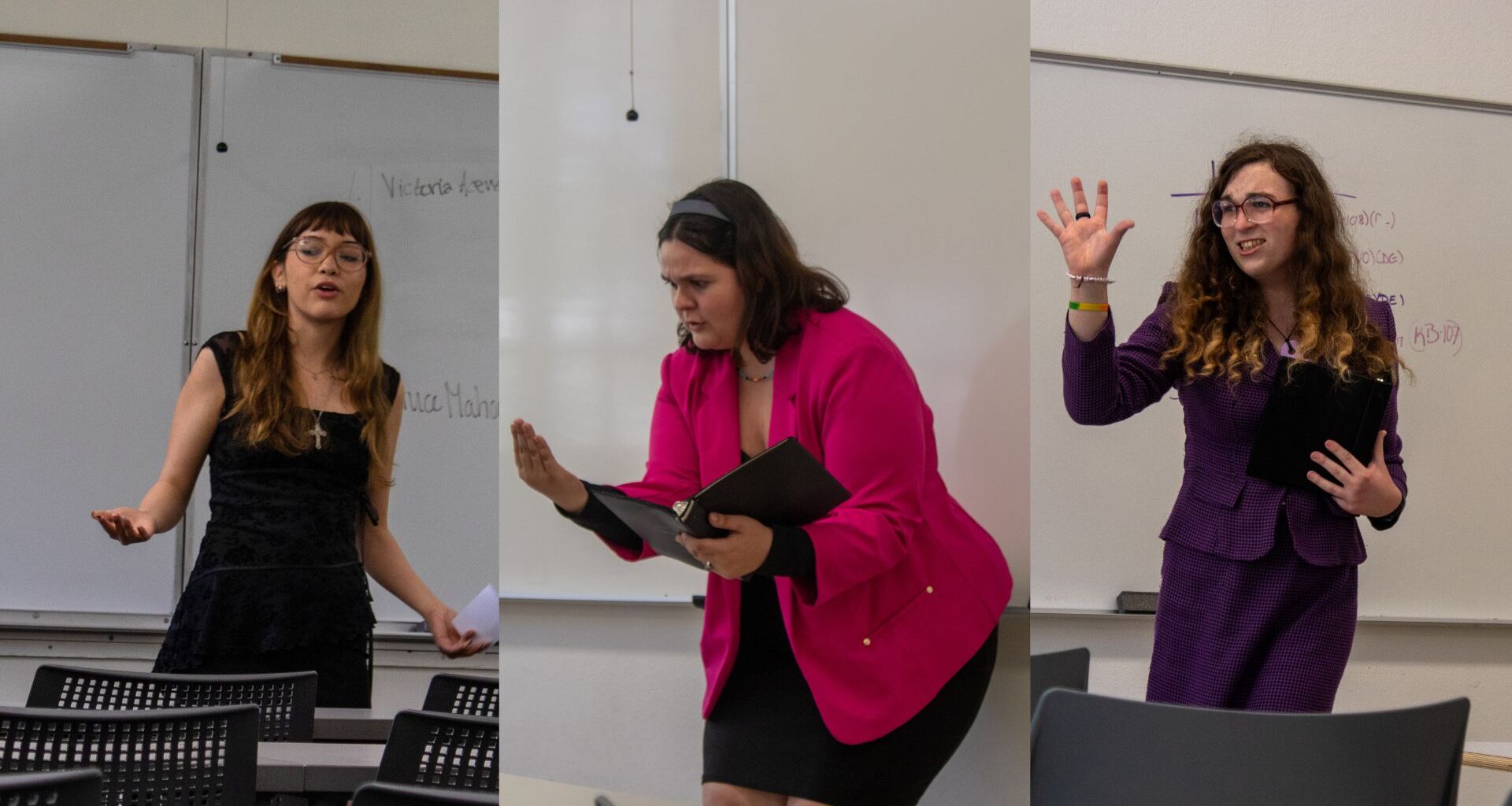
Speech and debate students from Northern California and neighboring regions came to Sacramento State for the 2026 Nicholas F. Burnett Hornet Cup from March 20-22. Twenty different schools competed in the three-day event, which featured speech and debate competitions across campus.
Competitive speech and debate, also called forensics, takes many forms. The International Public Debate Association Debate was the main event Friday, with four rounds. In the IPDA Debate, participants selected a topic to debate, and had 30 minutes to research and prepare.
Charlie Garcia-Speigel, a sophomore at City College of San Francisco, said he planned to compete in the IPDA Debate on Friday and other speech events on Saturday.
“I’m looking forward to debating a bunch of really great people over today and tomorrow morning in this round robin,” Garcia-Speigel said.
Saturday featured multiple speech events, which are typically performed individually, without facing other participants. These events range from formal to theatrical.
RELATED: ‘In a Nutshell’ live storytelling features four unique stories that discuss ‘The People Who Made Us’
Alexis Nicole McAdams, a sophomore political science and communications studies major at the University of the Pacific, competed in multiple speech events, including impromptu, communication analysis and informative.
“Impromptu is the only speech I’m doing, which is like in the name, you improvise,” McAdams said. “You get your topic or your quote right before you speak, and you get about a minute and a half to prepare a five-minute speech.”
Sac State also offered declamation, which is unique at the collegiate level. In declamation, participants edit a previously-delivered speech and reenact it in five minutes.
Lincoln-Douglas, which also began Saturday, is a research-intensive style of debate with a topic chosen a year in advance. Participants competed through multiple rounds, accumulating points through the strength of their arguments and cross-examinations.
With multiple events underway, judges had to be familiar with all forensics formats.
Jasmine Avila, a former member of the Sac State debate team and a judge for the Hornet Cup, said some events have stricter rules, while others are judged looser. For the IPDA Debate, Avila said that the winner was determined by which side provides the most reliable evidence, known as the preponderance of evidence.
“I had one side that was making a lot of analytical arguments,,” Avila said. “The other opponent stated that we should be using preponderance of evidence, and she stated all her evidence, so I was able to weigh it more in their favor.”
Some judges also posted a paradigm online that participants could consider when creating their strategy.
She said hosting the Hornet Cup requires a passionate community of current students and alumni. Avila returned to judge events after feeling like they’ve made friends through debate.
“I would get emails from Jared to come back to judge the Hornet Cup,” Avila said. “Then my friends, also on the Sac State debate team, went on to become coaches for other teams.”
Veda Dean, another former member of the Sac State debate team, became an assistant coach for the Sac State team. Dean said that coaching a debate team takes more grit and energy than originally imagined.
“Debate is a research-heavy, very academic event and getting to help out with preparing cases is a laborious task,” Dean said. “I’m learning a lot about a topic that I would have never otherwise researched, which is the Arctic and Antarctic military presence or scientific exploration.”
The 2025-26 LD topic, chosen by the National Forensic Association, was drafted by Sac State debate coach Jared Anderson. Anderson said that NFA puts out a call for topics each year.
“This one that we’re debating this year is something I’ve been working on with a good friend of mine and colleague, who coaches in Southern California,” Anderson said. “We co-wrote the paper, we submitted that paper about Antarctica and the Arctic region.”
Anderson decided on submitting that topic because of the general lack of debate surrounding that region.
“We hear a lot of stuff about the Middle East, we hear a lot about Europe, we hear a lot about China, that sort of stuff,” Anderson said. “Let’s talk about, you know, Antarctica, the Arctic. That’s an interesting part of the world.”
Last year, Sac State placed eighth in the NFA LD debate sweepstakes. The university recognized the achievement with a message on one of its billboards.
Despite the competitive nature of forensics, many of the participants have nothing but kind words for the other competitors. Italy Marie McCoy, a freshman psychology and biology major at Modesto Junior College, said everyone got along.
“You enter a classroom, and everyone’s waiting for the judge. Everyone’s talking about whatever really,” McCoy said. “Like, we’re all asking where we’re from and just getting to know each other.”
Speech and debate typically start their season in September and conclude in April with the National Forensics Association Championship on April 16-20 at Tennessee State University. Sac State will also be hosting another public speaking invitational, covering housing policies, on April 30.