
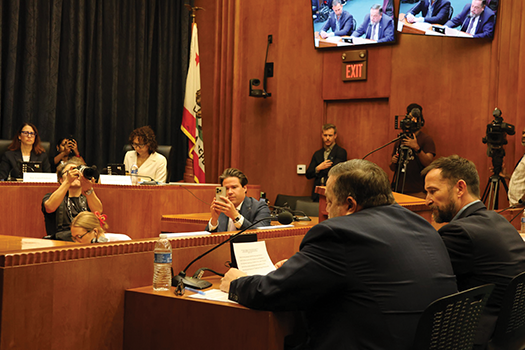
Noah Wyle, right, spoke at the hearing co-led by Rep. Laura Friedman, left. (photo courtesy the office of Laura Friedman)
Sen. Adam Schiff (D-Calif.) and Rep. Laura Friedman (D-Burbank) led a special hearing drawing attention to issues affecting the Los Angeles film and television industry on March 20 at the Burbank Courthouse. The discussion included advocating for a national tax credit, as well as criticisms and expectations in regard to the proposed merger between Paramount Studios and Warner Bros. Discovery.
“State programs cannot simply substitute for the kind of global, federal and competitive tax incentives that are needed to bring production back to American soil and stop its offshoring,” Schiff said, referencing the $750 tax incentive passed by California last year.
Emmy-winning actor Noah Wyle appeared at the hearing to highlight the success of the locally produced TV series “The Pitt,” which films on the Warner Bros. Studios lot, and emphasize the importance of keeping the industry in its hometown.
“I haven’t slept in my own bed in 15 years while I’ve been working as an actor,” Wyle said. “Since the end of ‘ER,’ I’ve chased tax credits with jobs. I’ve chased tax credits to Oregon, Louisiana, New Mexico, Vancouver, Toronto – I’ve worked everywhere. It’s hard on families. I can speak to that. It’s hard to fracture your industry that way. The tax incentive makes a huge difference, because it’s an investment in the infrastructure that’s been here generationally.”
“The Pitt,” which streams on HBO Max, was the beneficiary of a California tax credit, recovering a 20% tax rebate on many, Wyle said, “above the line costs.”
Wyle explained in detail how much this rebate helped save money on the production and, in turn, the effect it had on the local and state economy.
“Our pattern budget per episode was approximately $6.6 million. Based on that gross number, we got a rebate of about $760,000 per episode. In the end, our net budget was closer to $5.6 million, and at the end of season one, our spend was approximately $100 million. After the rebate, our adjusted spend was closer to $88 [million.] So we were able to save little over $11 million, roughly the cost of two full episodes,” Wyle said. “How did we spend the money? 72% went to labor, local cast and crew compensation. That’s roughly $62 million. We had 590 full time and part time crew jobs. The remaining 28% was spent with local vendors on goods and services. That’s about $24 million spent on local businesses. $4.6 million went to our background performers. Another [$1.5 million] went on food services. That’s just direct impact. Then there’s the indirect impact. That’s the ripple effect of that money, which in turn, stimulates additional economic activity. It’s estimated that the procurements associated with ‘The Pitt’ season 1 stimulated $22.6 million in contributions to the state’s GDP along the domestic supply chain. The show’s expenditure on inputs of goods and services from locally based suppliers also stimulated 150 full time jobs across California.”
He added that it was estimated that there was an impact of $40.3 million toward the California GDP during production, as well.
Schiff and Friedman’s advocacy comes from direct experience. Both have industry bona fides.
“It does seem the appropriate time since my colleagues have shared their own personal experiences in the industry that I share mine. As a young lawyer, I wrote three screenplays and was represented by William Morris,” Schiff said, then added wryly, “This fact came to the president’s attention to the point where he once referred to me as a ‘failed screen writer.’ I told my team he doesn’t realize what a great favor he’s doing me. Half my constituents are failed screenwriters. They’re going to think ‘He’s just like me.’”
Friedman was a Hollywood producer before becoming a Glendale City councilwoman, eventually becoming a state assembly member and U.S. representative. Among her credits was the 1995 Mary-Kate and Ashley Olsen film “It Takes Two.”
“I moved here in 1992. I was living in New York, working at HBO, and I got a job at Paramount Pictures. That’s what brought me to this coast,” Friedman said. “It’s what brought so many people here. Those jobs and that economic ecosystem that brought me into this community has been failing for years, and this merger is seen by so many people as a harbinger of things to come – of a shrinking of this industry that seems overwhelming to Los Angeles.”
Friedman also discussed the ways in which the film industry helps fuel the nation’s economy beyond the actual products.
“This is an important industry because of the … hundreds of thousands of jobs [locally], over 2 million jobs nationwide, but it also is the way that the United States has told its story to the rest of the world,” Friedman said. “And when you ask people who immigrate to this country what drew them to America, what made them want to come here – very often, they’ll talk about their vision of this country, of freedom, of what this nation means to people and to immigrants through the way we have told our story in movies from Hollywood. If you look at products that are sold around the world – from Levi’s blue jeans being a huge driving global force in the ‘60s and ‘70s – much of it traces back to the image of those products in American movies.”
In turning attention to the merger between Paramount’s parent company Skydance, run by CEO David Ellison, and Warner Bros. Discovery, Schiff questioned the merger’s ethics while promising to hold the potential conglomerate to account. He said that both he and Friedman had written with their concerns to Ellison.
“Paramount CEO David Ellison has since responded with a number of pledges, but many of them lack specificity, and we intend to examine them carefully,” Schiff said. “Because what workers need, what we will continue pushing for, are enforceable, specific commitments backed by actions that can be measured and held to account.”
Broadcast journalist Jim Acosta, a reporter with CNN from 2007-25, spoke to the potential ramifications of the merger on news media. The combination of companies would bring CNN, as well as CBS News and other outlets, under a single roof.
“The Trump administration, should it approve the Paramount WBD merger – and it looks like they will – would be setting the table for a MAGA-friendly family to own an unprecedented amount of the news and information we consume in this country,” Acosta said. “That is not media consolidation, ladies and gentlemen, that is media domination. What’s stopping that kind of media giant from gobbling up NBC or ABC next? This very real possibility, if realized, poses a danger to our democracy and the American dream.”
While no decisions or official announcements came from the hearing, Schiff and Friedman emphasized their intention to address the broad range of media-related issues brought forth in the meeting at the congressional level.
“I’m committed to introducing a federal film incentive proposal in Congress with as broad a coalition of support as possible, and [this] hearing, I hope, will be part of growing support for that, building the record and the case for why we must act,” Schiff said.