
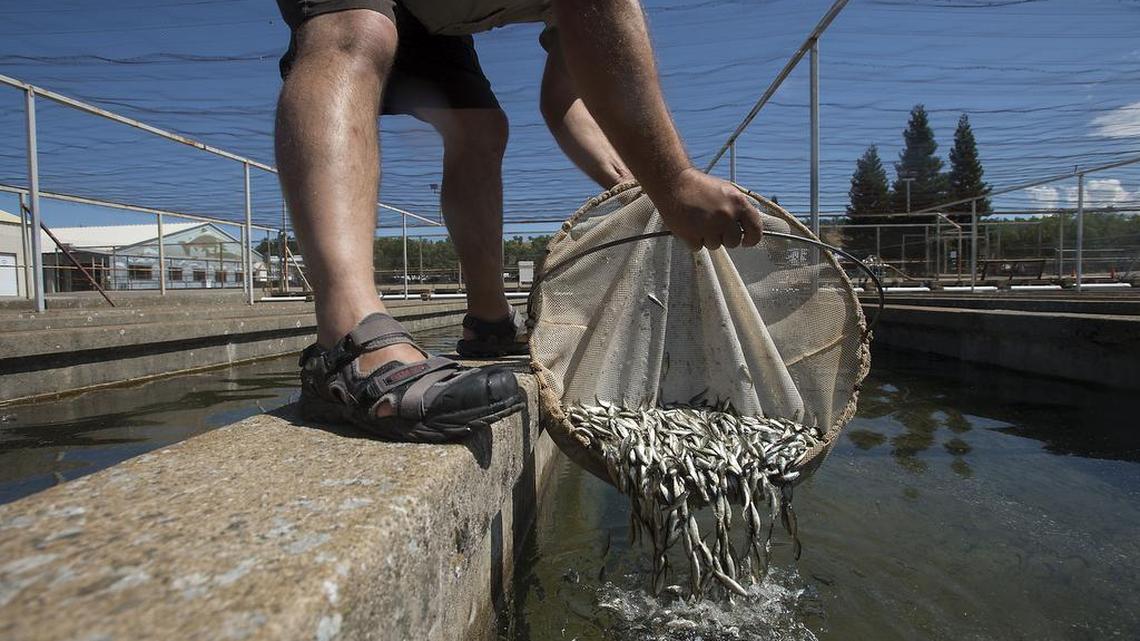
A U.S. Fish and Wildlife Service biologist handles salmon at the Coleman National Fish Hatchery, near Shasta Lake, in June 2015.
Randall Benton
Sacramento Bee file
The U.S. Fish and Wildlife Service released more than 6.2 million juvenile Chinook salmon from the Coleman Hatchery into the Sacramento River this week, even as the river faces unusual March heat and low water flows.
The announcement of the release came during a spell of extreme heat throughout California, prompting urgent calls from conservationists who warn the young fall‑run Chinook could die in the river’s warm, low‑flow conditions before making their way to the ocean, unless the Bureau of Reclamation releases more water from Shasta Dam.
“No sooner do we start to gain a little ground back in rebuilding our salmon runs, the federal Bureau of Reclamation is destroying them again,” Vance Staplin, executive director of the Golden State Salmon Association said in an email. “These fish are in big trouble if the Bureau doesn’t relent very soon.”
Above‑average reservoirs, thin river
California has gone from what appeared to be a decently wet winter to an extremely warm spring. While reservoirs throughout the state are experiencing above-average storage levels, the snowpack is expected to be near record low by April 1, when it is typically at its peak.
This has created a situation that Carson Jeffres, a senior researcher at UC Davis’ Center for Watershed Sciences, described as water managers “holding on to their water” as they fear the dry season ahead. Lake Shasta’s storage level stood at 115% of average as of Tuesday.
“Hatchery fish are less genetically fit in the first place, so they don’t do very well. The survivorship is less than 50%, and it goes down from there,” Ken Bouley, executive director at the Turtle Island Restoration Network said, referring to studies showing that many hatchery-reared salmon have substantially lower survival and reproductive success than wild‑origin fish.
Over 6.2 juvenile fall-run Chinook salmon were released into Battle Creek. From Battle Creek, the fish make their way down the Sacramento River and eventually out to the Pacific Ocean, before returning as adults to spawn.
As of Wednesday afternoon, water flows at Wilkins Slough stood at 7,780 cubic feet per second, about 38% below the roughly 10,700 cubic feet per second that a 2021 study linked to much higher juvenile salmon survival in the Sacramento River. According to the study, the survival rose from about 19% at flows below that threshold of 10,700 to about 51% once flows were between 10,700 and 22,900 cubic feet per second.
“These little salmon need a pulse flow to push them down the river and so far, pleadings from fishermen and people dependent on these fish for their livelihood have been ignored,” Staplin said. “Considering rain is forecast for next week, it’s hard to understand why the Bureau won’t act to save these fish, especially after three years of no fishing due to this kind of water operation.”
Following Fish and Wildlife Service’s Monday announcement, Staplin said he sent an email to the Bureau of Reclamation urging the federal agency to release more water from Shasta Dam.
“Flows in the upper river and at Wilkins Slough are nowhere near those needed to ensure even decent survival of this critical group of fish…For the sake of keeping the salmon industry from being forced back into possible closure of the fishery in 2028, we ask you to do whatever is needed to make some water available now from Shasta,” the email read.
As of Wednesday morning, Staplin said he had not received a response. The Coleman Hatchery and Bureau of Reclamation did not respond to The Sacramento Bee’s request for comment.
A crowded, aging hatchery
Bob Clarke, a former fisheries program supervisor with the U.S. Fish and Wildlife Service who for years oversaw operations at Coleman Hatchery, explained that the hatchery sometimes has to release fish once it reaches a point where fish can no longer be held safely without the risk of disease.
The hatchery has been asked to raise more fish in recent years following droughts, Clarke explained, through requests from fishing groups and state and federal agencies. The hatchery’s likely at its maximum capacity, he said. At the same time, its water purification equipment is “long overdue for repair,” reducing how much water it can put through the facility.
In 2024, the Biden administration announced $20 million in funding to “scope, plan, and design the major repair and rehabilitation” of the Coleman Hatchery, with the money aimed at completing the planning work.
“It’s a year-long process,” Clarke said, noting that the hatchery would have preferred to release the fish under better river conditions after investing so much time and effort caring for them from spawning onward. “You don’t feel good about releasing fish into poor conditions.”
Jeffres of UC Davis’ Center for Watershed Sciences said he sees some hope in forecast cooler, wetter weather next week. “Some, if not many, fish” will still be in the system by next week that could benefit from cooler weather, “if it actually does materialize,” he said.
“You hate to manage by hope,” Jeffres continued, adding that while water managers are trying to diversify risk by using a wider mix of release strategies under growing climate pressure, they are also in a situation where they must make decisions amid uncertainty about future conditions.
“All of these decisions that are being made are trying to minimize risk across the variety of potential climatic events that we might have,” Jeffres said.
Related Stories from Sacramento Bee

The Sacramento Bee
Chaewon Chung covers climate and environmental issues for The Sacramento Bee. Before joining The Bee, she worked as a climate and environment reporter for the Winston-Salem Journal in North Carolina.