
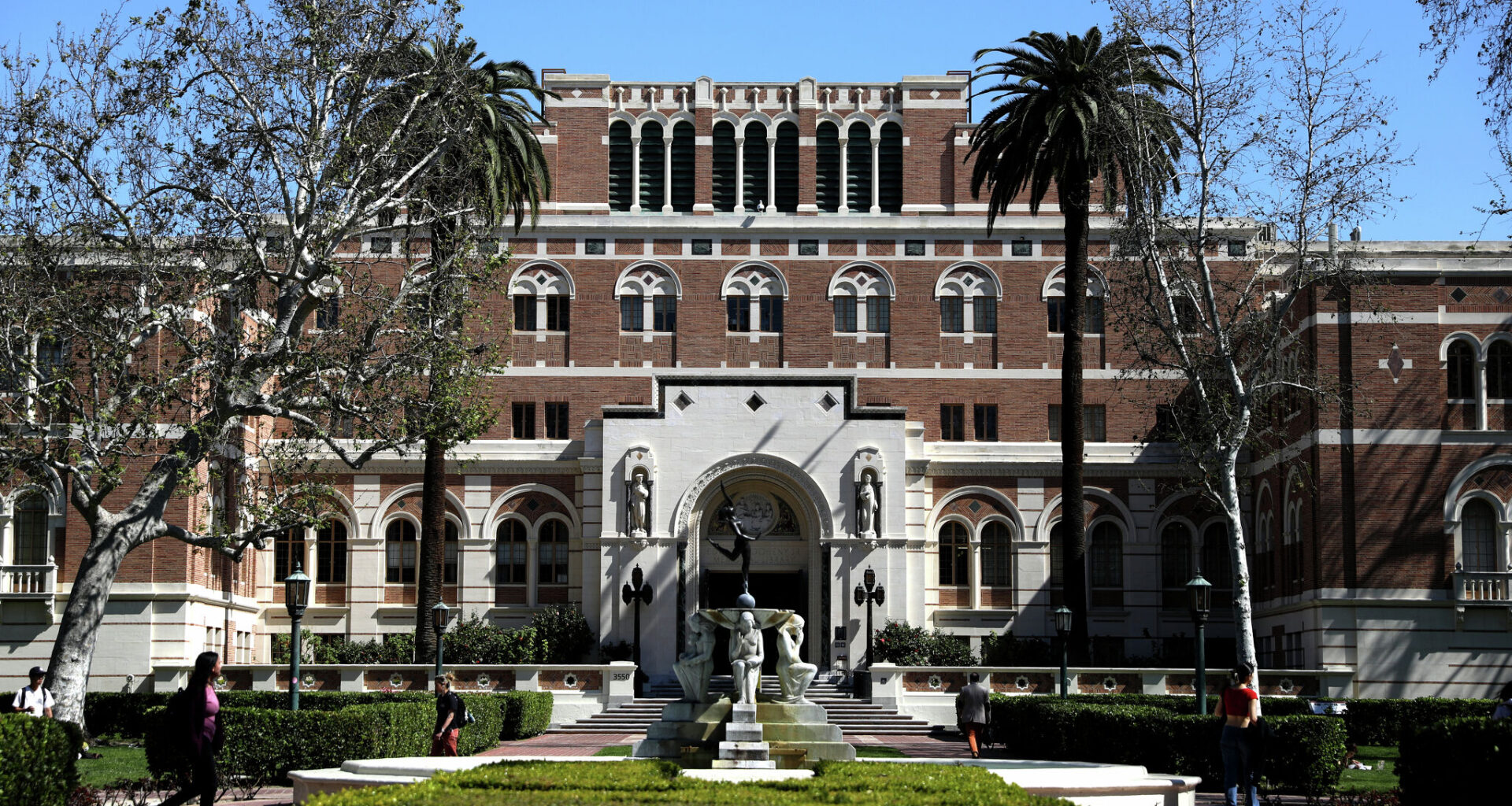
Doheny Library on the campus of the University of Southern California in Los Angeles.
Gary Coronado/Los Angeles Times via Getty Images
Students on campus at the University of Southern California in Los Angeles.
Robyn Beck/AFP via Getty Images
Admission to the University of Southern California is about to change dramatically as USC joins a national “megatrend” transforming how elite colleges accept students — and making it even harder for many to get in.
For the first time this fall, USC will offer an “early decision” option for applicants to most undergraduate majors. The approach — long used by some private universities to lock in highly interested, often wealthier students early in the admission cycle — is not only gaining new popularity, it’s also gobbling up a greater share of incoming freshman classes across the college landscape than ever before.
Article continues below this ad
• College Guide: UC acceptance rates for every California high school | Acceptance rates by major
“Our focus is really on enrolling students who are excited about being here at USC,” said Tim Brunold, dean of admission at USC. “We’ve been studying it for a few years, and students have asked, why not have this option?”
Under this approach, students can apply to as many colleges as they want — but to only one college through early decision. At USC, early applications that don’t make the cut will automatically roll into the school’s “regular decision” pool. But applicants who gamble successfully on early decision at USC this year should expect to pack their bags for Los Angeles next year.
San Francisco Chronicle Logo
Make us a Preferred Source to get more of our news when you search.
Add Preferred Source
Another rule: Early decision is binding. Most colleges let students back out if they experience unexpected financial hardship, and the agreements are not legal documents. But colleges often treat them as if they are because it’s valuable for them to know that nearly 100% of students admitted early are certain to enroll. It helps schools balance out the rest of their freshman class, such as knowing how many more science or history majors to admit. But more important, students who commit early provide greater financial certainty to schools trying to hit annual revenue goals.
Article continues below this ad
If a student walks away from the “formal, multi-party commitment” without a valid reason, “it directly undermines (the school’s) enrollment modeling — so they do pay attention,” said Adam Nguyen, founder of Ivy Link, an admissions consulting company. “There are real consequences” that can undermine the student’s efforts to apply elsewhere or even damage the relationship between the college and the applicant’s high school.
“My advice to students is simple: Only apply early decision if it’s your clear, first choice and financially viable,” he said. “Otherwise, don’t do it.”
Financial aid is a key consideration
This is why early-decision applicants are typically wealthier than students who need time to compare financial aid offers from other schools, a flexibility that only comes with the regular admissions cycle. At USC, the deadline to apply early will be Nov. 1, with a decision by mid-December — months before financial aid offers roll in.
Is early decision fair? Not according to two college seniors and two recent graduates who sued 32 private colleges and two college application platforms last August in federal court in Massachusetts to try to outlaw the practice. Their antitrust lawsuit labels it the “early decision conspiracy.” The students, including Max Miller of San Francisco, claim that by prohibiting applicants from shopping around, early decision suppresses competition and raises the price of education.
Article continues below this ad
A similar program, “restrictive early action,” also bars students from applying early to more than one university but is nonbinding. Some of the schools that offer it, however — Stanford, Harvard, Yale and Princeton, for example — are so prestigious that they don’t need to require students to attend. Applicants just do because, well, Harvard.
What makes it harder for regular applicants to get into schools with early admission is not just the number of colleges that offer it. It’s the growing portion of each freshman class that is taken up by early admits, which leaves fewer open spots for students applying in the regular round.
“This is a megatrend,” said Allen Koh, chief executive of Cardinal Education, a college consulting firm in Palo Alto. “The game theory of college admissions has changed quite a bit” since the explosion of early decision.
A decade ago, for example, Santa Clara University filled 11% of its first-year spots with early-decision applicants. By 2024, that had climbed to 30%, according to a 2025 report by education researcher James Murphy of Class Action, a nonprofit focused on transparency in college admissions.
Article continues below this ad
Santa Clara wasn’t alone. The Class Action data showed 137 universities across the country offering early decision in both 2015 and 2024. A Chronicle analysis showed that, on average, their freshman classes were 32% early admits in 2015, and 36% in 2024. That 4 percentage-point increase translated to thousands of additional students taking early spots in freshman classes and leaving fewer for the regular round.
At USC, Brunold said he expects to fill 35% to 40% of freshman seats through early decision when the program debuts next year.
If that happens, he said, “one would likely see a greater impact on nonbinding,” regular-decision applicants.
The highly ranked private research university is already competitive, with an acceptance rate of 10%, according to U.S. News & World Report. This year, 22 applicants competed for each freshman seat at USC. Yet for most high school students eyeing USC now, the chance of being accepted through regular decision for fall 2027 and beyond just got even harder.
“I’m kind of bummed out that USC is kind of just artificially making my chances lower,” said a Bay Area high school junior, 16, who plans to apply through regular decision this fall. The Chronicle is not naming him to avoid any admissions consequences. However, he said, “I’m not going to be super bummed out if I don’t get in.”
Article continues below this ad
The teen has other priorities when selecting a school, not the least of which is weather. Four years in Canada, for example, holds appeal.
But he is also skeptical that USC could compel him to enroll even if he applied early and got in.
“I know they’re not going to kidnap me,” he said. “But assuming they sent in SWAT teams, I think I could legally say, ‘I’m not going’ if I wanted.”
Compliance considerations
He could. Although the agreement isn’t legally enforceable, the binding agreement is “grounded in trust,” Brunold said. “Students admitted through that program are expected to honor their commitments.”
College counselors typically warn applicants that there can be “academic, institutional and social consequences” for backing out of the agreement without a good reason, said Amy Kirkcaldy, an admissions counselor at IvyWise.
“Colleges, particularly selective ones, do communicate,” said Kirkcaldy, a former Harvard admissions officer, so offers from other schools could be rescinded.
Claremont McKenna College in Los Angeles County, which admits 67% of freshmen through early decision, the most in the state, is a case in point. Its website says, “Failure to comply with the Early Decision guidelines may result in rescission of the offer of admission.”
Another counseling website, Ivy Coach, warns: “If you’re wondering if your child will get caught if they make binding commitments to two different schools, they will, and they will end up getting into neither school.”
In one example of the kind of pressure tactics some colleges use to enforce the rule, the New York Times reported in October that Tulane University in New Orleans recently suspended four high schools from participating in its early decision program after admitted students declined to enroll.
At USC, only performing arts applicants are excluded from early decision because they typically need to audition for a spot.
Meanwhile, early decision presents “a double whammy” for students aiming for an elite, upper-tier university, said Cardinal Education’s Koh.
A decade ago, students who applied to a top college and didn’t get in still had a good chance of getting into similar-tier schools.
Not anymore, Koh said. As high-end private universities pack their freshman classes with early admits, students who don’t make the cut — and aren’t allowed to apply early to other schools — are pushed into the regular admissions cycle alongside students competing for fewer seats.
“Now, if you miss one (top-tier school) in the early round, you may miss out on the others because all the spots are gone,” Koh said. “What’s happened is that if you guess wrong (on your one school), you could end up falling quite a bit.”
It’s a trend that most public universities, including the University of California and California State University, avoid.
“Early action/early decision tends to favor students from wealthier backgrounds who have access to early college advising and are not dependent on financial aid,” said Stett Holbrook, a UC spokesperson, noting that about 40% of UC’s first-year applicants come from low-income families or have parents who never went to college.
Students walk past the Tommy Trojan statue at the University of Southern California.
Genaro Molina/Los Angeles Times via Getty Images
Public vs. private schools
Early admission systems lay out a red carpet for students of means by inviting them to the front of the line — which would not be a good look for tax-funded schools.
“For a public school to say ‘We’ll have a separate pool for students who don’t need financial aid’ is unfair,” said economics professor Jesse Rothstein, director of the Center for Studies in Higher Education at UC Berkeley. “Privates have a little less public accountability. To me it’s a little unseemly, but they can make their own decisions.”
The students who sued last summer say that no college should be able to make those decisions. Their lawsuit claims that early decision violates antitrust laws through “mutual agreement between would-be competitors not to compete for students offered admission through early decision at other schools.”
USC is not among the 32 defendant schools, which include Brown, Columbia and the University of Pennsylvania in the Ivy League, and Pomona College in Southern California. The schools belonged to the “Consortium on Financing Higher Education,” which for 50 years collaborated confidentially on data, research, policy and “affordability,” according to MIT, where it was housed. The consortium shut down on Dec. 31.
Attorneys for the plaintiffs declined to speak with the Chronicle or to make the students available. One is Miller of San Francisco, a senior at Washington University in St. Louis, a defendant school, who was admitted through regular admission and pays full price.
Miller and the other plaintiffs argue that early admission drives up prices for everyone.
A study published in January found no evidence that such colleges extract any more revenue from freshmen than colleges without early admission programs.
The study’s author, economics professor Phillip Levine of Wellesley College, said he was interested in examining early decision partly because his school is one of those being sued. Also, his eyes lit up when he realized that Murphy, the Class Action researcher, had compiled data ripe for analysis: 73 schools with early decision programs stretching back to 2015.
Levine studied the 66 schools where early decision admits had swelled to at least 40% of the entering class by 2024. His college was among them, with 53% of Wellesley’s entering class admitted through early decision in 2024, up from 28% a decade earlier.
Levine found no evidence that average freshman revenue collected by the colleges had risen alongside their reliance on early decision, or that the percentage of students receiving federal Pell Grants — a marker of low income — had declined as a result.
A view of the University of Southern California campus in Los Angeles.
Allen J. Schaben/Los Angeles Times via Getty Images
“Colleges that expanded their use of early decision did not systematically collect more revenue from freshmen,” the study concluded with a high degree of confidence, noting that changes in freshman revenue and Pell Grants at the schools “were not correlated with changes in early decision use.”
So who wins and who loses as more colleges use early decision?
To answer that question, Levine advises people to look at the end of the admissions cycle, not the middle, when early admits are waving acceptance letters before everyone else has had a chance to figure out what college will cost them.
Drawing conclusions about fairness based only on early-admission enrollment “is the same as claiming a loss at halftime,” Levine said in an interview. “The game isn’t over yet. My analysis suggests that when the game is over, the score seems to be tied.”
At least when it comes to pricing.
“I recognize that other issues exist,” he said. “So I’m not taking a stand.”
Jack Lee contributed to this report.