
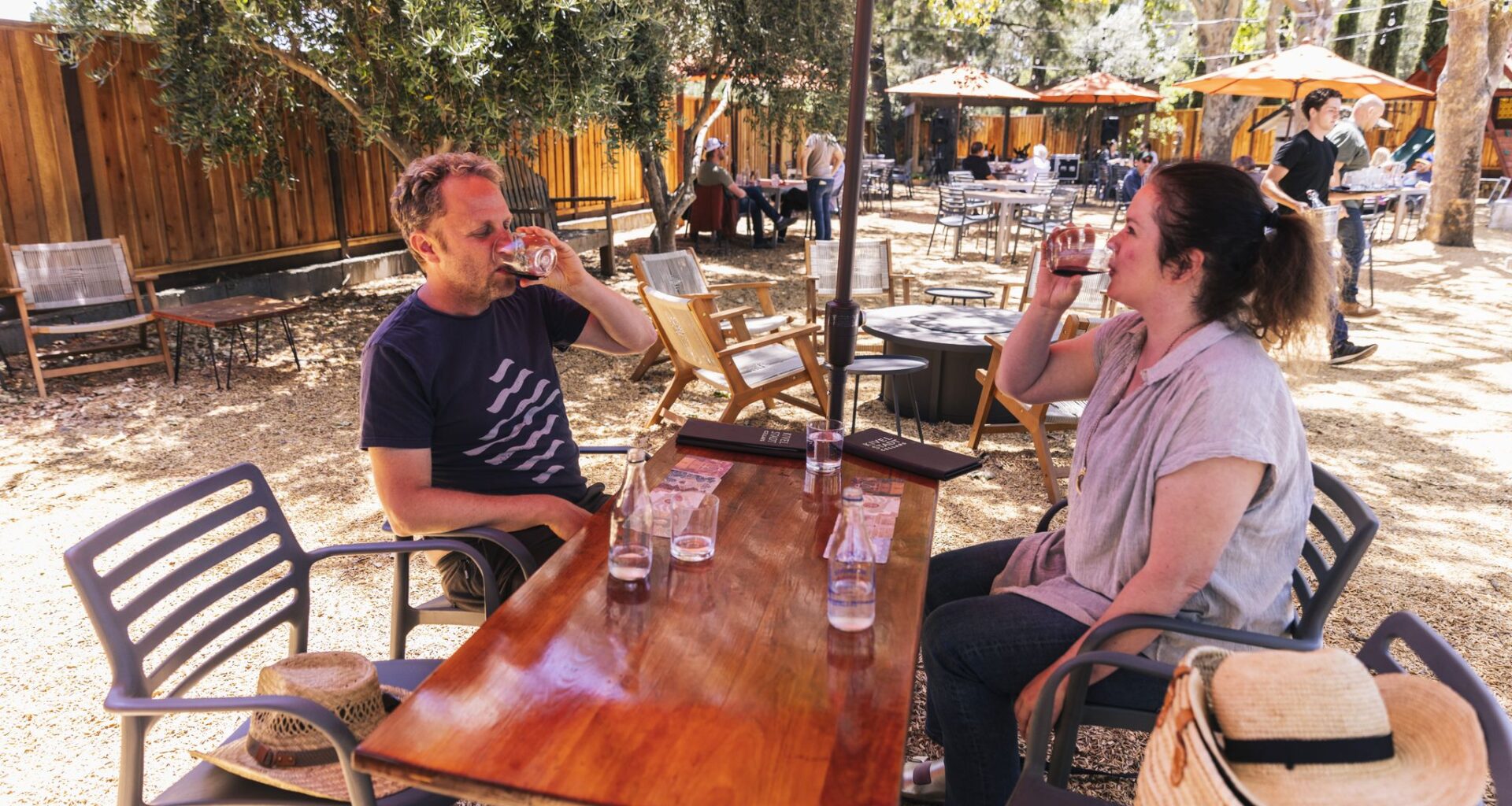
Jon Wurtzel, left, and Wendy Owen taste wine at Kivelstadt Cellars in Sonoma in 2022. Kivelstadt’s Community Club targets locals and uses an unconventional wine club model.
Stephen Lam/The Chronicle
In the age of subscriptions, when one might pay a recurring fee for everything from streamers to food delivery service to boxes of dog toys, I thought wine clubs — a winery’s most reliable revenue stream — would have evolved more by now.
There are hundreds of wine clubs to join in Napa Valley and Sonoma County alone, and I’d say the majority of them are offering good wines. Yet instead of trying to differentiate, most wineries offer the same perks they have for decades: modest discounts on wines and shipping; a few free tastings a year; members-only wines; and exclusive access to pick-up parties and other events (which usually cost extra money). Sure, some wine clubs let you customize your shipment, choosing whatever wines you’d like, though there’s often a minimum spend. Others have a special “members only” area at their tasting room.
Given the wine industry crisis and declining U.S. alcohol consumption, I’m not sure that’s enough anymore. According to Silicon Valley Bank’s 2025 Direct-to-Consumer Wine Report, the average wine club growth rate was just 2% in 2024, down from 5% the year prior and from 11% in 2018. Wine clubs are vital to success, accounting for 28% of wineries’ sales channels in 2024.
Article continues below this ad
Much of the industry has been focused on attracting new people, especially younger generations, to wine. Wineries are opening up for walk-ins and children; introducing matinee pricing for tastings; curating non-alcoholic flights; and creating fun experiences around wellness and leisure. Healdsburg’s Medlock Ames, for instance, just launched a fishing and wine tasting offering. Yet innovation within wine clubs seems to be on the back burner, despite their potential for locking in wine drinkers for decades to come.
I understand that the alcohol industry is highly regulated and wineries must tread carefully when offering deep discounts and freebies. But a handful of wineries are proving that there’s room for creativity, developing new club models and offering perks that extend beyond wine. In Napa Valley, for instance, Levendi Winery members can take advantage of benefits at a local golf club; Matthiason Wines offers a one-year subscription to the Somm TV streaming service; and Castello Di Amorosa allows members to rent out its 10th-century monastery in Italy.
San Francisco Chronicle Logo
Make us a Preferred Source to get more of our news when you search.
Add Preferred Source
Unquestionably, the best example of this is Ashes & Diamonds’ Traveler club, launched in 2022, which gives members (40% of whom are in California) complimentary access to hotel pools across the Bay Area, preferred rates at more than a dozen hotels and spas — including two resorts in Belize — and free pick-up parties in Napa and Los Angeles that feature popular local food vendors. The winery frequently adds new perks, most recently complimentary monthly movie tickets at cinemas in Napa Valley and Los Angeles.
The club was inspired by a film, “The Swimmer,” which Ashes & Diamonds proprietor Kashy Khaledi said “tells the story of a nostalgic man in an existential crisis who decides to hop from pool to pool in his neighborhood, aiming to recapture the good times.”
Article continues below this ad
“The sense of community shared around a pool mirrors the camaraderie at a table with food and wine,” Khaledi continued. “It’s attracting a new demographic that might not have otherwise engaged with Ashes & Diamonds, let alone Napa Valley.”
Sonoma’s Kivelstadt Cellars also taps into its Bay Area customer base with its Community Club, which it launched in 2020, after the tasting room moved from Glen Ellen to a former roadside restaurant off Sonoma’s Hwy 121. Community Club members pay $50-$150 a month, which is fully redeemable on food and wine purchases and rolls over. Members get a free glass of wine every visit — encouraged by the outdoor tasting space modeled on beer gardens, complete with communal tables, a casual farm-to-table restaurant and a play structure for kids — and discounts on food and wine purchases. “Some people, they’ll have like $1,000 on their account, and they’ll come up and have a party for 12 people and do something really over the top,” Kivelstadt said, noting that members typically spend far beyond their monthly dues when visiting.
Similarly, members of the Sierra Foothills’ Edio Vineyards pay a monthly fee (starting at $39), which can be used on purchases of wine, cider and food, including their on-site bakery, and tasting experiences.
Kivelstadt also stopped charging for pick-up parties, which include wine pours, food and live music. “We made them simpler and made them free and our attendance skyrocketed at those events,” he said. “It doesn’t really cost that much and you sell a ton of wine.”
Article continues below this ad
Anaba Wines, also in Sonoma, gives club members priority access to the winery’s pickle bar court. Michelle Hogan, Anaba’s marketing and brand director, said the perk has influenced nearly 100 wine club signups since 2021, and that many members use it multiple times a month, purchasing wine and food while there. Anaba has also partnered with two local hotels, offering discounts on rates, food and spa treatments, plus a day spa, where members can get $10 off sauna use and complimentary add-ons, such as an agave scalp massage.
“People need to open their minds to more consistent, low-cost engagements with their customers. There are a lot of different ways to do this,” Kivelstadt said. “People are drinking less, so what other things are you offering that aren’t just about alcohol?”