
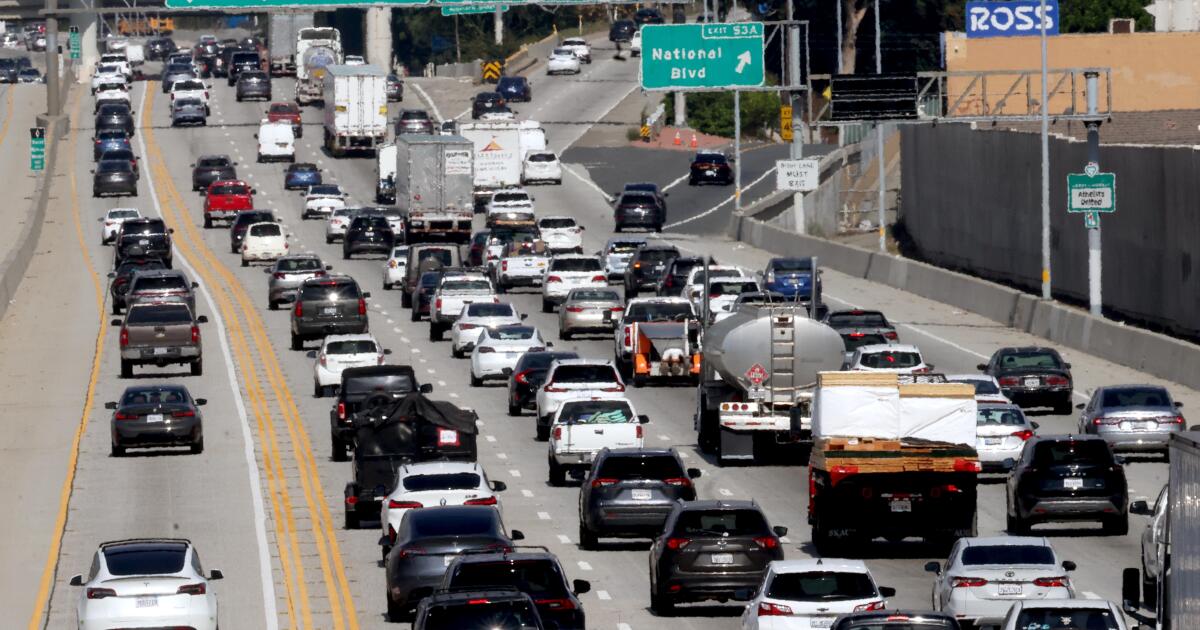

Even if you weren’t around Los Angeles in 1992, you’ve heard of Rodney King, the man whose videotaped beating at the hands of the LAPD put a match to the ensuing riots.
As sometimes destructive protests broke out after police were acquitted, King made his celebrated plea, “Can we all get along?” But who remembers what he said after that? It was this: “I mean, we’ve got enough smog in Los Angeles, let alone to deal with setting these fires and things.”
Smog. It’s embedded in L.A.’s brain. For good reason. From up in the space shuttle, in 1983, astronaut Sally Ride could see the pollution blotting out her Los Angeles hometown.

Smoglandia is a four-part series on L.A.’s historic battle with smog.
Brian Wilson, the creative genius of the Beach Boys, once recorded an impassioned riff about smog, singing “This poison that we breathe has such an effect on overall body and mind … I opened up my bathroom window today and I almost choked to death … ”
And in 1975, Smokey Robinson and the Miracles recorded perhaps the only smog-themed love song: “The sky is gray when the smog fills the air/Hiding the light that shines through your hair.”
Earl Ofari Hutchinson, an author and president of the Los Angeles Urban Policy Roundtable, moved here from Chicago as a teenager, and it took him “a long time to realize, wait a minute, there are actually mountains there.” The smog season regularly did a number on our mile-high mountains, wrapping them in a brown cloak of invisibility until wind and rain swept the sludge away.
It can’t be said that we threw everything in our power at smog, but we have tried some novel notions; some worked and some didn’t.
Smog checks. Californians even came up with a verb for it: “getting smogged.” Most gas-powered vehicles can be registered only if they pass a smog inspection every couple of years. Woe betide the cheaters. A Whittier man was sentenced to four years in prison in 1992 for faking smog “report cards.” Last year, a dozen people were charged with using and selling a smog-check cheating device.
Personalized license plates. They went on sale in 1970, with the extra $25 going to environmental programs. So many people originally asked for the NO SMOG plate that California had to hold a drawing to pick a winner.
Diamond lanes. At 7 a.m. on March 15, 1976, the fast lane of a dozen miles of the Santa Monica Freeway opened to buses and rush-hour carpoolers only. The woman who was blamed for them wasn’t sworn in as Caltrans’ new chief until 7:30 a.m. that day, but Adriana Gianturco was forever scarlet-lettered with the “diamond lanes.” Spiteful solo drivers tossed nails into the special lanes. A hearse driver lost his argument that the corpse in back was a passenger. They were an idea before their time. Despite the early resistance, carpool lanes became a feature on Southern California freeways, which now have between 700 and 800 miles of carpool lanes.
Cash for Clunkers. That was the name of the 2009 Obama-era program that helped to buy up 700,000 geezer-mobiles and got them off the roads. A very small fraction of old cars accounted for more than half the tailpipe smog. The feds have shut that program down but — speaking of clunky — the state still has its “voluntary accelerated vehicle retirement program” to accomplish the same thing.
Smog in your closets. In 1989, the four-county South Coast Air Quality Management District looked beyond tailpipes, and found smog-creators used in our houses and offices. Manufacturing foam cups and takeout food boxes created smog. So did barbecue lighter fluid, dry cleaners, paints, deodorants, breweries, and the ethanol in the aromas from commercial bakeries. It took several years and many more lawyers, but cleaner formulations of these offenders made it to the market. Capitalism comes through!
Gas leaf blowers. The noise is hideous, but the pollution is much worse. Running just one gas-powered leaf blower for an hour generates as much pollution as driving a car from L.A. to Denver. Cities have banned them for years — L.A. began in 1998 — and they’re now illegal statewide, but trying to enforce this ban has made the law, as Charles Dickens wrote, an ass.
There’s something else about pollution — besides the disappearing mountains — that Ofari Hutchinson came to realize. People of color like him and his family worked and lived surrounded by the industries that polluted their air, and many still do. A great many Black people worked at the Goodyear tire plant in South Los Angeles in the 1960s and ‘70s, and at other nearby industrial companies. “You had double exposure,” Hutchinson said. “It was a double whammy.”
L.A. grew these neighborhoods with a chicken-or-egg quandary: dirty industries and knots of freeways were put where land was cheaper, and which — also because of redlining and de facto segregation — were also often the few parts of town where people of color lived.
This year, UC Berkeley researchers sent sensors flying low above our cities, measuring polluting compounds not just from cars but from fixed sources like industry, and the ports. Sure enough, combined with census and demographic information, they found that pollution from cars and industry is still walloping poorer communities of color by orders of magnitude more than richer, whiter neighborhoods.
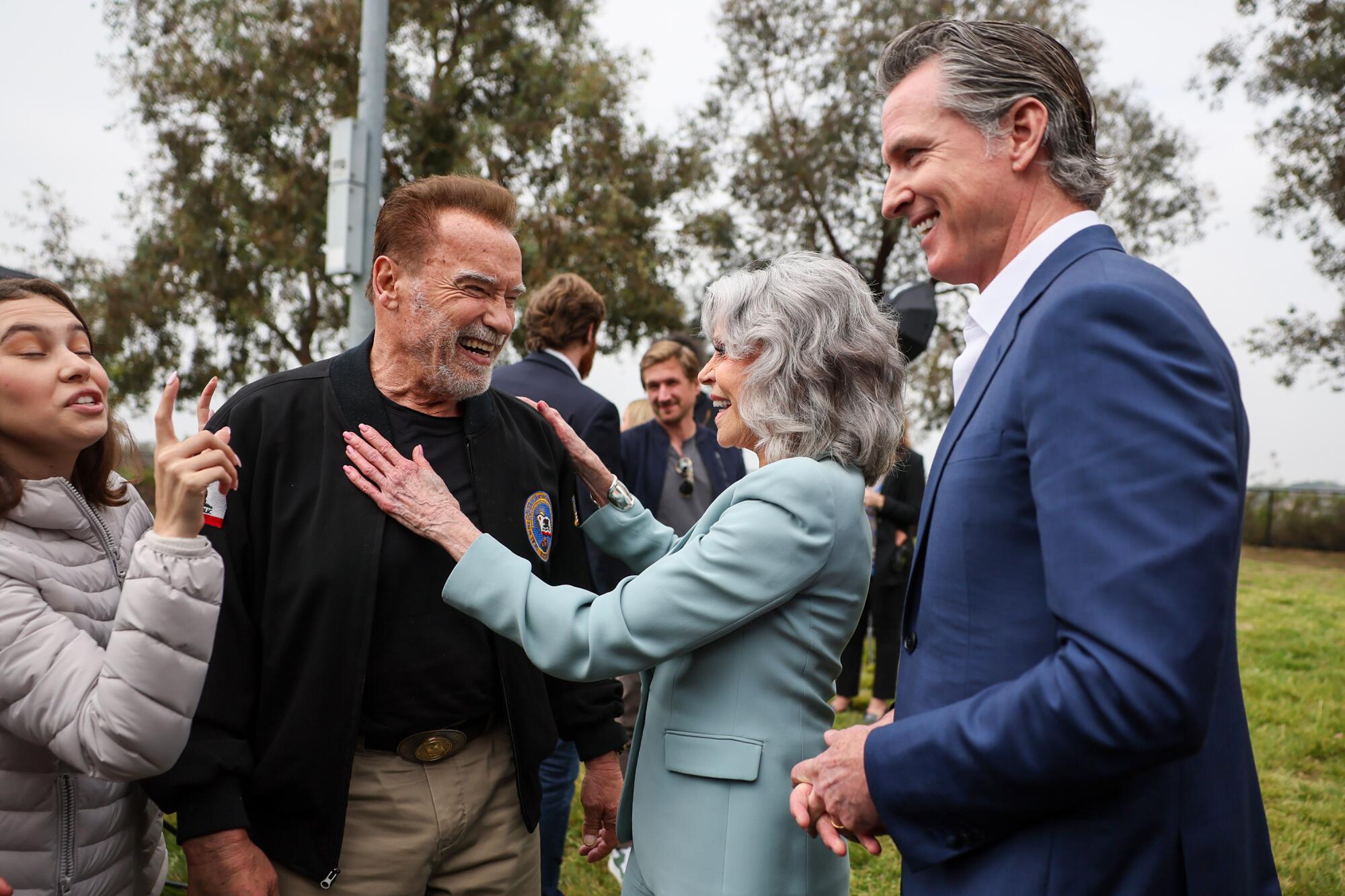
California Gov. Gavin Newsom looks on as Jane Fonda hugs former Gov. Arnold Schwarzenegger at a media event sponsored by the Campaign for a Safe and Healthy California at a Ladera Heights soccer field.
(Robert Gauthier / Los Angeles Times)
Jane Fonda and the Terminator take on smog
People living in those neighborhoods — like the L.A.-Long Beach ports, the chief source of the region’s pollution — have been protesting their polluting neighbors. They have an ally in Jane Fonda, the activist and actor, who in 2024 joined former Gov. Arnold Schwarzenegger on a soccer field near the vast Inglewood oil field. They campaigned to preserve a law banning new oil wells near schools, homes and hospitals. For Fonda, cleaning up polluted air is one element of breaking climate change, and protest and elections are the template.
“The way to use democracy is to get brave people elected to office and they can’t be moderate. It’s too late for moderate,” she said. “They have to be people who will say, no, we don’t need fossil fuels. No more drilling. No more fracking.”
As wretched as smog was, Angelenos were not about to stop driving their cars, so the cars had to change. Politics and policy could do only so much, and cleaning up smog could go only so far without technology to make improvement possible, and enforceable.
But in the 1950s, Detroit was still about blue-skying massive, gas-swigging machines and way-out concept cars. Ford dreamed up the atomic-age Nucleon, powered by a tiny nugget of uranium and incidentally requiring tons of lead shielding to protect anyone who came within a football field of the thing.
L.A. was just hoping for blue skies. Arie Haagen-Smit, the Caltech smog prof, imagined in the 1950s that clean-running cars were imminent, “exhaust devices, catalytic devices … and maybe we start putting them in the cars in 1962 and maybe 1965.”
In fact, such a thing had been in the works since the 1950s, but instead of hurrying to get them assembly-line ready as L.A. was sickening with smog, Detroit just made bigger, filthier cars. In 1969, the U.S. Justice Department sued some carmakers, alleging they conspired to keep smog control devices out of cars and off the market.
A new Republican administration swiftly settled the “smog conspiracy” case with a no-harm,-no-foul settlement. A federal judge refused a request by L.A. supervisors to throw out the secret deal. Nonetheless, in 1971, a California Democratic congressman named Phil Burton blew the whistle after the fact, reading the secret Justice Department memo into the Congressional Record.
Deep in the devastating smog attack of October 1954, Edward Roybal, the first Latino elected to the modern L.A. City Council, delivered startling news:
There was a car exhaust catalyst that could cut the smog, a device perfected by French engineer Eugene Houdry, and Roybal believed L.A. should try it. Houdry was a hero of both world wars. Between the wars, he created a catalytic cracker process that turned petroleum molecules into gasoline more efficiently, which also meant more pollution.
But about 20 years later, Houdry read about Haagy’s discovery of the cause-effect between cars and smog, and turned his talent to inventing a catalytic converter process, essentially undoing his catalytic cracker and scrubbing pollution from gasoline.
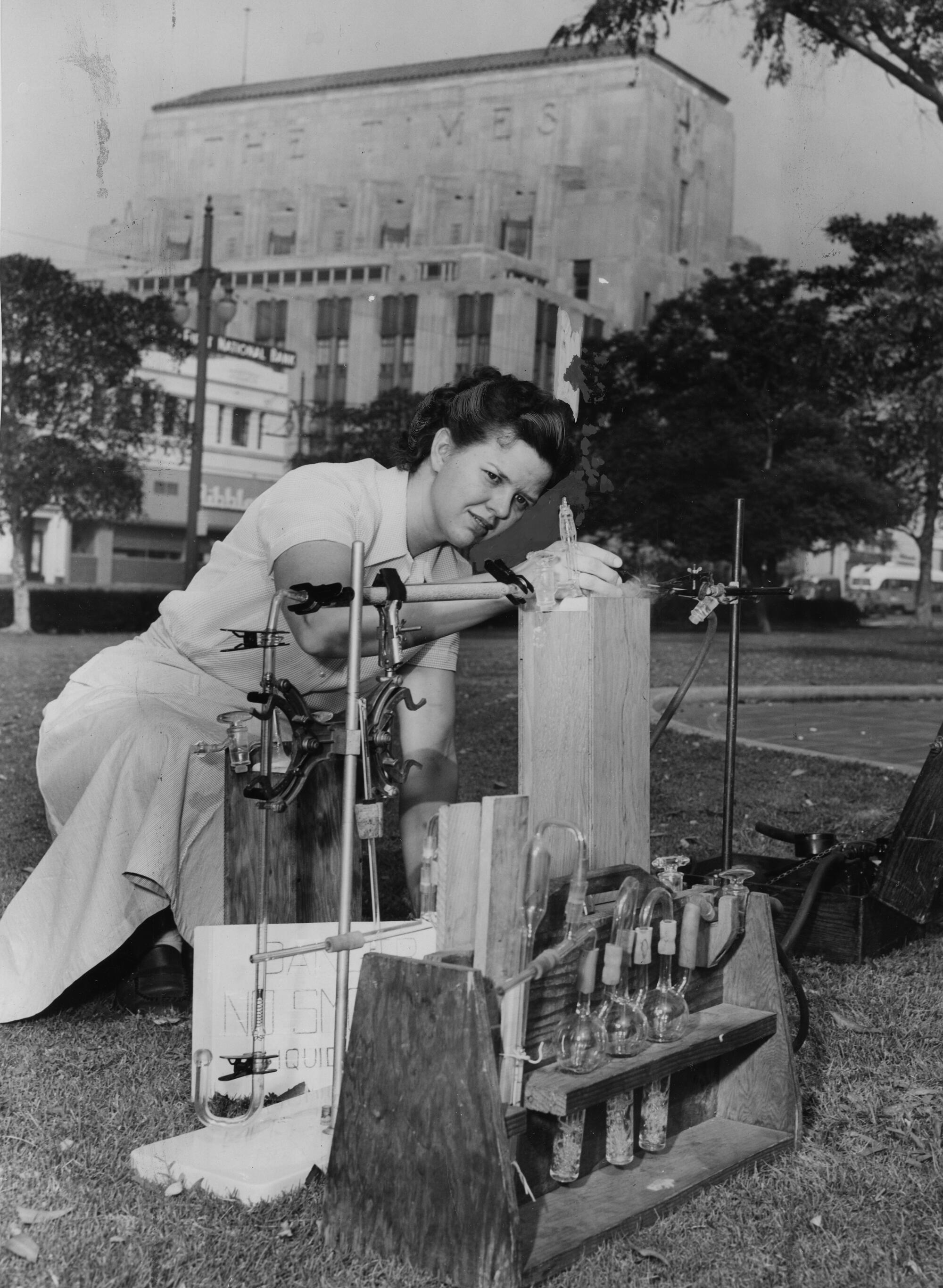
Janet E. Dickinson operates an apparatus with which gases are frozen to solid or liquid state for later analysis in a laboratory. The air pollution checkup of auto exhaust fumes and gas vapors was performed on the City Hall lawn in downtown Los Angeles on July 15, 1953.
(Frank Q. Brown / Los Angeles Times)
The fight to install the catalytic converter on cars
But catalytic devices worked only with unleaded gas, and America’s gas stations were still pumping fuel with hyped names like “super ethyl.” Not until 1996 did the feds ban most leaded gas, something California did two years earlier.
Catalytic converters need rare elements like palladium and platinum, precious metals more at home in a jewelry box than in a car. That’s why thieves steal our converters. Those metals can fetch as much as a thousand bucks per vehicle at some no-questions-asked scrap metal dealers.
Most Detroit car makers fell in line, and after 1975, most cars smog-qualified for California buyers were sold everywhere else too. In 1990, California began requiring more zero-emission vehicles. Their numbers are hard to nail down, but in the first half of 2025, nearly 4 in 10 new vehicle registrations were hybrid and EV variants. And Californians owned more than a third of all EVs and hybrids in the country.
Back when Haagen-Smit was discovering smog’s dirty secrets, he calculated that of the 30 pounds of air that an average Angeleno breathed every day, a few ounces of it was a brown, sludgy essence of smog.
Improved though we are, L.A. keeps flunking federal clean air standards. The AQMD has added wildfire smoke to air quality alerts. And this will blow your mind: The cooking from L.A.’s fab new restaurant scene creates as much man-made ozone as our cars do — one-quarter of the total!
On top of that, our old dangers are new again. For decades, Republican and Democratic administrations have trusted California to remedy its unique air pollution by setting stricter rules than other states, and waiving federal standards as long as we’re demonstrably working toward them. Call it states’ rights against smog.
Make America smoggy again
Now there’s a president in the White House who calls climate change a con job and a scam. The Trump administration and Congress are yanking away these special waivers and mandates. They ended federal tax credits for buying EVs, and booted EVs out of carpool lanes. Trump says he intends to reverse fuel economy mileage rules too. Gov. Gavin Newsom calls Trump’s campaign an effort to “make America smoggy again.”
California Democrats are appalled, and very worried.
Rep. Robert Garcia represents a district that includes the ports of Long Beach and Los Angeles, now the single biggest source of L.A.’s air pollution. Trump’s administration recently pressured other nations into canceling a long-standing plan to charge ship owners a modest fee to pay for environmental damage. Garcia says he and Democratic Sen. Alex Padilla will still press ahead to stop pollution from ships at the ports — even foreign ships.
Sen. Adam Schiff said Trump’s pollution policies could set smog battle-scarred Southern California back many years.
“Polluters are going to pollute more now, and there are going to be more cancers and more birth defects and more asthma. People living near freeways are going to be sicker. People traveling on freeways are going to be sicker. People living near power plants are going to be sicker. And we’ll have Donald Trump to thank for it.”
So California may be readying to wage a two-front battle — the familiar one against smog, but a second, altogether new one, against an administration determined to let California get smoggy again.