
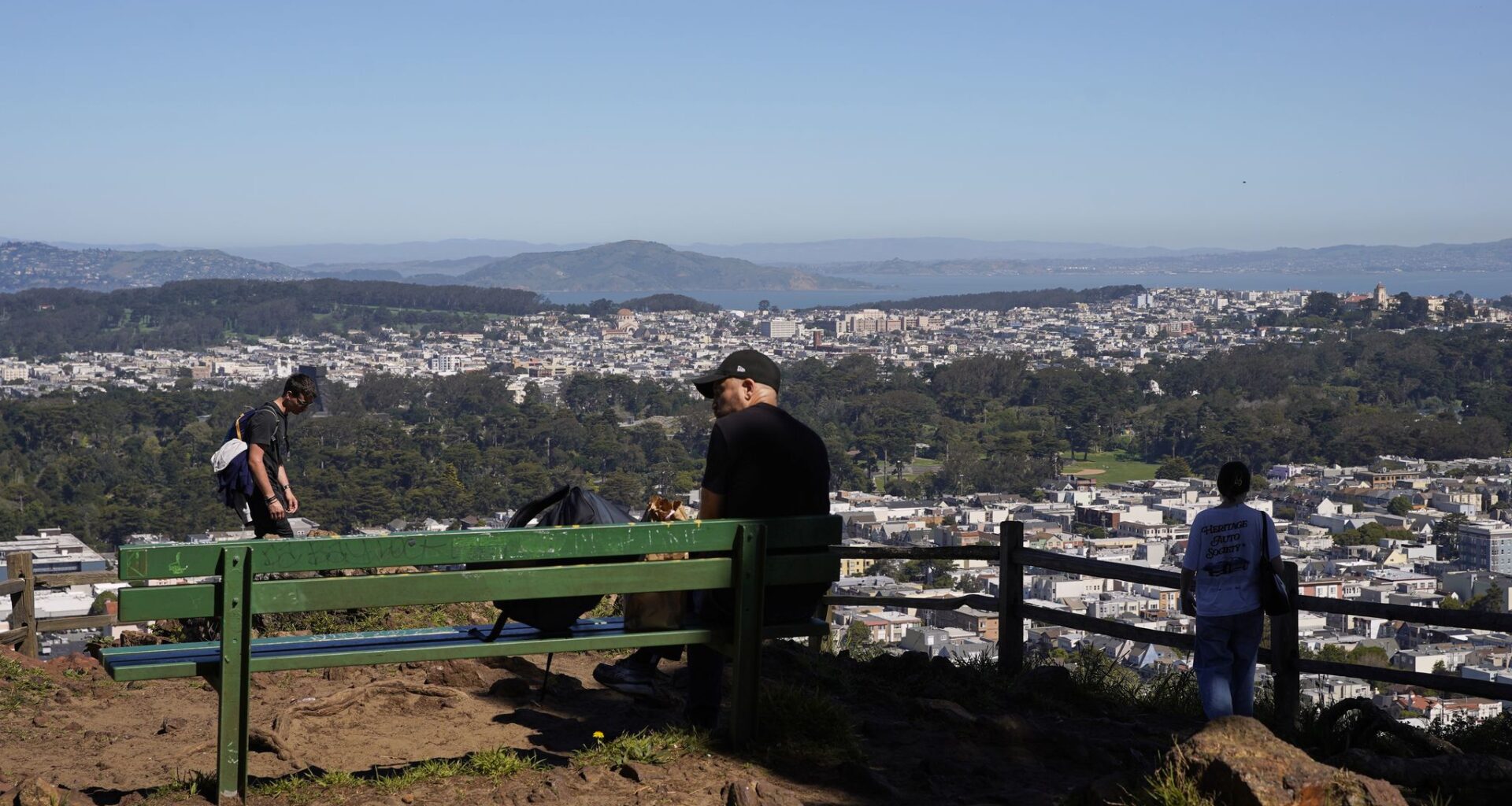
Hikers take in the view at Grandview Park in San Francisco, which was nearly bulldozed before a Chronicle columnist rallied the city to save it.
Giselle Garza Lerma/S.F. Chronicle
Grandview Park in the 1920s when developers began housing builds in the Sunset District.
Courtesy Open SF History
When San Francisco Chronicle columnist Harold Gilliam in 1967 saw diggers and bulldozers assembled at the foot of what would become Grandview Park, his favorite piece of land in the city, he made a simple plea to the people of San Francisco:
Come see it for yourself.
“The peak has no name and is virtually unknown except to people who live nearby, yet it is in some ways the most remarkable of all the hills of San Francisco,” Gilliam wrote.
Article continues below this ad
“Its days,” Gilliam continued, “apparently, are numbered.”
But nearly a half-century later, the enchanting 666-foot hill overlooking the Sunset District remains almost exactly as Gilliam experienced it: a time portal to San Francisco’s pre-development days with jagged red chert outcroppings, the sandy ground that once covered the Outside Lands and panoramic views clear to the Pacific.
San Francisco Chronicle Logo
Make us a Preferred Source to get more of our news when you search.
Add Preferred Source
The 16th Avenue Tiled Steps, the city’s most famous mosaic stairway, has become the park’s premiere attraction, appearing in Hollywood productions, guidebooks and multiple Chronicle lists. But the tree-lined, four-acre peak to the east is an underrated triumph, and a spot every local who can handle the steep climb should visit.
A child runs up the 16th Ave. Tiled Steps, created by artists Aileen Barr and Colette Crutcher, below Grandview Park.
Giselle Garza Lerma/S.F. Chronicle
It took me a while to get here. I’ve profiled nine other San Francisco parks in the last two years, but passed on Grandview repeatedly, in part because it’s so one-dimensional. There are no bathrooms, barbecues, pickleball courts, ruins, playgrounds or picnic tables, and you can only explore on very narrow paths to preserve the native plants. It is the worst San Francisco park to host a small child’s birthday party. But it’s the perfect afternoon getaway, especially at dusk when the sun sets to the west over Ocean Beach.
Article continues below this ad
I choose a long lunch instead, hopping on the N-Judah, grabbing a sandwich on Irving Street, then walking from 16th Avenue and Judah Street. The steady uphill route is filled with charm, including a stroll up the mosaic tile Hidden Garden Steps at 16th and Kirkham Street — filled with mushrooms, butterflies, flowers and other nature scenes — the first of two art installations by Aileen Barr and Colette Crutcher I’ll climb today.
Farther along, the 16th Avenue Tiled Steps at 16th and Moraga are my entrance to Grandview Park. This stairway’s narrative journey seems to document life itself, from single-celled organisms to a trip through outer space.
But I’m paying more attention to what’s on either side of the steps. Succulents near the bottom make way for native plants that blanketed these blocks before the first homes were built in Golden Gate Heights, including California poppies, patches of tiny white alyssum flowers and the brush-like cones of towering blue lupine. The grove of Monterey cypress at the very top were planted by San Francisco parks legend John McLaren in the 1920s.
California native plants surround the 16th Ave. Tiled Steps.
Giselle Garza Lerma/S.F. Chronicle
This was the scene that spurred Gilliam, one of the nation’s first environmental journalists, into action. Developers had already shaved off the northern end of the park to make way for Noriega Street and new homes below it, when Gilliam wrote his first column in April 1967 under the headline “A Hill With No Name and a Clouded Future.” He warned that the planned development on the south end would decimate the hill and close access to what was left of its peak.
Article continues below this ad
“As a nature preserve, this hill would be an invaluable asset to the city for generations to come,” Gilliam wrote. “Hacked up by bulldozers, it could at best afford dubious sites for a few more houses in an already overcrowded area.”
Gilliam was pragmatic. While cities and park departments take years to float bond measures and acquire land, “the developers are ready now, checkbooks in hand,” he wrote. So he urged citizens to visit the space, while the wildflowers were in bloom, and gauge its value for themselves.
Phone calls and letters of protest flowed in. By the end of the month, San Francisco Supervisor Terry Francois had joined the cause. The city put a halt to construction plans for more study. The peak, which neighbors gave multiple informal names — including Grand View Park and Turtle Hill — was recognized by San Francisco leaders. A decade later, two more acres for Grandview Park were purchased with city funds as part of the same San Francisco bond measure that led to Tank Hill becoming a park. One more acre was donated later.
None of this history is on a plaque at Grandview Park, which is partly the point. Other than a couple of seats painted park-bench green and some lichen-covered wood railings, the space is as natural as it was centuries ago.
Article continues below this ad
With views of Sutro Tower, downtown and the Pacific Ocean, Grandview Park is a four-acre San Francisco treasure.
Giselle Garza Lerma/S.F. Chronicle
It’s also filled with startling views. Walking the perimeter dirt trail that encircles the top, you can see layers of the city and its surroundings: Sutro Tower up close, downtown San Francisco and the very top of the Golden Gate Bridge towers in the distance and Mount Tamalpais beyond that. Only a rocky hill to the south blocks about 20 degrees of the panorama. The outlook west is the best, especially late in the day, when people start to fill the benches, chairs and wood logs that face the Pacific.
Gilliam enjoys no monument or tribute at the park, but he got something better than credit: Time to enjoy the open space he helped save.
Gilliam worked at the Chronicle until the mid-1990s, fighting freeways, writing books and inspiring other journalists to the point where his Grandview Park victory didn’t make his obituary. Gilliam made a 2004 cameo in Chronicle editor Tom Graham’s “The Walking Man” column, climbing Grandview Park with Graham at age 86. He died in 2016 at 98.
Former Chronicle columnist Harold Gilliam in 1994, nearly 30 years after he helped rally readers and city leaders to save Grandview Park from development.
Russell Yip/The Chronicle
But he was already thinking beyond his own pleasures way back in 1967, framing Grandview Park not just as a need for the present, but a gift for future generations.
Article continues below this ad
“Help raise money for parks,” he wrote, “and your grandchildren in the super-crowded America of the 21st century will have reason to be profoundly grateful.”
Come see it for yourself.